
|
![[]](topline.gif)
 |
The World's Poets and Mystics have had access
|
![[mysticism]](bottomline.gif)
|
The Poet's eye, in a fine frenzy rolling, William Shakespeare
Philip James Bailey But words are things, and a small drop of ink, Lord Byron
Shakespeare and Byron are obviously world renowned Poets. There
are also Mystics, from several world faiths, who enjoy immense
reputations amongst those who are knowledgable about their
amazing insights. One such Mystic is Thomas a Kempis author a work entitled "Of the Imitation of Christ". The following is an example of the spiritually impact-FULL quotations that are to be found in this celebrated work. To the humble He revealeth His secrets, and sweetly draweth
and inviteth him to Himself. Of the Imitation of Christ Bk. 3, Ch. 4, v. 4
The following few examples convey something of the way that
ALL the world faiths maintain that Enlightenment is not
"intellectual". ChristianityThis I say therefore, and testify in the Lord, that ye henceforth walk not as other Gentiles walk, in the vanity of their mind. Having the understanding darkened, being alienated from the life of God through the ignorance that is in them, because of the blindness of their heart: St. Paul
|
|||||||||||||||||||||||||||||||||||||||||||||||||||||
Our selections of inspirational quotations, familiar quotations and quotable quotes drawn from World Faiths Texts and from the works of the Supreme Poets, "somehow encapsulate" profoundly important insights. |
We are attempting to assemble a definitive anthology of
"Wisdom" quotes.
These quotes focus on many, often surprising,
aspects of Human Spirituality and Being.
It can be shown that alongside such "more readily evident"
characteristics as "Charity", "Purity of Heart", "Humility" and
"Meekness" associable with our individual Human Spirituality
there are also a large number of other, identifiable,
characteristics.
The insights of the the Mystics and Poets - The Sage -
can actually be explored, and mapped, in efforts to better
comprehend Human Spirituality and Being!!!
Science can not do this but
the Mystics and Poets can!!!
| Poets are masters of us ordinary men, in knowledge of the mind, because they drink at streams which we have not yet made accessible to science. Sigmund Freud |
Know more about Human Spirituality!
Know more about Human Nature!
Know more about the Human Condition!
mysticism in World Religions quotations
Humanity has a history over recent centuries of intolerance and disputation over many things - not least Religion !!!
Many people today would like to see the emergence, and continuance, of a World of Peace and tolerance and tend to view Interfaith Dialogue in a very positive light as a potential contributor to greater mutual understanding and respect.
We suggest that each of the World Religions is essentially composed of a:-
A Historical and Cultural background
of Origin and priestly organisation.
and also a:-
A Body of Teachings that
each is seeking to transmit.
If this suggestion is a valid one it seems reasonable surely that those interested in Interfaith Dialogue should look to message rather than medium for signs of really meaningful Common Ground between World Religions !!!
The remaining content of this page section largely consists
of sets of truly impactful "mysticism" quotations drawn
from translations of original Sacred writings. These sets of
quotations were brought together as a result of studies that were
specifically directed towards the identification of the most
evident areas of agreement between the respective mysticisms of
several World Religions. The approach adopted being one of
assessing quotations from Buddhist, Christian, Hindu, Islamic,
Jewish, and Taoist mysticism, for Mystical-Poetic
"impact".
We consider that the results of these studies definitely extend the range of established and accepted similarities between the messages of several World Religions.
We hope and expect that those interested in Interfaith
Dialogue, and those interested in promoting Peace and tolerance,
will find much worthy of their serious consideration arising from
a more full establishment that their are many similarities
between the mysticisms of several World Religions.
Click on these links to review quotations
about "Central" spiritual insights
drawn from sources as indicated :-
| Christian mysticism | Islamic mysticism | ||
| Jewish mysticism | Hindu mysticism | ||
| Buddhist mysticism | Taoist mysticism |
There may well be other faiths (not least Sikhism) that
should properly be included in any definitive consideration of
mysticism in World Religions / World Faiths !!!
Jesus was born two thousand years ago in Judea and even in his
youthful years astonished many scholars and holy men with his
understanding and discourse upon religious matters.
It was only when in his thirties that Jesus began a period of
teaching upon which the various forms of Christianity are
based.
After Jesus' death several disciples made written records based
upon his life and teachings and continued to spread the faith
that they had been taught by Jesus. These written records, and
also later documents such as Epistles or letters written by these
disciples to faith communities they were attempting to nurture,
are contained in the New Testament of the Holy Bible. The New
Testament is divided up into several books amongst which are the
Gospels of St. Matthew, St. Mark, St. Luke, and St. John, and
also the Epistles of St. Paul, St John, and St. James.
Alongside a number of selections from the New Testament that
are about to be presented are several quotations from Of the
Imitation of Christ - the second most widely read Christian
publication after the Bible itself.
And when he had called the people unto him with his disciples also, he said unto them, Whosoever will come after me, let him deny himself, and take up his cross, and follow me. For whosoever will save his life shall lose it; but whosoever shall lose his life for my sake and the gospel's, the same shall save it. For what shall it profit a man, if he shall gain the whole world, and lose his own soul?
Some have Me in their mouths, but little in their
hearts.
There are others who, being enlightened in their understanding
and purified in their affection, always breathe after things
eternal, are unwilling to hear of earthly things, and grieve to
be subject to the necessities of nature; and such as these
perceive what the Spirit of Truth speaketh in them.
For it teacheth them to despise the things of the earth and to
love heavenly things; to disregard the world, and all the day and
night to aspire after heaven.
This I say therefore, and testify in the Lord, that ye henceforth walk not as other Gentiles walk, in the vanity of their mind. Having the understanding darkened, being alienated from the life of God through the ignorance that is in them, because of the blindness of their heart:
Beware lest any man spoil you through philosophy and vain deceit, after the tradition of men, after the rudiments of the world, and not after Christ.
If thou reliest more upon thine own reason or industry than upon the virtue that subjects to Jesus Christ, thou wilt seldom and hardly become an enlightened man; for God wishes us to be perfectly subject to Himself, and to transcend all reason by inflamed love.
Howbeit we speak wisdom among them that are perfect: yet not the wisdom of this world, nor of the princes of this world, that come to nought: But we speak the wisdom of God in a mystery, even the hidden wisdom, which God ordained before the world unto our glory: Which none of the princes of this world knew: for had they known it, they would not have crucified the Lord of glory. But as it is written, Eye hath not seen, nor ear heard, neither have entered into the heart of man, the things which God hath prepared for them that love him. But God hath revealed them unto us by his Spirit: for the Spirit searcheth all things, yea, the deep things of God. For what man knoweth the things of a man, save the spirit of man which is in him? even so the things of God knoweth no man, but the Spirit of God. Now we have received, not the spirit of the world, but the spirit which is of God; that we might know the things that are freely given to us of God. Which things also we speak, not in the words which man's wisdom teacheth, but which the Holy Ghost teacheth; comparing spiritual things with spiritual. But the natural man receiveth not the things of the Spirit of God: for they are foolishness unto him: neither can he know them, because they are spiritually discerned.
Then one of them, which was a lawyer, asked him a question, tempting him, and saying, Master, which is the great commandment in the law? Jesus said unto him, Thou shalt love the Lord thy God with all thy heart, and with all thy soul, and with all thy mind. This is the first and great commandment. And the second is like unto it, Thou shalt love thy neighbour as thyself. On these two commandments hang all the law and the prophets.
Beloved, let us love one another: for love is of God; and every one that loveth is born of God, and knoweth God. He that loveth not knoweth not God; for God is love.
Wherefore, my beloved, as ye have always obeyed, not as in my presence only, but now much more in my absence, work out your own salvation with fear and trembling. For it is God which worketh in you both to will and to do of his good pleasure. Do all things without murmurings and disputings: That ye may be blameless and harmless, the sons of God, without rebuke, in the midst of a crooked and perverse nation, among whom ye shine as lights in the world;
Neither be ye called masters: for one is your Master, even Christ. But he that is greatest among you shall be your servant. And whomsoever shall exalt himself shall be abased; and he that shall humble himself shall be exalted.
To the humble He revealeth His secrets, and sweetly draweth
and inviteth him to Himself.
The humble man, having received reproach, maintaineth himself
well enough in peace, because he is fixed in God and not in the
world.
Never think that thou hast made any progress till thou look upon
thyself as inferior to all.
Wherefore, my beloved brethren, let every man be swift to hear, slow to speak, and slow to wrath: For the wrath of man worketh not the righteousness of God.
And when he was demanded of the Pharisees, when the kingdom of God should come, he answered them and said, The kingdom of God cometh not with observation: Neither shall they say, Lo here! or, Lo there! for, behold, the kingdom of God is within you.
That they all may be one; as thou, Father, art in me, and I in thee, that they also may be one in us: that the world may believe that thou has sent me. And the glory which thou gavest me I have given them; that they may be one, even as we are one: I in them, and thou in me, that they may be made perfect in one; and that the world may know that thou hast sent me, and hast loved them, as thou hast loved me.
Almost fourteen hundred years ago Muhammad, born in Mecca and
raised as an orphan by an uncle and receiving little or no formal
education, began in middle age to experience what he believed to
be Divine Revelations which were recorded through the services of
a scribe who later became a disciple.
Muhammad began to expound religious and social teachings based
upon these revelations and was obliged to flee from Mecca in what
the western world regards as the year 622 A.D. as his teachings
had alienated powerful local interests.
The Islamic world has its own calendar which counts up from
this year of Muhammads flight from Mecca.
After an eight year absence in the city of Medina, where his
teachings had won many converts, Muhammad and a band of muslim
faithful thousands strong proceeded to Mecca where the existing
idolatrous religious forms were overthrown and the local
population were persuaded, more by the clemency shown rather than
by the force used, to profess Islam themselves.
Islam had appeal by virtue of the strength of its message and
also by virtue of demonstrably regarding all persons as being
morally equal under God.
It was seen by its Prophet Muhammad as a completion of the
tradition of faith which also encompasses Judaism and
Christianity. Christians and Jews are regarded, alike with
Muslims, as being "people of the Book".
In order to present Spiritual Insights sourced from Islamic
mysticism a number of quotations from the Masnavi, attributable
to the remarkable mystical poet Rumi, are related here. Rumi was
born in Afghanistan some eight hundred years ago but his family
moved to Anatolia soon thereafter in order to escape the
depradations of the Mongols. Rumi is considered as having been a
member of the mystical Sufi tradition within Islam.
Quit thy wealth, even if it be the realm of Saba; Thou wilt find many realms not of this earth. What thou callest a throne is only a prison; Thou thinkest thyself enthroned, but art outside the door. Thou hast no sovereignty over thine own passions, How canst thou turn away good and evil? Thy hair turns white without thy concurrence, Take shame for thy evil passions. Whoso bows his head to the King of Kings Will receive a hundred kingdoms not of this world; But the delight of bowing down before God Will seem sweeter to thee than countless glories.
Would he had been less full of borrowed knowledge! Then he would have accepted inspired knowledge from his father. When, with inspiration at hand, you seek book-learning, Your heart, as if inspired, loads you with reproach. Traditional knowledge, when inspiration is available, Is like making ablutions in sand when water is near. Make yourself ignorant, be submissive, and then You will obtain release from your ignorance.
Sell your cleverness and buy bewilderment; Cleverness is mere opinion, bewilderment intuition.
Reason is like an officer when the king appears; The officer then loses his power and hides himself. Reason is God's shadow; God is the sun. What power has the shadow before the sun.
Little is known by any one but the spiritual man, Who has in his heart a touchstone of vital truth. The others, hovering between two opinions, Fly towards their nest on a single wing. Knowledge has two wings, opinion only one wing; Opinion is weak and lopsided in its flight. The bird having only but one wing quickly drops down, And again flies on two steps or more. This bird of opinion goes on rising and falling On one wing, in hope to reach his nest. When he escapes from opinion and knowledge is seen, This bird gains two wings and spreads both of them. Afterwards he "goes upright on a straight path, Not grovelling on his face or creeping." He flies up on two wings even as the angel Gabriel, Free of opinion, of duplicity, and of vain talk.
How long wilt thou dwell on words and superficialities? A burning heart is what I want; consort with burning! Kindle in thy heart the flame of love, And burn up utterly thoughts and fine expressions. O Moses! the lovers of fair rites are one class, They whose hearts and souls burn with love are another.
"Why hast thou said I have sinned so much, And God of His mercy has not punished my sins?" Thou sayest the very reverse of the truth, O fool! Wandering from the way and lost in the desert! How many times do I smite thee, and thou knowest not? Thou art bound in my chains from head to foot. On thy heart is rust on rust collected, So thou art blind to divine mysteries.
I regard not the outside and the words, I regard the inside and the state of the heart. I look at the heart if it be humble, Though the words may be the reverse of humble. Because the heart is substance and the words accidents.
Would you become a pilgrim on the road of love? The first condition is that you make yourself humble as dust and ashes.
O Thou that changest earth into gold, And out of other earth madest the father of mankind, Thy business is changing things and bestowing favours, My business is mistakes and forgetfulness and error. Change my mistakes and forgetfulness to knowledge; I am altogether vile, make me temperate and meek.
Fools laud and magnify the mosque, While they strive to oppress
holy men of heart. But the former is mere form, the latter spirit
and truth. The only true mosque is that in the heart of saints.
The mosque that is built in the hearts of the saints Is the place
of worship for all, for God dwells there.
I pray God the Omnipotent to place us in the ranks of His
chosen, among the number of those He directs to the path of
safety; in whom He inspires fervour lest they forget Him; whom He
cleanses from all defilement, that nothing remain in them except
Himself; yea, of those whom He indwells completely, that they may
adore none beside Him.
End of Islamic quotations section.
Judaism is a relatively ancient faith which grew up in the near East having a man named Abraham as its traditional earthly founding figure. Abraham migrated from Ur of the Chaldees to Canaan under what he believed to be Divine guidance and there established a religious community which was both monotheistic and non-Idolatrous.
We have all heard of the legendary Wisdom of Solomon and
there is a "Book of Proverbs" in the Old Testament, or Jewish
scriptures, which is attributed to King Solomon's influence.
Several quotations from the Book of Proverbs exemplify the Wisdom
that is to be found in mystical aspect of several of the major
World Religions.
Better is the poor that walketh in his uprightness, than he that is perverse in his ways, though he be rich.
Trust in the Lord with all thine heart; and lean not unto thine own understanding. In all thy ways acknowledge him, and he shall direct thy paths. Be not wise in thine own eyes: fear the LORD, and depart from evil. It shall be health to thy navel, and marrow to thy bones.
How much better it is to get wisdom than gold! and to get understanding rather to be chosen than silver!
The path of the just is as the shining light, that shineth more and more unto the perfect day. The way of the wicked is as darkness: they know not at what they stumble.
A man's pride shall bring him low: but honour shall uphold the humble in spirit.
He that is slow to anger is better than the mighty; and he that ruleth his spirit than he that taketh a city.
End of Jewish quotations section.
The Vedas are the more ancient of the sacred texts recognised within the Vedic / Hindu tradition of faith dating from almost three and a half thousand years ago. Another series of Holy writings, the Upanishads, a name which suggests "sitting at the feet of the Teacher" are often more philosophically and mystically sophisticated than the Vedas. The earliest of the Upanishads date from some three thousand years ago. The term Vedanta refers to teachings based primarily upon the Upanishads. The Bhagavad Gita - the Song of God - is a celebrated and more recent addition to Hindu holy writings dating from the second century A.D.
Which is as poison in the beginning, but is like nectar in the end; that is declared to be "good" pleasure, born from the serenity of one's own mind. That which is like nectar in the beginning from the connection of the sense-object with the senses, but is as poison in the end, is held to be of "passion".
"The wise who knows the Self as bodiless within the bodies, as unchanging among changing things, as great and omnipresent, does never grieve". "That self cannot be gained by the Veda, nor by understanding, nor by much learning. He whom the Self chooses, by him the Self can be gained. The Self chooses him (his body) as his own". But he who has not first turned away from his wickedness, who is not tranquil, and subdued, or whose mind is not at rest, he can never obtain the Self (even) by knowledge.
Perseverance in (seeking to gain) the knowledge of the Supreme Spirit, and perception of the gain that comes from knowledge of the truth: This is called knowledge : all that is contrary to this is ignorance.
He that does everything for Me, whose supreme object I am, who worships Me, being free from attachment and without hatred to any creature, this man, Arjuna!, comes to Me.
The Holy One spoke
They who have stated their hearts on Me, and do Me service with
a constant devotion, being endowed with perfect faith, these I
deem to be the most devout.
Whenever the wavering and unsteadfast heart wanders away, then so often let him subdue it and bring it back to the control of the soul; For supreme happiness comes to the Yogin whose heart is at rest, in whom passion is tranquilised, who is one with Brahma, and free from sin. The Yogin thus uniting his soul (to Brahma), who has ceased from sin, enjoys easily the boundless happiness of union (lit. contact) with Brahma.
(note: Brahma here should be read Brahman)
He who hates no single being, is friendly and compassionate, free from self-regard and vanity, the same in good and evil, patient; Contented, ever devout, subdued in soul, firm in purpose, fixed on Me in heart and mind, and who worships Me, is dear to Me.
He whom the world troubles not, and who troubles not the world, who is free from the emotions of joy, wrath, and fear, is dear to Me. The man who is guileless, pure, upright, unconcerned, free from distress of mind, who renounces every enterprise and worships Me, is dear to Me. He who has neither delight nor aversion, who neither mourns nor desires, who renounces good and evil fortune, and worships Me, is dear to Me. He who is the same to friend and foe, and also in honour and dishonour, who is the same in cold and heat, pleasure and pain, who is wholly free from attatchment; To whom praise and blame are equal, who is silent, content with every fortune, home-renouncing, steadfast in mind, and worships Me, that man is dear to Me.
Devout men (Yogins) who are intent (thereon) see this (spirit) seated in themselves; but the senseless, whose minds are unformed, see it not.
End of Hindu quotations section.
Buddhism is a religious philosophy which has its origins south of the Himalaya mountains some two and a half thousand years ago. The founding figure of Buddhism was born a Royal Prince and raised within the Vedic tradition. Whilst in his twenties and married with a young family this Prince, Siddharta, had his first real exposure to some of the more tragic aspects of Human life. Much affected by a realisation of the existence of such sources of sorrow Prince Siddharta abandoned his materially rich station and took up the life of an itinerant seeker of Enlightenment. Such Enlightenment dawned some seven years later and the one time Prince began a course of religious teaching with such effect and influence as to become known to posterity as :-
The name Buddha translating as "the Enlightened One".
Several quotations from the Dhammapada or "Path of Truth"
are presented here. This is a most important Buddhist text in
southern Asia and beyond.
He who lives looking for pleasures only, his senses uncontrolled, immoderate in his food, idle, and weak, Mara (the Tempter) will certainly overthrow him, as the wind throws down a weak tree. He who lives without looking for pleasures, his senses well controlled, moderate in his food, faithful and strong, him Mara will certainly not overthrow, any more than the wind throws down a strong mountain.
They pass from generation to generation ,
Poor in virtue and of little happiness,
Oppressed by all the sorrows
And dwelling in the thickets of debate,
Such as, Existence? or Non-existence?
Relying on their propositions,
sixty-two in number,
They become rooted in false philosophy,
Tenacious and unyielding,
Self-sufficient and self-inflated,
Suspicious, warped, without faith.
During thousands and milliards of kalpas
Such hear not the name of Buddha,
Nor ever learn of the truth
Wise people, after they have listened to the laws, become serene, like a deep, smooth still lake.
The disciples of Gotama are always well awake, and their mind day and night always delights in compassion.
Let him live in charity, let him be perfect to his duties; then in fullness of delight he will make an end to suffering.
All that we are is the result of what we have thought: it is founded on our thoughts, it is made up of our thoughts. If a man speaks or acts with an evil thought, pain follows him, as the wheel follows the foot of the ox that draws the carriage. All that we are is the result of what we have thought: it is founded on our thoughts, it is made up of our thoughts. If a man speaks or acts with a pure thought, happiness follows him, like a shadow that never leaves him.
He who controls his hand, he who controls his feet, he who is well controlled, he who delights inwardly, who is collected, who is solitary and content, him they call a bhikshu. The bhikshu who controls his mouth, who speaks wisely and calmly, who teaches the meaning and the law, his word is sweet. He who dwells in the law, delights in the law, meditates on the law, follows the law, that bhikshu will never fall away from the true law. Let him not despise what he has received, nor ever envy others: a mendicant who envies others does not obtain peace of mind. A bhikshu who, though he receives little, does not despise what he has received, even the gods will praise him, if his life is pure, and if he is not slothful.
Let a man overcome anger by love, let him overcome evil by good; let him overcome the greedy by liberality, the liar by truth! Speak the truth, do not yield to anger; give, if thou art asked for little; by these three steps thou wilt go near the gods.
End of Buddhist quotations section.
Some two and a half thousand years ago two enduring
philosophic-religious traditions emerged in China. One of these,
Confucianism, is not directed towards exploiting or exploring
Mystical Wisdom the other, Taoism, is.
Lao Tzu was one of the earlier figures of note in the Taoist
tradition, his teachings are associated with a central Taoist
text called the Tao Te Ching - a title which has been translated
as "the Way and its Power".
Taoism holds that those who live in full sympathy and harmony
with original nature are also, inevitably and beneficially,
attuned to the Way. Those who defy original nature rarely find
tranquility.
The influence and appeal of Taoism was much enhanced by the
writings of one Chuang Tzu who lived some two centuries after Lao
Tzu.
End of Taoist quotations section.
There are two other "age-of-the-sage" sections that should be of particular relevance to those interested in Interfaith Studies or in Interfaith Dialogue.
The "Other" spiritual insights link leads to a page section which details quotations that "somehow encapsulate" Insights about a number of other Aspects of Spirituality and Being that several World Religions regard as being relevant to spiritual life, practice, and growth. It would appear that some of the World Religions, however, place less emphasis on these Aspects than they do on the Aspects of Spirituality that are considered in this present "Central" spiritual insights section.
The Spirituality & the wider
world link leads to content that strays a little from the
usual concerns of Interfaith Studies and Interfaith Dialogue into
an examination, through quotations that encapsulate insights, of
those clues which the Sacred Texts of the World Religions might
give us as to "The Relationship that might be held to exist
between God and the World" !!!
Essentially these clues seem to suggest that people tend to be
capable of Desirous, and of Wrathful, as well as of Spiritual,
behaviours.
We hope and expect that the undeniable clues given by the
Sacred Texts as to the "Relationship that might be held to exist
between God and the World" will be accepted as giving a valid,
and a needful insight, into the conditions of Human Existence and
facilitate Interfaith Studies in contributing significantly to
the emergence of a more harmonious World.
Christian Islamic Jewish Hindu Buddhist Taoist
... who love Jesus for Jesus' sake and not for any comfort of
their own, bless Him no less in tribulation and anguish of heart
than in the greatest consolation.
And if He should never give them his comfort, yet would they
always praise Him and give Him thanks.
Oh, how much is the pure love of Jesus able to do, when it is
not mixed with any self-interest or self-love !
If any of you lack wisdom, let him ask of God, that giveth to all men liberally, and upbraideth not; and it shall be given him.
Ask, and it shall be given you; seek, and ye shall find; knock, and it shall be opened unto you: For every one that asketh receiveth; and he that seeketh findeth; and to him that knocketh it shall be opened.
Rejoice in the Lord always: and again I say, Rejoice. Let your moderation be known unto all men. The Lord is at hand. Be careful of nothing; but in everything by prayer and supplication with thanksgiving let your request be made known unto God. And the peace of God, which passeth all understanding, shall keep your hearts and minds through Christ Jesus. Finally, brethren, whatsoever things are honest, whatsoever things are just, whatsoever things are lovely, whatsoever things are of good report; and if there be any virtue, and if there be any praise, think on these things. Those things, which ye have both learned, and received, and heard, and seen in me, do: and the God of peace shall be with you.
Learn to despise exterior things and to give thyself to the interior, and thou shalt see that the kingdom of God will come into thee.
When we were in the flesh, the motions of sins, which were by the law, did work in our members to bring forth fruit unto death. But now we are delivered from the law, that being dead wherein we were held; that we should serve in newness of spirit, and not in the oldness of the letter.
In truth, sublime words make not a man holy and just; but a
virtuous life maketh him dear to God.
I had rather feel compunction than know its definition.
If thou didst know the whole Bible by heart and the sayings of
all the philosophers, what would it profit it thee without the
love of God and His grace.
"O God!, if I worship Thee in fear of Hell, burn me in Hell; and if I worship Thee in hope of Paradise, exclude me from Paradise; but if I worship Thee for Thine own sake, withold not Thine everlasting Beauty!"
The knowledge of men of external sense is a muzzle
To stop them sucking milk of that sublime knowledge.
But God drops into the heart a single pearl-drop
Which is not bestowed on oceans or skies!
For the LORD giveth wisdom: out of his mouth cometh knowledge
and understanding.
He layeth up sound wisdom for the righteous: he is a buckler to
them that walk uprightly.
He keepeth the paths of judgement, and preserveth the way of the
saints.
Then shalt thou understand righteousness, and judgement, and
equity; yea, every good path.
When wisdom entereth into thine heart, and knowledge is pleasant
to thy soul;
Discretion shall preserve thee, understanding shall keep thee.
There is a way which seemeth right unto a man, but the end
thereof are the ways of death.
Even in laughter the heart is sorrowful; and the end of that
mirth is heaviness.
The backslider in heart shall be filled with his own ways: and a
good man shall be satisfied from himself.
A sacrifice which is offered without desire for gain and according to rule, in saying, "Sacrifice must be done," with a resolved mind, is "good". But the sacrifice which is offered for the obtaining of reward and for ostentation, know, O best of Bharatas! that this is of the nature of "passion".
Learn this (knowledge) by (becoming the disciples and ministers of religious teachers). The wise, who see the truth, will teach thee knowledge. When thou hast known it, thou wilt not come again to this trouble ( of mind), O son of Pandu! for thou wilt see all things, without exception, in thyself and then in Me.
The man who, having abandoned all desires, goes onward without attachments, free from selfishness and vanity attains to peace. This is the Brahma state, O son of Pritha! he who has attained it is troubled no more.
The dull, who delight in petty rules,
Who are greedily attached to mortality,
Who have not, under countless Buddhas,
Walked the profound and mystic way.
If we think of Spirituality as being a sea then that sea has
"Islands of Certainty" (such as "Charity" and "Humility") that
are well known to its most experienced and intrepid voyagers -
the True Mystics and the supreme Poets.
The profoundly impactful quotations set out below will undoubtedly persuade you that many famous quotations from poetry recognise the significance of numerous, and identifiable, "Aspects of Spirituality and of Being".
Several famous quotations about -
All the world's a stage
And all the men and women merely players:
They have their exits and their entrances;
And one man in his time plays many parts,-
His acts being seven ages. At first, the infant,
Mewling and puking in the nurse's arms.
Then the whining School-boy, with his satchel
And shining morning face, creeping like snail
Unwillingly to school. And then the lover,
Sighing like a furnace, with a woful ballad
Made to his mistress' eyebrow. Then a soldier,
Full of strange oaths, and bearded like the pard;
Jealous in honour, sudden and quick in quarrel,
Seeking the bubble Reputation
Even in the cannon's mouth. And then the Justice,
In fair round belly with good capon lin'd
With eyes severe and beard of formal cut,
Full of wise saws and modern instances,-
And so he plays his part. The sixth age shifts
Into the lean and slipper'd Pantaloon,
With spectacle on nose and pouch on side;
His youthful hose well sav'd, a world too wide
For his shrunk shank; and his big manly voice,
Turning again toward childish treble, pipes
And whistles in his sound. Last scene of all,
That ends this strange eventful history,
Is second childishness and mere oblivion;
Sans teeth, sans eyes, sans taste, sans - everything.
The glories of our church and state
Are shadows, not substantial things;
There is no armour against fate;
Death lays his icy hand on kings.
Poor and content is rich, and rich enough.
The loss of wealth is loss of dirt,
As sages in all times assert;
The happy man's without a shirt
Lord of himself, though not of lands;
And having nothing, yet hath all.
Several famous quotations about -
O for a life of sensations rather than thoughts.
What the imagination seizes as beauty must be truth.
The intellectual power, through words and things,
Went sounding on, a dim and perilous way!
Errors like straws, upon the surface flow;
He who would search for pearls must dive below.
Into the eye and prospect of his soul.
Here the heart
May give a useful lesson to the head,
And learning wiser grow without his books
A cogent quotation about -
God guard me from those thoughts men think
In the mind alone;
He that sings a lasting song
Thinks in a marrow-bone;
Several famous quotations about -
Poets are all who love, who feel great truths,
and tell them: and the truth of truths is love.
All love is sweet,
Given or returned. Common as light is love,
And its familiar voice wearies not ever
They who inspire it most are fortunate
As I am now; but those who feel it most
Are happier still.
That best portion of a good man's life,
His little, nameless, unremembered acts
Of kindness and of love.
He hath a tear for pity, and a hand
Open as day for melting charity
Several famous quotations about -
Suspicion always haunts the guilty mind:
The thief doth fear each bush an officer.
My conscience hath a thousand several tongues
And every tongue brings in a several tale
And every tale condemns me for a villain
A peace above all earthly dignities,
A still and quiet conscience
O! while you live, tell the truth,
And shame the devil!
What stronger breastplate than a heart untainted!
Thrice is he armed that has his quarrel just,
And he but naked, though locked up in steel,
Whose conscience with injustice is corrupted
There is no terror, Cassius, in your threats;
For I am armed so strong in honesty
That they pass by me as the idle wind,
Which I respect not.
Virtue is bold, and goodness never fearful.
Several famous quotations about -
The best of men
That e'er wore earth about him, was a sufferer,
A soft, meek, patient, humble, tranquil spirit,
The first true gentleman that ever breathed
I charge thee, fling away ambition
By that sin fell the angels. How can man then,
The image of his maker hope to win by it ?
Love thyself last: cherish those hearts that hate thee;
Corruption wins not more than honesty
Still in thy right hand carry gentle peace,
To silence envious tongues: be just, and fear not.
Let all the ends thou aim'st at be thy country's,
Thy God's and truth's
Several famous quotations about -
Thy steady temper, Portius,
Can look on guilt, rebellion, fraud, and Caesar,
In the calm lights of mild philosophy.
Since my dear soul was mistress of her choice,
And could of men distinguish her election,
Sh'hath sealed thee for herself, for thou hast been
As one in suff'ring all that suffers nothing,
A man that Fortune's buffets and rewards
Hast ta'en with equal thanks; and blest are those
Whose blood and judgement are so well co-medled,
That they are not a pipe for Fortune's finger
To sound what stop she please: give me that man
That is not passion's slave, and I will wear him
In my heart's core, ay in my heart of heart,
As I do thee
As can be seen from the many famous quotations, (and less well known quotations), in the "age-of-the-sage" "Central" spiritual insights section the True Mystics - be they Buddhists, Christians, Hindus, Jews, Muslims, Taoists, or whatever - all seem to recognise these very same "aspects of spirituality", (i.e. Charity, Humility etc.), as being of an Utmost Significance.
There are however slight differences between the Wisdom
identified by secular writers and the Wisdom identified by the
Mystics.
These differences in recognition, and emphasis, between
"poetry" and "spirituality" are more evident in relation to those
insights considered through the famous quotations on our "Other"
insights sections.
Eloquent quotable quotes from secular writers variously deal with "aspects of truth" which are definitely spiritual as well as with "aspects of truth" that are not readily characterised as being primarily spiritual.
The pure and simpleTruth is rarely pure,
and never simple.
Several quotable quotes about -
Nor less I deem that there are Powers
Which of themselves our minds impress;
That we can feed this mind of ours
In a wise passiveness
Those obstinate questionings Of sense and outward
things,
Fallings from us, vanishings;
Blank misgivings of a Creature
Moving about in worlds not realised,
High instincts before which our mortal Nature
Did tremble like a guilty thing surprised
One in whom persuasion and belief
Had ripened into faith, and faith become
A passionate intuition.
Truths that wake
To perish never
Several quotable quotes about -
Without the smile from partial beauty won,
O what were man? - a world without a sun.
She is pretty to walk with,
And witty to talk with,
And pleasant, too, to think on.
Why man, she is mine own
And I as rich in having such a jewel
As twenty seas, if all their sands were pearl,
The water nectar, and the rocks pure gold.
Love looks not with the eyes, but with the mind,
And therefore is winged Cupid painted blind.
The bashful virgin's sidelong looks of love,
The matron's glance that would those looks reprove.
By my modesty, - the jewel in my dower - I would
not wish any companion in the world but you.
Domestic happiness, thou only bliss
Of paradise that has surviv'd the fall!
You are my true and honourable wife;
As dear to me as the ruddy drops
That visit my sad heart.
Trifles light as air
Are to the jealous confirmations stone
As proofs of Holy Writ
O, what damned minutes tells he o'er
Who dotes, yet doubts, suspects, yet fondly loves!
For a light wife doth make a heavy husband.
Charms strike the sight , but merit wins the soul.
A mother is a mother still,
The holiest thing alive.
Happy he With such a mother! faith in womankind
Beats with his blood, and trust in all things high
Comes easy to him, and though he trip and fall,
He shall not bind his soul with clay.
No. holy father, throw away that thought.
Believe not that the dribbling dart of love
Can pierce a complete bosom.
Thrice blessed they that master so their blood,
To undergo such maiden pilgrimage:
But earthlier happy is the rose distilled,
Than that which withering on the virgin thorn
Grows, lives, and dies in single blessedness.
A quotable quote about -
Thyself and thy belongings
Are not thine own so proper, as to waste
Thyself upon thy virtues, they on thee.
Heaven doth with us as we with torches do,
Not light them for themselves; for if our virtues
Did not go forth of us 't were all alike
As if we had them not. Spirits are not finely touch'd
But to fine issues; nor Nature never lends
The smallest scruple of her excellence,
But, like a thrifty goddess, she determines
Herself the glory of a creditor -
Both thanks and use.
Several quotable quotes about -
The primal duties shine aloft, like stars;
The charities that soothe, and heal, and bless,
Are scattered at the feet of Man, like flowers.
Live while you live, the epicure would say,
And seize the pleasures of the present day;
Live while you live the sacred preacher cries,
And give to God each moment as it flies.
Lord, in my views let both united be;
I live to pleasure when I live to thee.
He that has light within his own clear breast
May sit in the centre and enjoy bright day;
But he that hides a dark soul and foul thoughts
Benighted walks under the midday sun.
Well may your hearts believe the truths I tell;
't is virtue makes the bliss where'er we dwell.
For blessings ever wait on virtuous deeds,
And though a late, a sure reward succeeds.
The soul's calm sunshine and heartfelt joy.
Several quotable quotes about -
I am as free as nature first made man,
Ere the base laws of servitude began
When wild in woods the noble savage ran.
Happy he who far from business persuits
Tills and re-tills his ancestral lands
With oxen of his own breeding
Having no slavish yoke about his neck.
God made the country, and man made the town.
There are several cases where "other" Poetry Insights relate
directly to some of the more problematic areas of human
existence.
We should welcome this!!!
World Wide Humanity desperately needs such Insights as
they may provide clues to a compassionate and considered
alleviation of many difficulties.
Several quotable quotes about -
There's neither honesty, manhood, nor good fellowship in thee.
If society fits you comfortably enough you call it liberty.
Before God, there is neither Greek nor barbarian, neither rich nor poor,
and the slave is as good as his master, for by birth all men are free; they
are citizens of the universal commonwealth which embraces all the world,
brethren of one family, and children of God.
Permit me... to tell You what the freedom is that I love and that to which I think that all men intitled. It is not solitary, unconnected, individual, selfish liberty. As if every man was to regulate the whole of his conduct by his own will. The Liberty I mean is social freedom. It is that state of things in which Liberty is secured by the equality of Restraint; A constitution of things in which the liberty of no one Man and no body of Men and no Number of men can find Means to trespass on the liberty of any Person or any description of Persons in the Society. This kind of Liberty is indeed but another name for Justice, ascertained by wise Laws. And secured by well constructed institutions.
The co-existence of several nations under the same State is a test, as well as the best security,
of its freedom. It is also one of the chief instruments of civilisation; and, as such, it is in the
natural and providential order, and indicates a state of greater advancement than the national unity
which is the ideal of modern Liberalism. The greatest adversary of the rights of nationality is the modern
(i.e. July 1862) theory of nationality. By making the State and the nation commensurate with each
other in theory, it reduces practically to a subject condition all other nationalities that may be
within the boundary. It cannot admit them to an equality with the ruling nation which constitutes
the State because the State would then cease to be national, which would be a contradiction of the
principle of its existence. According, therefore, to the degree of humanity and civilisation in that
dominant body which claims all the rights of the community, the inferior races are eliminated, or
reduced to servitude, or outlawed, or put in a condition of dependence.
If we take the establishment of liberty for the realisation of moral duties to be the end of civil society,
we must conclude that those States are substantially the most perfect which ... include various distinct
nationalities without oppressing them.
Liberalism is the supreme form of generosity; it is the right which the majority concedes to minorities and hence it is the noblest cry that has ever resounded on this planet.
Liberty is not a means to a higher political end. It is itself the highest political end...liberty is the only object which benefits all alike, and provokes no sincere opposition...The danger is not that a particular class is unfit to to govern. Every class is unfit to govern ...Power tends to corrupt, and absolute power corrupts absolutely.
Reason and Knowledge have always played a secondary, subordinate, auxiliary role in the life of peoples, and this will always be the case. A people is shaped and driven forward by an entirely different kind of force, one which commands and coerces them and the origin of which is obscure and inexplicable despite the reality of its presence.
One cannot avoid a certain feeling of disgust, when one observes the actions of man displayed on the great stage of the world. Wisdom is manifested by individuals here and there; but the web of human history as a whole appears to be woven from folly and childish vanity, often, too, from puerile wickedness and love of destruction: with the result that at the end one is puzzled to know what idea to form of our species which prides itself so much on its advantages.
Out of the crooked timber of humanity no straight thing was ever made.
We hope that your interest in quotable quotes from the poems
and other works of secular writers has been greatly stimulated by
the contents of this selection and also of our "Central" poetry
insights selection.
As can be persuasively experienced through the impact of the profoundly moving words of - the Sage - the True Mystics and the supreme Poets - as related in our "spiritual insights" and "poetry insights" sections we can rely on Insight, perception, and Enlightenment, to help us get to grips with TRUTHS about obscure, seemingly innate, "Aspects of spirituality and being" with which all human beings are endowed.
We are all of us well aware that the "World of Events" is an intermittently unquiet place where day to day life is occasionally, and sometimes most tragically, disrupted by such stresses as economic booms and busts, by widely differing views as to the just politico-economic functioning of society, or in cases, by civil disturbance or by outright international conflict.
How then should the existence of the God of the Mystics be
reconciled with the actualities of Humanity's historical
experiences?
Any attempt to take a broader view of human existence in order to account for non-spiritual behaviours in a God acknowledging philosophical scheme soon involves speculations about human nature, and on how we can be confident of our having a TRUE estimate of human nature.
Most fortuitously Comparative Religion investigation shows that intriguing Tripartite Soul teachings that can be thought of as being "Observations about Spirituality and the wider world" are common to several World Faiths !!!
The implications of these Observations may well represent the key to much necessary understanding about the human condition!!!
We can look to a range of spiritually impact-full quotations drawn from very diverse sources, including indisputably central World Faiths teachings, which taken together establish to the point of full certainty that, whilst God may be regarded as being an Absolute Existence, the spirituality of individual persons should be viewed as being one of several facets of the manifold human nature (Tripartite Soul) which is in us all.
Click on these
links to review quotations about
"Spirituality & the wider world"
drawn from World Faiths and other sources as indicated :-
Christianity Islam Hinduism Buddhism Plato Shakespeare
Jesus' keynote teaching is known as the Sermon on the Mount. Inherent to the Sermon on the Mount is an undeniable assertion, in Jesus' own words as related in more than one of the Gospels in each case, of the relativity of our personal capacities for spiritual expression and progress.
The Sermon on the Mount can be regarded as being composed of three themes-
And seeing the multitudes, he went up into a mountain: and when
he was set, his disciples came unto him:
And he opened his mouth, and taught them, saying,
Blessed are the poor in spirit: for theirs is the kingdom of
heaven.
Blessed are they that mourn: for they shall be comforted.
Blessed are the meek: for they shall inherit the earth.
Blessed are they which do hunger and thirst after
righteousness: for they shall be filled.
Blessed are the merciful: for they shall obtain mercy.
Blessed are the pure in heart: for they shall see God.
Blessed are the peacemakers: for they shall be called the
children of God.
Blessed are they which are persecuted for righteousness' sake:
for theirs is the kingdom of heaven.
Blessed are ye, when men shall revile you, and persecute you,
and say all manner of evil against you falsely, for my
sake.
Rejoice, and be exceeding glad: for great is your reward in
heaven: for so persecuted they the prophets which were before
you.
Ye are the salt of the earth: but if the salt have lost his
savour, wherewith shall it be salted? it is thenceforth good for
nothing, but to be cast out, and to be trodden under foot of
men.
Ye are the light of the world. A city that is set on a hill
cannot be hid.
Neither do men light a candle, and put it under a bushel, but
on a candlestick; and it giveth light unto all that are in the
house.
Let your light so shine before men, that they may see your good
works, and glorify your Father which is in heaven.
Think not that I am come to destroy the law, or the prophets: I
am not come to destroy, but to fulfil.
For verily I say unto you, Till heaven and earth pass, one jot
or one tittle shall in no wise pass from the law, till all be
fulfilled.
"Whosoever therefore shall break one of these least
commandments, and shall teach men so, he shall be called the
least in the kingdom of heaven: but whosoever shall do and teach
them, the same shall be called great in the kingdom of heaven.
Ye have heard that it hath been said, An eye for an eye, and a
tooth for a tooth:
But I say unto you, That ye resist not evil: but whosoever
shall smite thee on thy right cheek, turn to him the other
also.
And if any man will sue thee at the law, and take away thy
coat, let him have thy cloke also.
And whosoever shall compel thee to go a mile, go with him
twain.
Give to him that asketh thee, and from him that would borrow of
thee turn not away.
Ye have heard that it hath been said, Thou shalt love thy
neighbour, and hate thine enemy.
But I say unto you, Love your enemies, bless them that curse
you, do good to them that hate you, and pray for them that
despitefully use you and persecute you;
That ye may be the children of your Father which is in heaven:
for he maketh his sun to rise on the evil and on the good, and
sendeth rain on the just and on the unjust
For if ye love them which love you, what reward have ye? do not
even the publicans do the same?
And if ye salute your brethren only, what do ye more than
others? do not even the publicans so?
Be ye therefore perfect, even as your Father which is in heaven
is perfect.
No man can serve two masters: for either he will hate the one,
and love the other; or else he will hold to the one, and despise
the other. Ye cannot serve God and mammon.
Therefore I say unto you, Take no thought for your life, what
ye shall eat, or what ye shall drink; nor yet for your body, what
ye shall put on. Is not the life more than meat, and the body
than raiment?
Behold the fowls of the air: for they sow not, neither do they
reap, nor gather into barns; yet your heavenly Father feedeth
them. Are ye not much better than they?
Which of you by taking thought can add one cubit to his
stature?
And why take ye thought for raiment? Consider the lilies of the
field, how they grow; they toil not, neither do they spin:
And yet I say unto you, That even Solomon in all his glory was
not arrayed like one of these.
Wherefore, if God so clothe the grass of the field, which today
is, and tomorrow is cast into the oven, shall he not much more
clothe you, O ye of little faith?
Therefore take no thought, saying, What shall we eat? or, What
shall we drink? or, Wherewithal shall we be clothed?
(For after all these things do the Gentiles seek:) for your
heavenly Father knoweth that ye have need of all these
things.
But seek ye first the kingdom of God, and his righteousness;
and all these things shall be added unto you.
Take no thought for the morrow: for the morrow shall take
thought for the things of itself. Sufficient unto the day is the
evil thereof.
The results of Comparative Religion investigation allows us to state that several World Faiths other than Christianity also assert views about spirituality comparable to that implicit in the Sermon on the Mount - i.e. that human nature is a compound of several elements.
The Masnavi of Jalaluddin Rumi is an overtly religious work formed within an Islamic context more than seven hundred years ago.
In the Masnavi there are several passages which suggest that personal spirituality is relative -
The monk said, "I am searching everywhere for a man
Who lives by the life of the breath of God."
The other said, "Here are men the Bazaar is full;
These are surely men, O enlightened sage!"
The monk said, "I seek a man who walks straight
As well in the road of anger as in that of lust.
Where is one who shows himself a man in anger and lust?
In search of such an one I run from street to street.
If there be one who is a true man in these two states,
I will yield up my life for him this day!"
The Ka'ba is a singularly important Islamic shrine which
stands in the court of the Great Mosque of Mecca and is a site of
pilgrimage for all Muslims.
The Ka'ba, whose renown waxes greater every moment,
Owes its foundation to the piety of Abraham.
Its glory is not derived from stones and mortar,
But from being built without lust or strife.
Hinduism or Vedanta is another of the World Faiths which imputes a multi-faceted character to human nature.
In the Bhagavad Gita we read -
Arjuna spoke.
But by what is a man impelled, O Varshneya! when he commits sin
even against his will, as if compelled by force?
The Holy One spoke.
It is lust: it is wrath, born from the "passion" mode: know
that this, all-devouring, all-defiling, is here our foe.
and again -
He who even here, ere he is freed from the body, can resist
the impulse of lust and wrath, he is devout (yukta); he is
blessed.
He who is happy in himself, pleased with himself, who finds
also light in himself, this Yogin, one with Brahma, finds
nirvãna in him.
The (wise and holy men) whose sins are destroyed, whose doubts
are removed, who are self-restrained and pleased with the
well-being of all that live, obtain nirvãna in
Brahma.
They who are freed from lust and wrath, who are subdued in
nature and in thought, and who know the soul, are near to
nirvãna in Brahma.
(Note: In the second of these quotations "Brahma" should be
read "Brahman")
Buddhism also joins with Christianity, Islam, and Vedanta in suggesting that human nature has several identifiable tendencies -
Him I call indeed a Brâhmana who does not cling to
pleasures, like water on a lotus leaf, like a mustard seed on the
point of a needle.
Him I call indeed a Brâhmana who, even here, knows the
end of his suffering, has put down his burden, and is
unshackled.
Him I call indeed a Brâhmana whose knowledge is deep, who
possesses wisdom, who knows the right way and the wrong, and has
attained the highest end.
Him I call indeed a Brâhmana who keeps aloof both from
laymen and from mendicants, who frequents no houses, and has but
few desires.
Him I call indeed a Brâhmana who finds no fault with
other beings, whether feeble or strong, and does not kill nor
cause slaughter.
Him I call indeed a Brâhmana who is tolerant with the
intolerant, mild with fault-finders, and free from passion among
the passionate.
Him I call indeed a Brâhmana from whom anger and hatred,
pride and envy have dropt like a mustard seed from the point of a
needle.
Ancient, classical, Greek philosophy also evidences cogent suggestions that human nature is complex with that complexity following the pattern set out in the teachings and texts of several World Faiths:-
Plato was a pupil and friend of the greek philosopher
Socrates. Amongst the many works attributed to Plato's authorship
is his "The Republic" wherein is set out a series of discourses
that allegedly took place between Socrates and a number of other
persons who variously arrived and departed as the discussions
continued. (Plato may actually have been putting his own ideas in
Socrates' mouth!!!)
It is in this record, made by Plato, of "Socrates? "
philosophising that most intriguing themes are developed -
...can we possibly refuse to admit that there exist in each
of us the same generic parts and characteristics as are found in
the state? For I presume the state has not received them from any
other source. It would be ridiculous to imagine that the presence
of the spirited element in cities is not to be traced to
individuals, wherever this character is imputed to the people, as
it is to the natives of Thrace, and Scythia, and generally
speaking, of the northern countries; or the love of knowledge,
which would be chiefly attributed to our own country; or the love
of riches, which people would especially connect with the
Phoenicians and the Egyptians.
Certainly.
This then is a fact so far, and one which it is not difficult
to apprehend.
No, it is not.
But here begins a difficulty. Are all our actions alike
performed by the one predominant faculty, or are there three
faculties operating severally in our different actions? Do we
learn with one internal faculty, and become angry with another,
and with a third feel desire for all the pleasures connected with
eating and drinking, and the propagation of the species; or upon
every impulse to action, do we perform these several actions with
the whole soul
...As there are three parts, so there appear to me to be
three pleasures, one appropriate to each part; and similarly
three appetites, and governing principles.
Explain yourself.
According to us, one part was the organ whereby a man learns,
and another that whereby he shews spirit. The third was so
multiform that we were unable to address it by a single
appropriate name; so we named it after that which is its most
important and strongest characteristic. We called it appetitive,
on account of the violence of the appetites of hunger, thirst,
and sex, and all their accompaniments; and we called it
peculiarly money-loving, because money is the chief agent in the
gratification of such appetites.
Yes, we were right.
Then if we were to assert that the pleasure and the affection
of this third part have gain for their object, would not this be
the best summary of the facts upon which we should be likely to
settle by force of argument, as a means of conveying a clear idea
to our own minds, whenever we spoke of this part of the soul? And
shall we not be right in calling it money-loving and
gain-loving?
I confess I think so, he replied.
Again, do we not maintain that the spirited part is wholly bent
on winning power and victory and celebrity?
Certainly we do.
Then would the title of strife-loving and honour-loving be
appropriate to it?
Yes, most appropriate?
Well, but with regard to the part by which we learn, it is
obvious to everyone that its entire and constant aim is to know
how the truth stands, and that this of all the elements of our
nature feels the least concern for wealth and reputation.
Yes, quite the least.
Then shall we not do well to call it knowledge-loving and
wisdom-loving?
Of course we shall.
Does not this last reign in the souls of some persons, while in
the souls of other people one or other of the two former,
according to circumstances is dominant?
You are right.
And for these reasons may we assert that men may be primarily
classed as lovers of wisdom, of strife, and of gain?
Yes, certainly.
And that there are three kinds of pleasure, respectively
underlying the three classes?
Exactly so.
Now are you aware, I continued, that if you choose to ask three
such men each in his turn, which of these lives is pleasantest,
each will extol his own beyond the others? Thus the money-making
man will tell you, that compared with the pleasures of gain, the
pleasures of being honoured or of acquiring knowledge are
worthless, except in so far as they can produce money.
True.
But what of the honour-loving man? Does he not look upon the
pleasure derived from money as a vulgar one, while, on the other
hand, he regards the pleasure derived from learning as a mere
vapour and absurdity unless honour be the fruit of it.
That is precisely the case.
And must we not suppose that the lover of wisdom regards all
other pleasures as, by comparison, very far inferior to the
pleasure of knowing how the truth stands, and of being constantly
occupied with this pursuit of knowledge…
Pythagoras also, in earlier times, advanced a similar
tripartite view of human nature.
In 518 B.C. Pythagoras travelled west and during his journey
reputedly had a significant interview with the prominent ruler
Leon of Philus whilst both were attending some public
Games.
King Leon was most impressed by Pythagoras' range of knowledge
and asked which of the arts he was most proficient in. Pythagoras
replied that, rather than being proficient in any art, he
regarded himself as being a philosopher.
King Leon had never heard this term before and asked for an
explanation.
This is the recorded reply:-
And lastly the Bard of Avon bringing down the curtain on this review -
O! what a noble mind is here o'erthrown!
The courtier's, soldier's, scholar's, eye, tongue, sword;
The expectancy and rose of the fair state,
The glass of fashion, and the mould of form,
The observed of all observers, quite, quite, down!
and again -
There's neither honesty, manhood, nor good fellowship in thee.
So we have the teachings or the works of -
...all either implicitly or explicitly imparting the unmistakable idea that each person's capacity for spirituality is one amongst other potentialities of behaviour.
We have then, from a Comparative Religion survey of the teachings of several World Faiths, from Philosophy, and from Poetry, (and also from Common Sense based on experience!!!), more than sufficient grounds for accepting that there exists a range of particularly evident human behavioural potentialities or proclivities.
Surely ALL of this leads us to be in a better position to
contemplate upon the whole broad vista of Human
Existence!!!
Each successive generation effectively inherits, (but often fails to appreciate),
the "Wealth of Wisdoms" that have been established through the teachings of the Founders of the World Religions
and through the efforts of Mystics, Poets, and Philosophers.
|
|
Whilst it is by no means a happy thing to dwell upon we
cannot deny that across the globe it is possible that some
individuals will act "wrathfully" possibly motivated by their
own sense of Economic or Ethnic or Religious or Historical
injustice. |
Humanity is pleased to "scientifically" know itself as Homo Sapiens Sapiens (Wise, Wise, Man) but there is surely grounds for suggesting that we flatter ourselves.
Thomas Carlyle has it that:-
History is the essence
of innumerable biographies
On reflection this view seems persuasive with the broad tide of
Human Events being open to be seen as composed of individual, and
of collective, expressions of "Honesty, Manhood, and Good
Fellowship".
Can a case be made that Human Intellects are more usually
brought into play in pursuit of "Desire", of "Spirituality", or
of "Wrath" than in the pursuit of more purely intellectual
goals?
Given the authority of those sources that implicitly, or explicitly, recognise the existence of a tripartite soul we at age-of-the-sage.org strongly suggest that it should be given a most serious consideration in relation to:-
That framework of beliefs
which exists in relation
to God, to Man, and to Society
Our Spirituality & and the wider world section showed
numerous World Faith, Philosophical, and Literary Authorities ALL
revealing a profound recognition that Human Nature is complex and
that individual Human Beings have a "Tripartite Soul".
This profound recognition provides awe-inspiring material of
an unparalleled richness upon which to base metaphisical
speculations and philosophical speculations. As someone once
said:-
The images which follow "depict" metaphysical speculations and philosophical speculations based on the Tripartite Soul view of Human Nature recognised by several World Faiths, by several Famous Philosophers, and by Shakespeare!!!
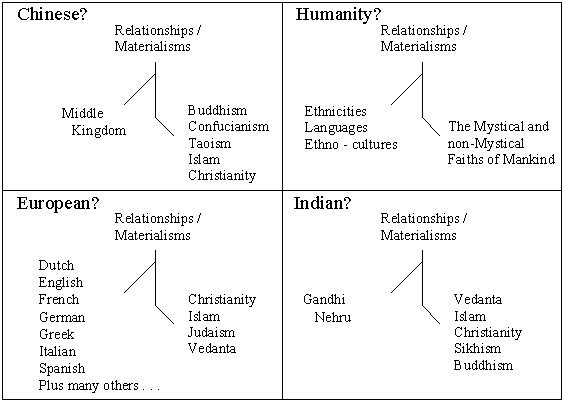
The above views of Human Nature / the Tripartite Soul suggest that people are essentially the same yet differences exist in terms of ethnocultural and confessional heritages.

We cannot deny that despite suggestions of a deep similarity in Human Nature across the Millenia and across the Globe there have been, for good and for ill, some notable "extreme?" personalities.
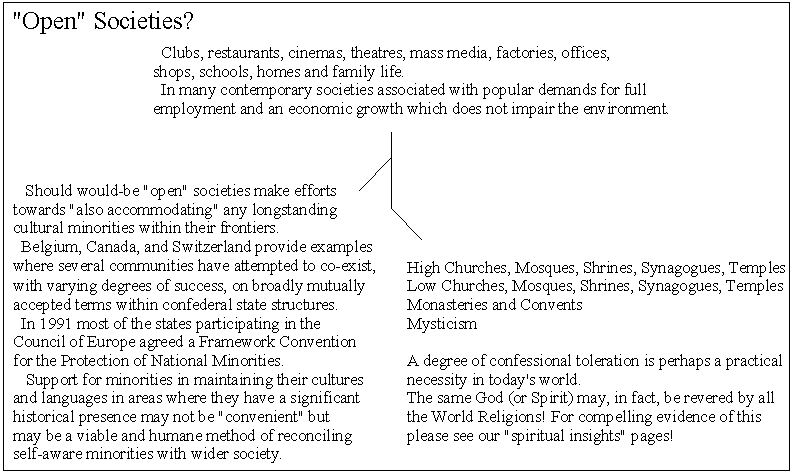
It may well be that the Tripartite Soul approach to insights
into human nature can even be extended to a "Societal Level" of
social theory speculations.
This view would suggest that Societies themselves!!!
have a Tripartite character.
"Whatever concept one may hold, from a metaphysical point of view, concerning the freedom of the will, certainly its appearances, which are human actions, like every other natural event, are determined by universal laws. However obscure their causes, history, which is concerned with narrating these appearances, permits us to hope that if we attend to the play of freedom of the human will in the large, we may be able to discern a regular movement in it, and that what seems complex and chaotic in the single individual may be seen from the standpoint of the human race as a whole to be a steady and progressive though slow evolution of its original endowment."
Immanuel Kant
Idea for a Universal History from a Cosmopolitan Point of View (1784)
Or to quote Emerson, from his famous Essay ~ History:-
"In old Rome the public roads beginning at the Forum proceeded north, south, east, west, to the centre of every province of the empire, making each market-town of Persia, Spain, and Britain pervious to the soldiers of the capital: so out of the human heart go, as it were, highways to the heart of every object in nature, to reduce it under the dominion of man. A man is a bundle of relations, a knot of roots, whose flower and fruitage is the world. His faculties refer to natures out of him, and predict the world he is to inhabit, as the fins of the fish foreshow that water exists, or the wings of an eagle in the egg presuppose air. He cannot live without a world."

"There is one mind common to all individual men....
....Of the works of this mind history is the record. Man is explicable by nothing less than all his history. All the facts of history pre-exist as laws. Each law in turn is made by circumstances predominant. The creation of a thousand forests is in one acorn, and Egypt, Greece, Rome, Gaul, Britain, America, lie folded already in the first man. Epoch after epoch, camp, kingdom, empire, republic, democracy, are merely the application of this manifold spirit to the manifold world."
From Ralph Waldo Emerson's Essay ~ History (on-line page at Age of the Sage)
We, Heads of State and Government of the member States of the Council of Europe, meeting for the first time in our Organisation's history at this Vienna summit conference, solemnly declare the following:
The end of the division of Europe offers an historic opportunity to consolidate peace and stability on the continent. All our countries are committed to pluralist and parliamentary democracy, the indivisibility and universality of human rights, the rule of law and a common cultural heritage enriched by its diversity. Europe can thus become a vast area of democratic security.
This Europe is a source of immense hope which must in no event be destroyed by territorial ambitions, the resurgence of aggressive nationalism, the perpetuation of spheres of influence, intolerance or totalitarian ideologies.
We condemn all such aberrations. They are plunging peoples of former Yugoslavia into hatred and war and threatening other regions. We call upon the leaders of these peoples to put an end to their conflicts. We invite these peoples to join us in constructing and consolidating the new Europe.
We express our awareness that the protection of national minorities is an essential element of stability and democratic security in our continent.
The Council of Europe is the pre-eminent European political institution capable of welcoming, on an equal footing and in permanent structures, the democracies of Europe freed from communist oppression. For that reason the accession of those countries to the Council of Europe is a central factor in the process of European construction based on our Organisation's values.
Such accession presupposes that the applicant country has brought its institutions and legal system into line with the basic principles of democracy, the rule of law and respect for human rights. The people's representatives must have been chosen by means of free and fair elections based on universal suffrage. Guaranteed freedom of expression and notably of the media, protection of national minorities and observance of the principles of international law must remain, in our view, decisive criteria for assessing any application for membership.....
| The
Vienna Declaration - Full Text N.B. This is an Online page |
The opening sentence of Appendix II of the Vienna Declaration
states that-
The national minorities which the upheavals of history have
established in Europe should be protected and respected so that
they can contribute to stability and peace.
But a specific list of minorities recognised by the Council of
Europe is not defined.
The Vienna Declaration of 9 October 1993 was
followed by the agreement of a Framework Convention for the
Protection of National Minorities by the Council of Europe on
1 February 1995.
The member States of the Council of Europe and the other
States, signatories to the present framework Convention,
Considering that the aim of the Council of Europe is to achieve
greater unity between its members for the purpose of safeguarding
and realising the ideals and principles which are their common
heritage;
Considering that one of the methods by which that aim is to be
pursued is the maintenance and further realisation of human
rights and fundamental freedoms;
Wishing to follow-up the Declaration of the Heads of State and
Government of the member States of the Council of Europe adopted
in Vienna on 9 October 1993;
Being resolved to protect within their respective territories
the existence of national minorities;
Considering that the upheavals of European history have shown
that the protection of national minorities is essential to
stability, democratic security and peace in this continent;
Considering that a pluralist and genuinely democratic society
should not only respect the ethnic, cultural, linguistic and
religious identity of each person belonging to a national
minority, but also create appropriate conditions enabling them to
express, preserve and develop this identity;
Considering that the creation of a climate of tolerance and
dialogue is necessary to enable cultural diversity to be a source
and a factor, not of division, but of enrichment for each
society;
Considering that the realisation of a tolerant and prosperous
Europe does not depend solely on co-operation between States but
also requires transfrontier co-operation between local and
regional authorities without prejudice to the constitution and
territorial integrity of each State.....
| Framework
Convention - Full Text N.B. This is an Online page |
A similar absence of a recognised list of minorities that
occurs in relation to the Vienna Declaration is true also of the
Framework Convention. Several of the states that have ratified
the Framework Convention assert that they themselves recognise
that they have specified, longstanding, minorities that should
qualify for such consideration as is set out in the Framework
Convention. Other ratifying states have asserted that they
themselves have no qualifying minorities themselves but they have
still signed up in overt solidarity with the other states in the
Council of Europe. Most of those states that have signed or
ratified the Framework Convention have however done so without
any recorded comment.
As of 16 October 2001 thirty four member states of
the Council of Europe had ratified the Framework Convention - a
further eight states had initially signed in support of the
Framework Convention but had yet to fully ratify their acceptance
of it's provisions.
Click on these links to review quotations
about "Central" spiritual insights
drawn from sources as indicated :-
| Christianity | Islam | ||
| Judaism | Hinduism | ||
| Buddhism | Taoism |
There may well be other faiths (not least Sikhism) that
should properly be included in any definitive consideration of
mysticism in World Religions / World Faiths !!!
Ralph Waldo Emerson resigned as an Unitarian minister in 1832
and subsequently tried to establish himself as a lecturer and
writer. His efforts in this direction included the self-financed
publication of a pamphlet entitled "Nature" in 1836. This essay,
only five hundred copies of which were printed (and these took
some six years to be distributed), received little initial notice
but effectively articulated the philosophical underpinnings of
the subsequently widely influential New England Transcendentalism
movement.
Emerson's first substantial publication was a volume of Essays
that issued from the presses in 1841. There were twelve essays in
this volume the very first being one entitled "History".
This essay sets out a transcendentalist approach to History
where the "innate Humanity" that is common to all of mankind is
seen as operating throughout the ages in the shaping of events.
The first two paragraphs include such sentiments as:-
"There is one mind common to all individual men.
Of the works of this mind history is the record.
Man is explicable by nothing less than all his history.
All the facts of history pre-exist as laws. Each law in
turn is made by circumstances predominant The creation
of a thousand forests is in one acorn, and Egypt, Greece, Rome,
Gaul, Britain, America, lie folded already in the first man.
Epoch after epoch, camp, kingdom, empire, republic, democracy,
are merely the application of this manifold spirit to the
manifold world".
Towards the end of the Essay Emerson asserts that :-
" every history should be written in a wisdom which
divined the range of our affinities and looked at facts as
symbols. I am ashamed to see what a shallow village tale our
so-called History is".
Emerson suggests that it is by looking at facts as symbolic of
the application of human affinities that people may hope for a
broader and deeper writing of history that would more truly
express, and constructively demonstrate, Humanity's central and
wide-related nature.
There are several pages on our site that investigate the
variously persuasive approaches to the study of History that have
been adopted by a number of Famous Historians.
That being said none of these Historians have really attempted
to approach their studies from a Transcendentalist
perspective!!!
Given this fact we have attempted to briefly set out the
background to an approach to Historical studies which hints at
the operation of human affinities in the providing of the
facts which Historians tend to take as their subjects of
study.
The "introductory" section which follows may lack "pace" in
some readers estimation - if you usually have little interest in
reading about History we suggest that you read a brief series of our On-Line
pages that consider one of the more "dramatic" episodes in
European History
We hope that the evidence of Human affinities acting to sponsor events that you find on that page will encourage you to return here and give the following section your interested consideration.
For most of the eighteenth century western Europe was under
the sovereignty of Emperors and Kings. Territories occasionally
changed sovereignty as an outcome of Dynastic wars or Dynastic
marriages. As far as Belles Lettres went the Europe of
these days was under the influence of the Enlightenment -
Lumière - Aufklärung where people hoped and expected
that Human intellects would discover scientific laws whose
application would lead to progress.
Increasingly towards the end of the eighteenth century
Enlightenment principles were displaced in the esteem of
influential sections of society by ideas associated with the
Romanticism movement which, amongst other things, prized Feeling
and Sensibility above Intellect. The rather "Classical" pattern
of society as shaped the principles of Enlightenment was seen by
the rising generation of Romantics as being formal, dull and
prosaic.
In association with the emerging Romanticism as sponsored by
Rousseau and others there were movements supportive of a more
sensitive and less strictly disciplined approach to the education
of the young. In the 1760's much of educated Europe had been
swayed, in contrast to the prosaic and formal modes which
prevailed, by certain Tales of Ossian, that were presented as
being discovered authentic records dating from the third century
that presented lives of Scots Celts who lived
romantically-heroically in unsophisticated, but vital,
circumstances. These tales were later proven to be contemporary
fabrications framed by a James Macpherson but nonetheless
established a genre widely translated and imitated across
Europe.
One Johann Gottfried Herder played a significant role in terms
of the incorporation of such romantic attitudes into the wider
functioning of political society. It may be that all times are to
some extent "times of transformation" and one of the many ways in
which transformations were occuring in Herder's day was that the
broader masses of society were gaining, albeit gradually, in
education, wealth, and sophistication. It was often the case in
these Dynastic times that such broader masses were originated
from ethnic traditions that were different from that of those
elites who ruled them. Dynasties had extended their sway across
centuries of wars and marriages and Rulers were held in theory to
exercise their sovereignty in the interest of all their subjects.
Increases in literacy and sophistication acted in any case to
present the ruled with a situation where their non-representation
in the corridors of power began to be increasingly questioned.
Where there was also a difference in ethnic or religious
tradition between the ruler and the ruled other questions of
cultural sensitivity were also more open to being raised.
Transitions of society can be slow but between say 1750 and say
1950 one of the more dramatic transformations was to be the
effective transfer of Sovereignty from Monarchs to Peoples. The
"Spirit of the Age" in 1750 was in many ways laying the
foundations for this, eventual, transfer of sovereignty.
The Germanic peoples had long been one of the most potent in
western Europe. In 1750 they constituted the politically
influential majority populations throughout the German
Confederation. Through the Prussian Dynasty a Germanic power
extended into the Baltic region and parts of eastern Europe and
through the Habsburg dynasty a Germanic power exercised sway over
vast tracts of central Europe. Germanic influence was also
widespread as a legacy of trade, as in the case of the Hanseatic
League, which contributed to there being a number of
substantially Germanic trading cities outside traditionally
German lands.
During an appointment at the substantially German city Riga in
Latvia, Herder reflected on the value of local Lettish culture,
and the problems of its suppression by international cosmopolitan
culture. Whilst based in Riga Herder gained attention with his
Fragments concerning current German literature (1767)
which advocated the emancipation of German literature from
foreign influences.
In 1770 Herder, whilst visiting Strasbourg, met Goethe and
became involved in a long and culturally significant conversation
with him. This meeting led to a subsequent friendship and
literary collaboration. In his treatise On the Origin of
Language (1772) Herder held that language and poetry are
spontaneous necessities of human nature, rather than supernatural
endowments. Herder developed the idea of Volksgeist ("national
character") as expressed in the language and literature of a
nation. Each nation was held to have its own Volksgeist that was
of unique value due to being shaped by that nation through its
history. In 1776 Herder became court preacher at Weimar through
the influence of Goethe who had entered the service of its
ruling Prince.
Something of Herder's outlook as per a Romanticisation of
Nationality can be gauged from the following quotations:-
Nature brings forth families; the most natural state
therefore is also one people, with a national character of its
own. For thousands of years this character preserves itself
within the people and, if the native princes concern themselves
with it, it can be cultivated in the most natural way: for a
people is as much a plant of nature as is a family, except that
it has more branches. Nothing therefore seems more contradictory
to the true end of governments than the endless expansion of
states, the wild confusion of races and nations under one
scepter. An empire made up of a hundred peoples and a 120
provinces which have been forced together is a monstrosity, not a
state-body....
....No greater injury can be inflicted on a nation than to be
robbed of her national character, the peculiarity of her spirit
and her language. Reflect on this and you will perceive our
irreparable loss. Look about you in Germany for the character of
the nation, for their own particular cast of thought, for their
own peculiar vein of speech; where are they? Read Tacitus; there
you will find their character: "The tribes of Germany, who never
degrade themselves by mingling with others, form a peculiar,
unadulterated, original nation, which is its own archetype. Even
their physical development is universally uniform, despite the
large numbers of the people," and so forth. Now look about you
and say: "The tribes of Germany have been degraded by mingling
with others; they have sacrificed their natural disposition in
protracted intellectual servitude; and, since they have, in
contrast to others, imitated a tyrannical prototype for a long
time, they are, among all the nations of Europe, the least true
to themselves.". . .
The many princely courts of Germany, and her established
intellectual life, for many decades up these times had been in
the habit of communicating through the French language as a
result of a long period of French cultural predominance in
Europe. From circa 1776 there appeared an increasingly
influential Sturm und Drang (Storm and Stress) literary
movement. This movement was given a considerable creative impetus
by many young persons, from many of the states of which "the
Germanies" were then composed. It was often the case that these
young persons were dismissive of the "foreign" and "formalistic"
courts maintained by the secular and clerical lords of the
Germanies. They sought to be creative through a free expression
of emotion, inclination, and passion often in opposition to
established cultural forms.
Herder was a central figure in the Sturm und Drang
movement and shared in its rejection of French cultural forms.
Goethe's German versions of Ossian's 'Songs of Selma' occupy
several pages of his The Sorrows of Young Werther (1774), which
became the cult novel of the day. The German language was upheld,
on cultural rather than nationalistic grounds by the
Stürmer as being youthful, truthful, simple, vigorous
and sensuous and was as such adopted by them in overt preference
to "aged and aristocratic French". The Sturm und Drang
movement was dramatically influential in the cultural life of the
Germanies for less than a decade but, despite its brevity,
nonetheless constituted evidence of a noticeable alteration in
cultural perspectives.
These were politically interesting times - a potent minority
amongst the colonial Americans actively sought independence from
Britain and were helped to achieve this by the interventions of
the French and others. The prodigious expense of this French
involvement however contributed to the onset of an initially
financial and ultimately political crisis in the French
Kingdom.
In the aftermath of the French Revolution of 1789 populist
energies were unleashed within the markedly populous French
Kingdom in what were to become an eventual twenty six years of
intermittent French Revolutionary and Napoleonic turmoils. In
association with these turmoils the pre-existing Dynastically and
Clerically based patterns of Sovereignty and Governance were
brought down in many parts of Europe. A more popular sovereignty
and forms of nationalism meanwhile were encouraged by the various
contending parties in their attempts to secure allies to their
respective causes.
In the case of the Germanies where many intellectuals had
initially welcomed the French Revolution in the hope that it
would bring much needed reforms in its train the actual
establishment of Napoleonic power brought with it enforced
demands for wealth to support Napoleon's Empire and for manpower
to fill the ranks of his armies moreso than locally welcome
social or political reform.
German indignation at Napoleon's many impositions gave rise to
a defiant assertion of a German nationality. In the winter of
1807 Johann Gottlieb Fichte delivered a series of "Addresses to
the German Nation" in the hall of the Academy of Sciences in
Berlin. At that time "the Germans" and "Germany" were divided
into a multiplicity of states and it is surely of a prime
significance that Fichte addressed the "German Nation" rather
than say the subjects of the King of Prussia in who's capital
city the Address was being delivered.
In these Addressess Fichte called for a system of national
education that would tend to preserve the distinctive quality or
ethos of the German Nation. Nationality was seen as being higher
than statehood. Fichte held that people should be willing to give
a complete and consuming loyalty to their nation as something
eternal in contrast to the lesser civic loyalty that was due to a
state.
In these times several radical ministers had been authorised
by the King of Prussia to effect root and branch reforms across
the Prussian territories that would simultaneously lessen the
appeal of policies that emanated from Napoleonic France and would
also tend to greatly enhance popular identification with the
Prussian Royal state.
At the time Fichte delivered these Addresses "Germany" was
undefined. As far as Prussia itself went there were numerous
Polish subjects in her northern and eastern provinces. What would
their position be in a "National" Germany?
Some forty years after these events (1848-9) there was another
period of revolution in Europe. At this time the territorial
extent of "Germany" was a central issue as there was a contest
for acceptability between a Kleindeutsche resolution where
the western and northern Germanies might coalesce under Prussian
leadership and a Grossedeutsche resolution where the
Habsburg lands would be included in a Germany where the Habsburg
influence would be most significant. This contest was not
entirely distant from religious questions as Prussia was a
predominantly Protestant state and the Habsburg lands were
predominantly Catholic. Further deep complications arising from
the fact that Germans were a minority in the Habsburg lands where
the Hungarians vied with the Germans as a people of state and
numerous Slav peoples (Czechs, Slovaks, Poles, Croats,
Ruthenians, Serbs) together represented a more numerous
population than the Germans and Hungarians combined.
Peace settlements following on from some of the many Wars of
Dynastic Succession in European History had led to the ancient
House of Savoy, traditionally powerful in south-eastern France
and north-west of the Italian Peninsula, to be recognised as
Kings of Sardinia. Count Camillo di Cavour was appointed Prime
Minister in 1852.
Cavour was somewhat in favour of liberalism, secularism, and of
economic development. The political and diplomatic aftermath of
the Crimean War (from 1853) featured a breach between the
Austrian Empire (traditionally an involved power in the affairs
of the Italian Peninsula) and the Russian Empire. Given that the
Austrian state had effectively needed Russian assistance to
secure the return of Hungary to its control in the wake of the
revolutions of 1848-9 the breach with Russia meant that Austrian
state, still strained by Hungarian restiveness, was in a
substantially weaker position to resist Cavour's diplomatic
machinations directed towards the incorporation of several
territories in the Italian peninsula into an extended Kingdom of
Sardinia. Cavour's diplomacy, which in some ways exploited
"Italian" nationalism, laid the foundations for the "Making of
Italy" as a kingdom by 1870.
As the nineteenth century ran its course
Kleindeutscheland was largely imposed from above by
the diplomatic manipulations of Bismarck in support of the
expansion of they sway of the Prussian monarchy which led to the
proclamation of the second German Empire in 1870. Habsburg
Austria meanwhile was forced, by reverses suffered through
Bismarck's diplomatic conflicts to concede a compromise with its
Hungarian element that saw the Hungarians exercising much more
authority in those lands which were traditionally associated with
the Hungarian crown of St. Stephen. The Hungarians had won
concessions for themselves but tended to overtly attempt to
impose Hungarian "Magyarisation" upon the various Slav peoples
domiciled in the lands of the Crown of St Stephen.
Within the "Germanic Austrian" Viennese Parliament and the
territories with which it was legislatively associated meanwhile
there were many instances of linguistic and ethnocultural rivalry
where representatives of Slavic peoples often raised issues about
the languages of administation and education within lands where
they were respectively domiciled.
The following On Line links can take you to pages where historical developments are detailed in ways that attempt to quietly display the operation of the Human affinities for "Honesty-Spirituality", "Good Fellowship-Desire", and "Manhood-Ethnicity" in the Unfolding of History.
The
Revolution of 1848
The "Making of Italy"
Bismarck,
Prussia and Imperial Germany
As with The Perennial Philosophy a very large number of impactful quotations from mysticism in world religions and from secular poetry appear in our page sections.
In this page section you can find brief details of
several quotations sources or links to on-line pages containing
fuller details of several quotations sources.
World Faiths quotations sources
So far as I am aware, with one certain exception, all of the sources quoted are no longer under Copyright protection. The certain exception that is known to me is the Chuang Tzu, this work is still under a restricted, (rather than a full), form of Copyright, quotes from this source, and also from the Lotus Gospel (as I am unsure of the status here) have been kept to a bare minimum.
We hope that readers will be interested enough in these sources to access the originals. Said originals and some better, (still under Copyright restriction or just more readily available), alternatives are listed below.
Click on
these Links to review brief details
about quotations sources used by us to illustrate the Wisdom of
the Mystics
for selected World Faiths or for General background:-
| Islam | Christianity | ||
| Judaism | Hinduism | ||
| Buddhism | Taoism | ||
| General | |||
Numerous Christian and Judaic quotes featured come from the New Testament and the Old Testament of the Holy Bible as presented in the King James Bible. This translation is generally deemed to be scholarly and is also prized for the literary quality of its content.
Whilst only a few quotes from Thomas à Kempis' celebrated work are presented on this Web page a host of awesomely impactful passages in the Of the Imitation of Christ do focus on the very same Aspects of Spirituality and Being that have been identified by - the Sage - the True Mystics and the supreme Poets.
Fuller information about Thomas a Kempis and the Of the Imitation of Christ can be reached by following this on-line link:-
Thomas
à Kempis & the
Of
the Imitation of Christ
A number of quotations from Jalaluddin Rumi's Masnavi I Ma'navi appear in our "Central" spiritual insights section and our "Other" spiritual insights section.
Fuller information about Jalaluddin Rumi and the Masnavi can be reached by following this on-line link:-
Jalaluddin
Rumi
and
the Masnavi
A number of quotes from the Bhagavad Gita appear on our "Central" spiritual insights section and our "Other" spiritual insights section.
Fuller information about the Bhagavad Gita and Hinduism can be reached by following this on-line link:-
The Bhagavad Gita and Hinduism
The quotations you can read in our spiritual insights sections come from a rather dated translation - by F. Max Muller - a translation by Juan Mascaro is usually available from Penguin Classics.
As with the Bhagavad Gita and the Upanishads the quotes from the Dhammapada you have read come from a dated translation - by F. Max Muller - a translation by Mascaro is usually available from Penguin Classics. The Dhammapada tends to be more central to Theravada Buddhism than Mahayana Buddhism
A most important Text in the Mahayana Buddhism of extensive and populous regions of East Asia.
This may be available as The Lotus of the Wonderful Law - a translation by W.E. Soothill and published by Curzon Press of Richmond, Surrey, England.
A number of quotations from the Chuang Tzu appear in our "Central" spiritual insights section and our "Other" spiritual insights section.
Fuller information about Chuang Tzu, Lao Tzu and Taoism, and yet more quotes, can be reached by following this on-line link:-
The Perennial Philosophy, by Aldous Huxley - online link is a book similar in content to the "age-of-the-sage" Web site.
It considers a few areas of agreement ( Charity, Purity of
Heart, Humility, Divine Edification ) between the major World
Faiths and includes many quotations from Buddhism and Hinduism,
Taoism and Islam, etc. including some from Chuang Tzu and
Rumi.
The Perennial Philosophy treats mainly with Eastern rather
than Western sources as Aldous Huxley hoped to present readers
with quotations that were unfamiliar.
The quotes from The Republic of Plato come from the translation attributable to J.L. Davies and D.J. Vaughan.
The myriad of quotes that appear drawn from secular plays and
poetry have sources too numerous to mention in detail.
If you are really interested a good way to track many of the
plays and poems down would be to have recourse to a good book of
quotations.
Such books are generally indexed by phrase and tend to give
chapter and verse as to the original source after any and each of
the phrases quoted.
Comments about our Web presence are welcome and can be forwarded through aots_quotes@hotmail.com or otherwise through the e-mail link that appears further down this page.
We particularly welcome information about quotes that might enhance our Spiritual Insights selections or our Poetry Insights selections.
We also greatly welcome suggestions for expanding the
age-of-the-sage Site into subject areas that might be thought
complementary to its main themes.
We see these main themes as being:-
| 1 Attempting to popularise a fuller appreciation of the quite AWESOME Wisdom of the Mystics and the Poets. |
2 Attempting to promote the FULL realisation that there is NO fundamental conflict between the "Mystical Spirituality" as taught by the World Religions and an "Evolutionary Path" such as Science accepts that Humankind has followed. |
| If nothing else we hope that the time you have spent
browsing the age-of-the-sage selection of Enlightenments,
Wisdoms, and Spiritual Insights has been interesting. We welcome constructive criticism as it helps us to improve our Web site. |
If you do wish to Contact us the e-mail link below may work for you otherwise please use the e-mail address as you would normally.
aots_quotes@hotmail.com |
| Menu |