Emerson, Transcendentalism,
and the Unfolding of History
The Transcendental Idealism of Immanuel Kant was adopted and
adapted by many other people in Europe and the Americas, one of
the more interesting instances of these adoptions / adaptions
being that of the New England Transcendentalists.
Ralph Waldo Emerson was perhaps the most far-seeing of the New
England Transcendentalists, he came to believe that all people
share a 'commonality of mind' and that it is this mind that acts
as a foundational pattern for historical developments.
"A man is a bundle of relations, a knot of
roots, whose flower and fruitage is the world."
Ralph Waldo Emerson

"History is for human self-knowledge ... the only clue to what man can do is
what man has done. The value of history, then, is that it teaches us what man has done
and thus what man is."
R. G. Collingwood
|
Emerson's call
for a
"Transcendental Approach" to History
|
Towards the end of his Essay "History" Ralph Waldo Emerson
asserts that :-
" every history should be written in a wisdom which
divined the range of our affinities and looked at facts as
symbols. I am ashamed to see what a shallow village tale our
so-called History is".

"Mankind are so much the same, in all times and places, that history informs us of nothing new or strange in this particular. Its chief use is only to discover the constant
and universal principles of human nature."
David Hume
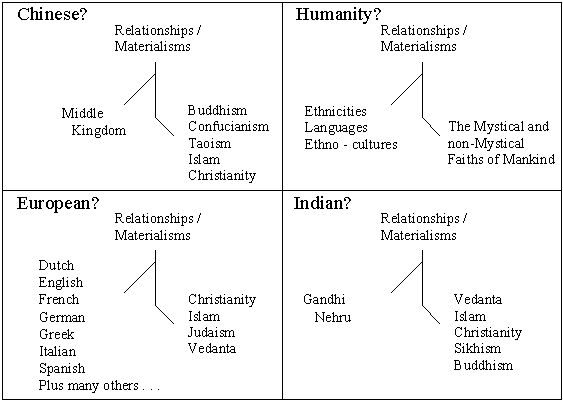
You can find key insights, (from the Great Faiths, Plato, Socrates
and Shakespeare!!!),
on several of our pages that give convincing support to this view of Human Nature!!!
"...man is a bundle of relations, a knot of roots,
whose flower and fruitage is the world..."
Ralph Waldo Emerson
"Whatever concept one may hold, from a metaphysical point of view, concerning the freedom of the will, certainly its appearances,
which are human actions, like every other natural event, are determined by universal laws. However obscure their causes, history,
which is concerned with narrating these appearances, permits us to hope that if we attend to the play of freedom of the human will
in the large, we may be able to discern a regular movement in it, and that what seems complex and chaotic in the single individual
may be seen from the standpoint of the human race as a whole to be a steady and progressive though slow evolution of its original endowment."
Immanuel Kant
Idea for a Universal History from a Cosmopolitan Point of View (1784)
Or to quote Emerson, from his famous Essay ~ History more fully:-
"In old Rome the public roads beginning at the Forum
proceeded north, south, east, west, to the centre of every
province of the empire, making each market-town of Persia, Spain,
and Britain pervious to the soldiers of the capital: so out of
the human heart go, as it were, highways to the heart of every
object in nature, to reduce it under the dominion of man. A man
is a bundle of relations, a knot of roots, whose flower and
fruitage is the world. His faculties refer to natures out of him,
and predict the world he is to inhabit, as the fins of the fish
foreshow that water exists, or the wings of an eagle in the egg
presuppose air. He cannot live without a world."
"There is one mind common to all individual men....
....Of the works of this mind history is the record. Man is explicable by nothing
less than all his history. All the facts of history pre-exist as laws. Each
law in turn is made by circumstances predominant. The creation of
a thousand forests is in one acorn, and Egypt, Greece, Rome, Gaul, Britain,
America, lie folded already in the first man. Epoch after epoch, camp, kingdom,
empire, republic, democracy, are merely the application of this manifold spirit
to the manifold world."
From Ralph Waldo Emerson's Essay ~ History
|
|
![[]](../philosophy.gif) European
European