
Widespread social chaos allows an assertion
of reactionary governmental authority
Many of the members of the Congress appeared in old Bohemian costumes, and from the windows of the town waved the flags of all the different Slavonic races. At 8 a.m. on June 2 the members of the Congress went in solemn procession through the great square called the Grosser Ring.
 In front of the procession went the Students' Legion, singing patriotic songs; two young men followed,
one in Polish national dress, the other bearing a newly devised flag featuring horizontal bands of blue, white, and red, which was
supposed to symbolize the union of the Slavonic
peoples.
In front of the procession went the Students' Legion, singing patriotic songs; two young men followed,
one in Polish national dress, the other bearing a newly devised flag featuring horizontal bands of blue, white, and red, which was
supposed to symbolize the union of the Slavonic
peoples.
The opening speech at this congress was delivered by its vice-president Pavel Jozef Safárik, a Slovak who had been living in Prague for a number of years, who was a friend of Palacký's and who earned his living as an academic, as an editor, and as a librarian alongside having some notability for his studies into Slavic languages.
In this speech, which was well-received by the delegates to the Congress, Safárik claimed that in declining to become Germans, Italians or Magyars, the Slavs were not acting as barbarians, but simply refusing to betray their country or the cause of liberty.
"The Slavs ask nothing but justice; they rest upon moral force only....It is only by struggle that we pass from slavery
to liberty. Let us therefore be victors, and we shall be free in a free nation, or let us die with honour, and glory will
follow us to the grave."
Following on from this speech, Palacký, who had been recognised as president of the Congress also addressed the assembly:-
"The Slavs have gathered from all sides to declare their eternal love and brotherhood to each other. Freedom, which we now desire, is no gift of the foreigner, but of
native growth, the inheritance of our fathers. The Slavs of old time were all equal before the law, and never aimed at the conquest of other nations. They understood
freedom much better than some of our neighbours, who cannot comprehend the idea of aiming at freedom without also aiming at lordship. Let them learn from us the
idea of equality between nations. The chief duty of our future is to carry out the principle of 'What thou wouldst not that men should do unto thee, that do not thou to
another.' "
The Congress held several sessions between 2-12 June 1848.
The proceedings of this Congress were held in the Czech National Museum where they were sub-divided into a section involving Poles and Ruthenians, one involving Czechs and Slovaks, and one involving Croats, Serbs and Slovenes. This Pan Slav Congress functioned as a more or less conscious counter-blast to the German National Assembly stressing support for the equality of nations and the continuation of several Slav peoples' existence within the Austrian Empire - its outlook was in favour of Slavic Revival and of resistance to cultural assimilationism be it German, Italian or Hungarian.
Ironically, given this Slavic Revivalist outlook, the sheer range of Slavic "mother-tongues" that were represented, and the then pervasive knowledge of the German language in central and eastern Europe because of trading and educational transactions, caused it to be practically necessary that German was adopted as being the language of the proceedings during several plenary sessions.
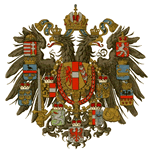 This Congress was largely directed by Palacký and others towards seeking greater constitutional freedoms for the Slavic peoples within a
reformed Habsburg Empire in preference to possible unwelcome encroachments on Slavic Europe that might emanate from the German parliamentary
proceedings then being held in Frankfurt or from Tsarist Russia. The hall in which the Congress met prominently featured a black and yellow Habsburg imperial banner and a
replica
of a double-headed eagle that all present would have recognised as a defining Habsburg insignia. The Congress held its sessions openly
and with the consent the Habsburg governor of Bohemia, a conservative germanised Bohemian nobleman named Count Leo Thun who had
nevertheless previously lent
his patronage to Czech linguistic
and literary revival movements.
This Congress was largely directed by Palacký and others towards seeking greater constitutional freedoms for the Slavic peoples within a
reformed Habsburg Empire in preference to possible unwelcome encroachments on Slavic Europe that might emanate from the German parliamentary
proceedings then being held in Frankfurt or from Tsarist Russia. The hall in which the Congress met prominently featured a black and yellow Habsburg imperial banner and a
replica
of a double-headed eagle that all present would have recognised as a defining Habsburg insignia. The Congress held its sessions openly
and with the consent the Habsburg governor of Bohemia, a conservative germanised Bohemian nobleman named Count Leo Thun who had
nevertheless previously lent
his patronage to Czech linguistic
and literary revival movements.
A passage from the Manifesto issued by the Pan-Slav Congress issued on the 12th June as the Congress came to a close reads:-
"In the belief that the powerful spiritual stream of today demands new
political forms and that the state must be re-established upon altered
principles, if not within new boundaries, we have suggested to the Austrian
Emperor, under whose constitutional government we, the majority, live, that he
transform his imperial state into a union of equal nations, which would
accommodate these demands no less fully than would a unitary monarchy.
On
12th June there was some rioting in Prague between radical interests, (mainly students and young journeymen apprenticed to various trades),
and soldiers during which Princess Windischgrätz, the wife of the Habsburg military commander in Bohemia,
was fatally wounded by a gunshot whilst observing the turmoil from a window in her house.
We see in such a union not only salvation for ourselves but also freedom, culture, and humanity for all, and we are confident that the nations of Europe will assist in the realization of this union. In any case, we resolve, by all available means, to win for our nationality the complete recognition of the same political rights that the German and Hungarian peoples already enjoy in Austria."
Although Count Thun was captured as he attempted to personally mediate in these disturbances he declined to make concessions whilst being held against his will. Negotiations were entered into resulting in some concessions by the Habsburg authorities and the release of Count Thun. The radical interests also gave undertakings which General Windischgrätz saw, due to ongoing turmoil, as not being sufficiently complied with - leading him to threaten force if more were not done to fulfil them.
There was subsequently some active deployment of the Habsburg forces and a re-assertion of Habsburg authority.

Back in France those promises made in February that the government would arrange work schemes had resulted in the organisation of "National Workshops" which proved to be very expensive at a time when the new administration found it difficult to raise loans and considered it most politically difficult to raise taxes sufficient to actually fund the considerable expense in continuing the project.
These National Workshops included the provision of employment in novel public works schemes like the weaving of 43,000 flags in Lyon or the numerous municipal construction projects including work on the Montparnasse station, on the Orsay railway line, landscaping of public spaces etc.
In many cases those in employment in Paris felt able to agitate for higher wages from their existing employers in the belief that they could fall back upon the public purse via the National Workshops. Several tens of thousands of persons from outside Paris, also distressed by the scarcity of employment, migrated to Paris in the hope of learning some trade or of taking advantage of the new provisions.
As those registered with the National Workshops increased in number the hours available per person became limited but those involved were able to draw a salary of inactivity for days on which there was no work available.
A labour commission headed up by Louis Blanc and Albert sought to reduce the working day from fifteen to ten hours in Paris and from fifteen to eleven hours in the provinces.
Direct taxation was actually raised significantly bringing further difficulties to persons who were already finding their incomes under pressure due to the ongoing weakness of the economy.
Such developments as the National Workshops scheme and the reduction of the working day gave some scope for taxpayers, including many rural peasant proprietors who themselves often worked long hours to gain only a modest income, to feel that they were being squeezed to provide unreasonable levels of support to people who were not working as hard as might be expected towards earning their own living.
French National Assembly elections of April 23rd based on universal suffrage produced a relatively conservative outcome where the small number of deputies in favour of Republicanism and Socialism were heavily outnumbered by a factor of five to one.
In mid May some twenty thousand persons protested in the streets of Paris that not enough was being done by the new French administration to secure liberties in Poland. Some three thousand of these were able to access the chamber where the newly elected National Assembly was holding its processes of deliberation.
Whilst in the Assembly chamber the protestors also condemned a recent forcible quelling of radicalism in the French city of Rouen - some voices were raised suggesting that the new government was betraying the people. After the National Guard subsequently cleared the protestors from the chamber radical elements decided that they should attempt to establish an alternative to the elected government that would pursue their preferred radical policies.
Although several hundred protestors seized control of the City Hall, from which would-be "governmental" decrees were issued, the National Guard again intervened and several of the radicals leaders were arrested and detained. The events of this day in May tended to give rise to concern among many moderates, across France, about the potential for more instances of disruptive social revolution.
In late May the authorities, with approaching one hundred thousand persons enrolled in the work schemes, began to place restrictions on them. On 21st June the administration moved to close down the work schemes. Young men were offered the deeply unattractive alternative of joining the French army. Others were offered an opportunity of participating in the draining of the (notoriously unhealthy!!!) swamplands of the Sologne region of the Loire valley. Persons originally from outside Paris who had enrolled themselves in the work schemes were to be cut off from membership and were offered expenses to return to their home districts.
On 23rd June barricades were set up widely over the poorer areas of eastern Paris by workers made desperate by the closure of the National Workshops which had been their only reliable means of subsistence.
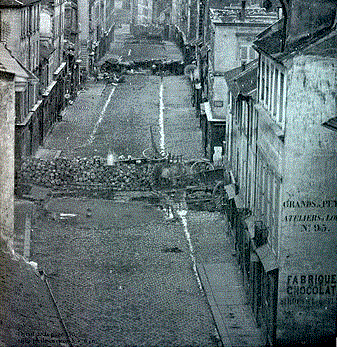
Although photography was then in its infancy a "daguerreotype" of one such barricaded street, in rue Saint-Maur-Popincourt, was taken on 25 June, 1848, and subsequently appeared in the press...
- to become one of the very earliest examples of pictorial journalism! The authorities ordered the army to intervene.
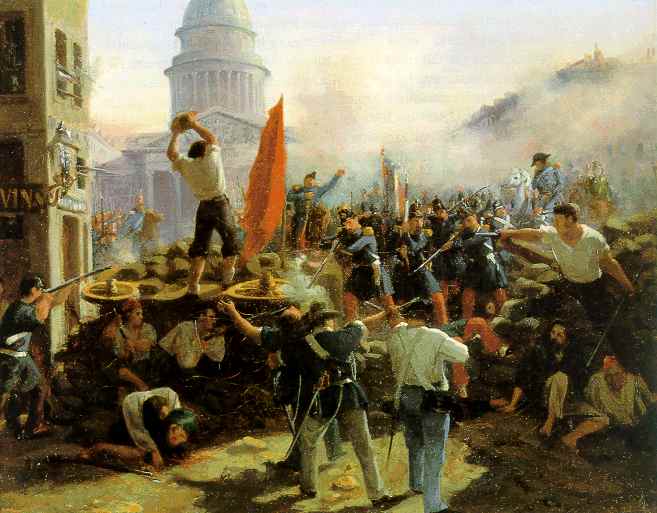
Horace Vernet, La barricade de la rue Soufflot, 1848-1850
Image Credit : The German Historical Museum
General Cavaignac, who had arranged his forces, 50,000 strong, to principally defend the functioning of the National or Constituent Assembly whilst having the capacity to advance against perceived opposition, was vested with virtually dictatorial powers. Cavaignac encouraged his soldiers to accept that they would be fighting for the sovereignty of the people of France, for a government that wished to guarantee liberty and justice for all. The barricaded streets of Paris were subjected to continued assaults by the French army. The workers of Paris living on the brink of poverty resisted tenaciously but were eventually obliged to yield ground. Thousands of fatalities occurred during the intense street fighting, with thousands more being captured and sent into exile or being given terms of imprisonment.
After these "June Days" Socialism was subjected to repression, Louis Blanc and Ledru-Rollin went into exile in England, the political clubs were closed down, press freedoms were curtailed.
General Cavaignac was invited by the assembly to continue with the exercise of sweeping powers until a new constitution was in place.
In their efforts to secure social peace in Paris the authorities arranged, by a law of 19 September, for the emigration of several thousand workers, with their families, to colonial north Africa as agricultural settlers. A budget of 50 million francs, an enormous sum for those days, spread over several years, was put in place to fund the programme.
Several "French" administrative Departements were established in colonial North Africa with an expectation that their politically enfranchised, (i.e. mainly French colonial), inhabitants would receive rights of representation in the National Assembly.
Over the months of his authority, however, General Cavaignac showed limited capacity for government and for the winning of political support. In the event people increasingly began to be attracted by the personality and policies of one Louis Napoleon, who had been raised as a nephew of the former Emperor Napoleon Bonaparte, who had long lived in exile, who had actually been elected to the Assembly in the elections of April, 1848, and had returned to France from English exile, to take up his seat only to meet with a degree of official hostility because of his "political" ancestry and some half-baked "Bonapartist" attempted coups he had been involved in as a younger man. Louis Napoleon was only given official approval to return to France in June, 1848, and made a widely publicised re-appearance on the French political scene in late September, 1848, thus avoiding association with the failure of the National Workshops and the brutalities of "The June Days", and the ensuing political repression.
Louis Napoleon stood for election as President of the Republic - an office which, under the constitution of the republic, was to continue over a four year term. In this campaign Louis Napoleon espoused policies that offered strong support for order, for the rights of private property, and for the maintenance of the republic. His close family association with Napoleon Bonaparte also seemed to offer the promise of a more dynamic policy at home and abroad. French public opinion, long supportive of extensions of French political, cultural, and military, influence had recently been moved by the works of Thiers and others celebrating the achievements of the Napoleonic era. At the election in December 1848 Louis Napoleon was returned with some five-and-a-half million votes out of the seven-and-a-half million cast. The now somewhat discredited General Cavaignac being the closest runner up in the presidential campaign, then came Ledru-Rollin; Lamartine received the least number of votes of any candidate.
In April 1848 Prussia, Brunswick, and Hanover, had sent forces into Holstein after being asked to intervene by those assembled at Frankfurt at a time of a succession crisis, following on from the repudiation of the incoming Danish Kings personal Sovereignty as Duke, by the Estates of Holstein and Schleswig. In early May Prussian forces penetrated into the Danish province of Jutland.
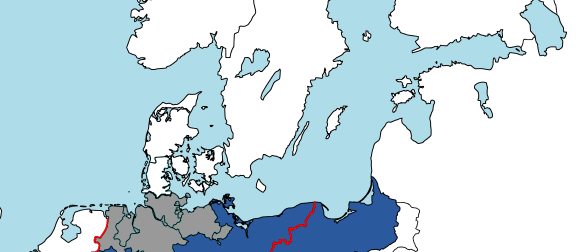
Danish lands - mainland and islands as of late 1847 - depicted here in white - and lying to the north of the Germanic lands shown in grey.
The Tsar of all the Russia's - who had a primary strategic interest in who controlled the navigable waters off the Danish coast through which Russian merchandise was conveyed from the Baltic Sea through narrow straits towards much of western Europe - had let it be known that he disapproved of these actions by Prussia, meanwhile, the British were pressing for the agreement of a peace. As a result of these international complications, and also of the seriously adverse effects of a Danish blockade on Prussian commerce, the Prussian Kingdom entered on 28th August into a so-called Malmo Armistice with Denmark without prior consultation with the German National Assembly. The Assembly initially condemned this armistice but, on the 16th September, narrowly endorsed it after a three-day debate. During these days there had been radically-led rioting in many west German towns. On 26th September Austrian, Prussian, and Hessian, forces were called upon to defend the Assembly's proceedings against those protesting this acceptance of an armistice so deeply unwelcome to German national sentiment. Two prominent conservative deputies, and some eighty other persons, lost their lives in this turmoil.
The incoming legislature for lower Austria, (i.e. the lands of the Austrian Empire that were not also part of the Hungarian Kingdom), convened in Vienna on 22 July. The newly introduced wider franchise resulted in an unprecedentedly large number on peasant deputies, (92 out of 383), with very few deputies being aristocrats, and with more than half on the deputies being of Slavic origin. Radicals, (who tended to be German), were outnumbered by a mixed bag of conservatives comprising Polish noblemen, Ruthenian peasants, Czech liberals, Tyrolese clericals and others.
Territories under the sovereignty of the House of Habsburg
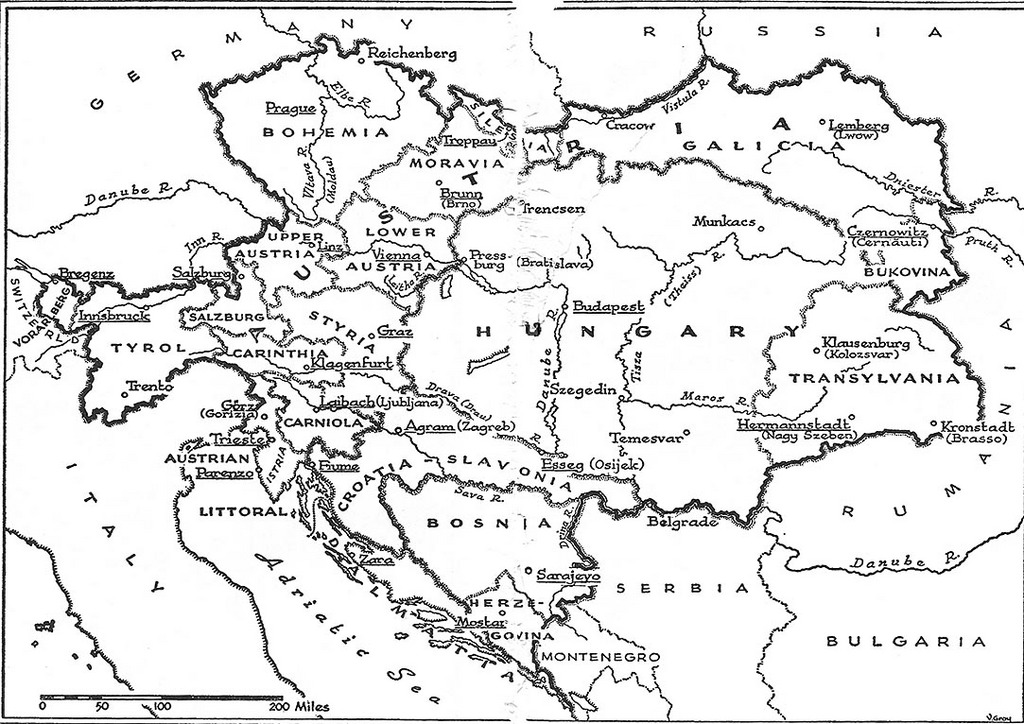
(N.B. Lombardy and Venetia in the north of the Italian peninsula were also under Habsburg sovereignty)
A wide range of languages, German, Czech, Polish, Ruthenian and Italian, were heard in the debates and translation services were made available to facilitate mutual communication. By September 7 the legislature had agreed to the removal of feudal burdens on peasant-held lands in return for provincially and peasant funded compensations. An Act of Emancipation abolished the feudal system of land tenure and the resulting obligations of peasants towards landowners, and placed limits on the jurisdiction and police powers held by landowners.
These reforms went a long way to satisfying peasant grievances. A gradual easing of the level of unrest in these weeks of debate had been accompanied by a return of the Emperor from Innsbruck to the Schonbrunn, one of his principal palaces, on the outskirts of Vienna. The gradual easing of tensions and this return of the royal court, together with many wealthy Viennese, to Vienna allowed an upturn in spending and trading confidence. There was a resulting increase in employment which also allowed people to feel more content with their lives.
The forces that the Austrian commander in the Italian peninsula, Radetzky, had been able to call upon in March, 1848, had stood at some 20,000 men in Milan, and its environs. Turmoil of March, 1848, in Milan, where some ten thousand citizens had taken to the streets in protest, together with the possibility of Piedmontese-Sardinian intervention and also news of other serious turmoils in Venice had caused Radetzky to order a withdrawal of his forces from Milan to the relative security of several strategic fortresses.
Radetzky's forces were drawn from many parts of the Habsburg Empire and he now saw a high level of desertion amongst those soldiers who originated from the Italian peninsula.
By late May, 1848, the Piedmontese-Sardinians had assumed control of Milan and during May, and into June, Lombardy, Parma, Modena and the Venetian mainland all separately voted to accept the sovereignty of Charles Albert of Piedmont-Sardinia in the hope of securing military aid.
In June Radetzky's forces were further reinforced with an additional 20,000 soldiers that had crossed on foot through the alpine passes. By mid-June the Emperor and his advisors came to see merit in attempting to bring an end to an expensive war by securing a ceasefire with Piedmont-Sardinia and entering into negotiations over the status of Lombardy. Radetzky was urged to seek to achieve a ceasefire preparatory to such negotiations.
In the event Radetzky questioned these orders sending an high ranking colleague, Prince Felix Schwarzenberg, to Innsbruck to implore the Emperor to trust to the valour of his soldiers and to continue the combat.
In early July the previously independence-minded city of Venice, (where a Republic of St. Mark had been proclaimed), itself voted to accept the sovereignty of Charles Albert as it then being blockaded by the Austrian navy and generally felt itself to be seriously threatened by an evident resurgence in Austrian power.
Although the assemblies of several Italian territories had voted to accept the sovereignty of Charles Albert this was not put into effect as the Austrian commander Radetzky exceeded his official orders by leading his now reinforced armies based in the Quadrilateral against the Piedmontese-Sardinian led interest and won a decisive victory at Custozza on July 23rd.
Radetzky's victory at Custozza contributed, along with other developments, to a resurgence in the fortunes of the Habsburg system. Given this resurgence - together with evidences of loyalty to the Emperor's authority being shown by many Viennese citizens, and the fact that Ministers and Deputies of the incoming "Constituent" assembly in Vienna united in demanding the return of the Emperor to the capital - the Emperor felt able to return to Vienna in the first half of August, 1848.
In a letter to Jellachic of early September the Emperor himself expressed satisfaction with his proven loyalty - but did not restore him to the office of governor. Soon thereafter, September 11, Jellachic led a force of over fifty thousand men against the Hungarian interest. By this move Jellachic intended to support the restoration of the Habsburg Empire. The Hungarian Parliament was declared abolished by the Emperor on the 3rd of October, on the 6th arrangements for the sending of Austrian German regiments to the aid of Jellachic were followed by a serious revolt by those in favour of continued radical reform in Vienna and aimed at impeding this deployment.
The radical interest considered that should Jellachic and the Austrian regiments suppress the Hungarian separatism this would tend to also diminish the possibility of securing the formation of an administration that would be less under the sway of the dynasty and more responsive to the wishes for constitutional freedom of the Empire's "Peoples of State" or "Master Nations."
Given the serious nature of this revolt the Emperor left Vienna for the Moravian cathedral-town of Olmutz where a manifesto was issued proclaiming that Imperial authority would be re-established by military action.
During these weeks the Reichstag was continuing to act as an Austrian Constituent Assembly attempting to frame a new constitution.
Due to the turbulence in radical Vienna the Reichstag was depleted by a withdrawal of many conservative Slavic and other representatives and was re-located, at the Emperor's invitation, to the town of Kremsier, not far from Olmutz.
In the event many conservative Slavic and other representatives were more inclined to participate in the proceedings at Kremsier than the radicals who tended to remain in Vienna.
These Slavic representatives included Frantisek Palacký and others who already accepted the "Slavic Revivalist" and "Equality between Nations" aspirations voiced at the Pan-Slav Congress.
During the proceedings at Kremsier Palacký was not only elected to a five-member "Constitutional Committee" but actually served as its chairperson.
The results of the deliberations held at Kremsier came to exhibit strong traces of making attempts to solve the problem of crown lands where several different languages were spoken by subdividing them, on linguistic grounds, into administrative districts.
The draft constitution drawn up at Kremsier included a Section 21 which held that:-
"All the peoples of the Empire are equal. Each of them has an inviolable right to the preservation and cultivation
of its nationality in general and its language in particular. Legal equality of all languages customarily spoken
in the provinces, in school, governmental agencies, and public life will be guaranteed by the state."
This Viennese revolt was forcibly contained by soldiers under the command of General Windischgrätz who could act in association with Jellachic's forces that had by this time reached the outskirts of Vienna.
In the event the Windischgrätz forcibly captured Vienna repulsing the advances of an Hungarian relieving force which was in any case hesitant to cross the frontiers of Hungary into Austria without the express invitation of the radical-controlled rump of the assembly which continued to hold sessions in Vienna.
Such nationalities as the Serbs, the Slovaks, and the Romanians also tended, in these times, to resist the establishment of a definite Hungarian political power - not so much to restore the Habsburg system as to inhibit the unwelcome threat of Magyarisation.
Thus a notable historical irony came about where those inclined to champion Slav and Romanian nationality felt practically obliged to give their support to a reactionary dynasty which favoured absolutism largely because the would-be constitutionally and politically reforming Magyars, who would be politically dominant in an independent kingdom of Hungary which would contain Slav and Romanian minorities, seemed to offer them full fruits of citizenship only after a substantial degree of assimilation.
By the late autumn of 1848 was the Habsburg system was showing strong signs of recovery in many of its historic territories.
In late October, the Frankfurt Parliament, in its efforts to define a future relationship between the Habsburg lands and the German Polity the Franfurt Parliament was hoping to represent in the future, voted to accept a Grossdeutsche, or Greater German, solution to the "German National Question" where Germanic and Czech lands, (i.e. Bohemia and Moravia), traditionally ruled by the Habsburgs would be represented in Frankfurt but the other lands of the Habsburgs would enjoy other arrangements in some form of personal union with the Austrian Emperor.
For historical reasons Bohemia and Moravia, although largely "Czech" in population were "Germanised" in administration, trade and education in 1848.
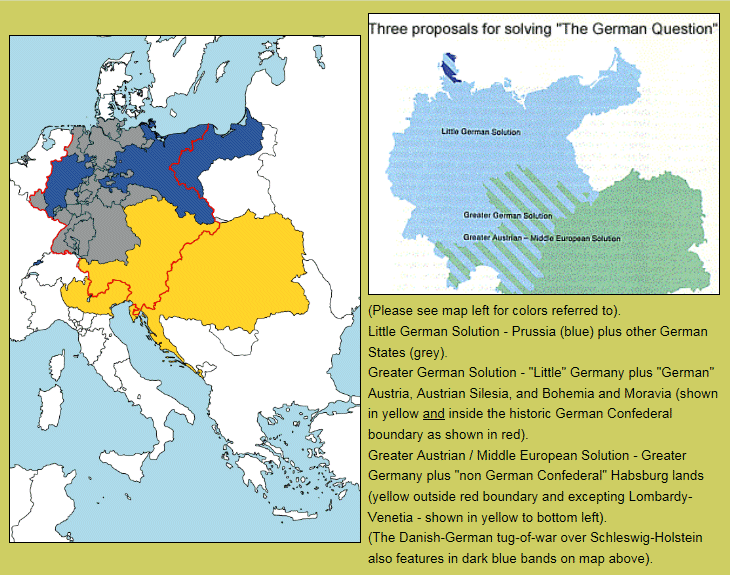
The text on the above image, (which may be rendered too small for convenience on some visitors' devices), reads:-
(Please see map left for colours referred to).
Little German Solution - Prussia (blue) plus other German States (grey).
Greater German Solution - "Little" Germany plus "German" Austria, Austrian Silesia, and Bohemia and Moravia (shown in yellow and inside the historic German Confederal boundary as shown in red).
Greater Austrian / Middle European Solution - Greater Germany plus "non German Confederal" Habsburg lands (yellow outside red boundary and excepting Lombardy-Venetia - shown in yellow to bottom left).
(The Danish-German tug-of-war over Schleswig-Holstein also features in dark blue bands on map above).
In November there was rioting in Berlin and King Frederick William ordered the dispersal of the Prussian Assembly. Prussian and other states' forces intervened in several German states to restore princely rule.
On 27th November the Austrian minister Schwarzenberg insisted that the Austrian Empire must be preserved intact. Given this declaration the deputies at Frankfurt had little option other than to throw their weight behind a Kleindeutsche, or Little German solution to the German National Question where none of the Habsburg lands would be represented in Frankfurt.
In such an arrangement a preponderance of influence would inevitably fall to the powerful Prussian state.
Austria was the traditionally the "leading power" in the German confederation, but of its thirty-six million inhabitants less than six million were German. Prussia was traditionally the "second power" in the German confederation, and of its sixteen million population some fourteen million were German.
Alongside the power that Prussia tended to exercise as a quite extensive collection of populous territories it had also won prominence through being the organisational centre of the Zollverein or Customs Union. The somewhat scattered existence of Prussian dynastic territories as gathered under one sceptre through dynastic inheritance or as a legacy of involvement in various political or dynastic turmoil had contributed to a desire to rationalise trading communications between Prussian territories.
Customs duties, "internal" to the Prussian lands, that had initially put in place to facilitate the raising of revenues were increasingly abolished after 1818 to facilitate trading activity. Neighbouring German states were invited to join in a single customs area, the implicit "carrot" of freer trade being made more appealing by the also evident "stick" of high tariffs being levied on those neighbouring German states who did not co-operate.
This approach had ultimately resulted in Bavaria, Würtemberg, Saxony, the Thuringian States, Baden, Nassau and the Free City of Frankfurt joining with the Prussian Customs Union by 1844. This widespread involvement of non-Prussian territories in the Zollverein tended to give Prussia some claims to leadership in other than economic matters also.
In early December Schwarzenberg arranged the abdication of the incapable Emperor Ferdinand, whose authority had been tarnished by his concessions, in favour of an eighteen-year-old nephew the Archduke Francis. At the time of his accession Francis, who could have succeeded as Francis II added his second given name, Joseph, to his name as Emperor in the hope of associating his rule, as Francis Joseph I, with that of an earlier Emperor, Joseph II, whose reforms were kindly remembered by many: and particularly so by the rural poor.
A manifesto was issued in Francis Joseph's name which declared that he:-
"firmly resolved to maintain untarnished the glory of the Crown, but ready to share
Our rights with the representatives of Our people, We trust that We shall succeed .... in uniting all the lands and races of the Monarchy
in one great organism."
Alongside his German mother tongue
Francis Joseph also spoke fluent Hungarian and had some facility in most of the dialects of his new subjects. The
Hungarians were unwilling to consent to Francis Joseph being
invested with the Crown of St. Stephen.
On 4th March, 1849, Francis Joseph, having gained confidence in the recovery of Habsburg power, decided to discount the "Kremsier Draft Constitution" which had just been finalised by the representatives meeting at Kremsier and issued, by decree, a new centralising Imperial Constitution, known to history as the ~ Forced March Constitution, ~ or as the ~ Imposed March Constitution, ~ devised by his own ministers, but largely based on the "Kremsier Draft Constitution," and moved to dissolve the Austrian Constituent Assembly on the 7th March, 1849.
An opening "First Article" of early version of the Kremsier Draft Constitution which had recognised "the people's sovereignty as the foundation of the power of the state", was highlighted as having been particularly unacceptable to Francis Joseph's ministers as they regarded it as being essential that the Emperor was accepted as being Emperor "by the Grace of God" with a "Divine Right" to rule.
Although this opening paragraph disappeared from the later versions of the Kremsier Draft Constitution, due to pressures from Francis Joseph's ministry, its very existence in the early versions had massively tarnished the Kremsier process in the eyes of the Emperor and his advisors.
The "Decreed Constitution" was held to be applicable across the Habsburg Empire. The Hungarian kingdom was held to have invalidated pre-existing constitutional arrangements by its revolt against the Habsburg system. The "Decreed Constitution" was even held to be applicable to the Lombard-Venetian kingdom that had hitherto been treated as something of an imperial colony.
Constitutional Developments
Meanwhile, work on the Kremsier Draft Constitution continued despite the increasing political isolation of the Reichstag, and the constitutional committee completed its work on 4 March, 1849. The Pillersdorf Constitution had applied only to Cisleithanien, i.e. the land on the western (Austrian) side of the River Leitha, excluding Hungary and Lombardy-Venetia, which were not represented in the Reichstag. For Cisleithanien, the Kremsier Draft Constitution certainly represented the first really promising attempt to solve the nationality problem, since it had come into existence with participation and consent of the deputies of all nationalities living in these crown lands. In fact, it was the nationality problem that finally caused the Habsburg monarchy to collapse. The constitution was an attempt to solve the problem of crown lands where several different languages were spoken by subdividing them into administrative districts. National courts of arbitration were also to be established, and the Bill of Rights embodied the principle of the equality of all nationalities and national languages.
The Reichstag provided for by the Kremsier Draft Constitution was to consist of two chambers: a "people's chamber" (Volkskammer) composed of 360 members to be elected on the basis of property qualifications (a step backwards compared to the Reichstag of 1848), and a "provincial chamber" (Länderkammer) with six representatives each to be elected by the provincial diets, as well as an additional representative from each district of provinces consisting of one or two districts. The approval of both chambers was required for a resolution to be adopted by the Reichstag. The emperor's veto was suspensive only, being overruled as soon as the Reichstag had adopted the resolution again after new elections. The fact that the concept of the people's sovereignty prevailed over the legitimacy of the ruler in the Kremsier Draft Constitution was only one of the reasons why the emperor refused to accept it. The constitution also provided for the responsibilities of ministers, the immunity of deputies, and, for the first time, for an imperial parliament (Reichsrat) that was to function as an advisory body to the ministry.
Before the draft constitution could be adopted by the plenary, the Reichstag was dissolved on 7 March, 1849. Emperor Francis Joseph refused to cooperate with the deputies who had supported the concept of the people's sovereignty. On 4 March, he had already enacted a constitution that was in many respects fairly similar to the Kremsier Draft Constitution, the fundamental difference being that it was not passed with the consent of parliament, but imposed by the emperor; it was therefore thus referred to as the "Forced March Constitution".
(Descriptive text taken from an official - Austrian Parliamentary - web site)
The Reichstag provided for by the Kremsier Draft Constitution was to consist of two chambers: a "people's chamber" (Volkskammer) composed of 360 members to be elected on the basis of property qualifications (a step backwards compared to the Reichstag of 1848), and a "provincial chamber" (Länderkammer) with six representatives each to be elected by the provincial diets, as well as an additional representative from each district of provinces consisting of one or two districts. The approval of both chambers was required for a resolution to be adopted by the Reichstag. The emperor's veto was suspensive only, being overruled as soon as the Reichstag had adopted the resolution again after new elections. The fact that the concept of the people's sovereignty prevailed over the legitimacy of the ruler in the Kremsier Draft Constitution was only one of the reasons why the emperor refused to accept it. The constitution also provided for the responsibilities of ministers, the immunity of deputies, and, for the first time, for an imperial parliament (Reichsrat) that was to function as an advisory body to the ministry.
Before the draft constitution could be adopted by the plenary, the Reichstag was dissolved on 7 March, 1849. Emperor Francis Joseph refused to cooperate with the deputies who had supported the concept of the people's sovereignty. On 4 March, he had already enacted a constitution that was in many respects fairly similar to the Kremsier Draft Constitution, the fundamental difference being that it was not passed with the consent of parliament, but imposed by the emperor; it was therefore thus referred to as the "Forced March Constitution".
(Descriptive text taken from an official - Austrian Parliamentary - web site)
On 9th March Schwarzenberg threw his support behind a possible resolution to the question of the extent of the new German State by suggesting that the entire Austrian Empire should join with the Germanic Confederation in "an Empire of Seventy Millions" - (This being the Greater Austrian / Middle European Solution to the "German Question").
Schwarzenberg further suggested that the political leadership of this "Empire" would alternate between Austria and Prussia.
Those present as representatives in the Frankfurt Parliament decided that they had another option to consider than the Empire of Seventy Millions being suggested by Schwarzenburg in the form of Kleindeutschesland or "little" Germany. After a period of debate the Frankfurt Assembly responded to the ongoing constitutional stalemate by approving, on 28 March with some two-fifths of the representatives abstaining, a Kleindeutsche outcome and offering the throne as hereditary "Emperor of the Germans" to the King of Prussia.
A thirty-two man delegation subsequently journeyed to Berlin to seek the consent of the King of Prussia. In the event King Frederick William, in polite and diplomatic terms told the delegation that he felt honoured but could accept the crown only with the consent "of the crowned heads, the princes, and the free cities of Germany." He nevertheless gave some consideration to the offer, over several weeks, before finally declining to become "Emperor of the Germans".
King Frederick William was less polite about these developments in a letter to a relative in England in which he related that he felt deeply insulted by being offered "from the gutter" a crown, "disgraced by the stink of revolution, baked of dirt and mud."
It appears that King Frederick William alongside his own romantic notions about kingship, (he had described Constitutions as "pieces of paper that stand between God, who appoints kings and rulers, and the people"), also thought of the House of Habsburg as being the naturally leading dynasty in the Germanies and as such was unwilling to attempt to challenge its leading role by accepting the Imperial title.
In practical terms the Habsburg dynasty would have found such an acceptance to be intolerable and would probably have sought to undo it. The Tsar of Russia could also be presumed to be be strongly opposed to the replacement of the "dynastic" German Confederation by a liberal, constitutional, national, "Germany".
On 3 April, 1849, King Frederick William of Prussia formally declined to become German Emperor by accepting a "diadem moulded out of the dirt and dregs of revolution, disloyalty and treason". He went on to further encourage the princes of Germany to restore the pre-existing and somewhat conservative German Confederation. Radicals in several German states launched insurrections in support of the constitution which had been agreed at Frankfurt but an alliance of German princes, significantly contributed to by Prussia, quelled these insurrections.
The "Imposed March Constitution", of early March, 1849 had greatly disappointed Magyar opinion as, it not only revoked the "liberal" Hungarian Constitution that had been conceded by the Habsburg Emperor in revolutionary days in the spring of 1848, but also declined to recognise Transylvania, Croatia, Slavonia and the Adriatic coast as belonging under the Hungarian crown.
On 14 April, 1849, the Hungarian Reichstag declared for the complete independence of Hungary from the sovereignty of the Austrian Empire.
DECLARATION RELATIVE TO
THE SEPARATION OF HUNGARY FROM AUSTRIA
WE, the legally constituted representatives of the Hungarian nation, assembled in Diet, do by these presents solemnly proclaim, in maintenance of the inalienable natural rights of Hungary,
with all its dependencies, to occupy the position of an independent European State -- that the house of Hapsburg-Lorraine, as perjured in the sight of God and man, has forfeited its right to the
Hungarian throne. At the same time we feel ourselves bound in duty to make known the motives and reasons which have impelled us to this decision, that the civilized world may learn we have
taken this step not out of overweening confidence in our own wisdom, or out of revolutionary excitement, but that it is an act of the last necessity, adopted to preserve from utter destruction
a nation persecuted to the limit of the most enduring patience. ...
At this time the Hungarians had considerable military resources to call upon in support of
the declaration of independence. These resources included a substantial Polish contingent of possibly
more than 20,000 volunteer soldiers and some
able Polish generals.The struggle to subdue Hungary proving difficult the Austrian authority reluctantly sought, in late April, the involvement of the Tsar and invited active Russian assistance in the name of "the holy struggle against anarchy."
The Tsar of all the Russias was in principle supportive of divine-right dynastic governance and had also, and importantly, become pressingly concerned lest the Hungarian developments be copied in "his own" Polish Kingdom. (Russian control in Poland was, in fact, then under a longstanding challenge from Polish nationalism which had featured a serious Polish revolt as recently as 1831). The Tsar now sent, (although estimates vary), well in excess of a hundred thousand of his soldiers to co-operate with Austrian forces in efforts to subdue Hungary.
By late June 1849, with Hungarian nationalism being hard pressed by Austrian, Russian, and local nationality opposition, a "Nationality Act" offering several significant concessions intended to promote reconciliation between the Magyar majority and the many significant minority ethnic groups in the Hungarian lands, was passed into law by the Hungarian Assembly at a time, late July 1849, when the would-be Hungarian parliament was obliged by the pressure of its many adversaries to hold it sessions away from Budapest in the provincial town of Szeged.
Law VIII of 1849, (the first such nationalities law in Europe), made some concessions guaranteeing "the free national development for all the nationalities living within the territory of Hungary". The nationalities could hope to see the use of their own languages in primary schools. Magyar would remain the language of the central governmental communication and legislation. Local political assemblies were made open to being addressed in any language, where any nationality was an absolute local majority at county level the minutes of their proceedings could be preserved in the local majority language as well as in Hungarian. Local National Guards were to be commanded through the medium of their local languages. Promotion within the public service was to be fully on the basis of ability and merit and there were guarantees that selection for public offices would be undertaken without regard to the mother tongue or the religion of the applicants.
Other concessions offering emancipation to the Jews and legal favour to peasants involved in land disputes with landlords were, in part, intended to generate new support for Hungarian independence.
This attempt to win support from the nationalities proved to be, however, at this time when overwhelming masses of Russian and Austrian troops were closing in on every side, (and when the Hungarian kingdom was still unhappily experiencing the grief stricken aftermath of an often furious conflict over language and communal rights), a case of too little and too late.
This law was the last measure enacted by this Hungarian Assembly as the Russian and Austrian interventions largely overwhelmed the movement towards the independence of the Hungarian Monarchy by mid-August 1849 by which time only a formidable fortress at Komorn in northern Hungary continued to hold out - until September 26.
There was also a joint Russian and Ottoman Turkish intervention into the Habsburg's "Transylvanian" lands. The Ottomans had suffered serious losses of territory and authority to re-assertive European would-be nationalities on their western borders e.g. the Greeks (independence), Romanians in the lower Danube (some autonomy) and Serbs (some autonomy).
The Ottomans thus had cause to see good strategic reasons to prefer that these Romanian lands be returned to Habsburg sovereignty as an "independent" or somewhat autonomous "Transylvanian" polity, (which could be presumed to be Romanian in outlook as a previously suppressed Romanian majority asserted itself democratically and constitutionally), could well become a beacon of aspiration for their own existing subjects of Romanian heritage.
In the wake of Frederick William's decision not to accept the proferred Imperial crown Prussian delegates were ordered to withdraw from the German National Assembly, other states also withdrew their representatives.
In the circumstances what was left of the credibility of the Assembly largely evaporated - the Frankfurt Assembly was discontinued in May with a rump of mainly left-leaning delegates ineffectively reconvening at Stuttgart.
During the early summer of 1849 such German states as Baden, Württemberg, the Bavarian Palatinate, the Prussian Rhineland and Saxony experienced turmoil that seemed to offer support to the Frankfurt Parliament but which also featured evident social revolutionary aspects. In early May Prussian forces intervened to suppress a serious radical rising in Dresden, the capital of the Kingdom of Saxony, without the encouragement or consent of the German National Assembly.
Following on from leftist rioting in the Prussian Rhineland Karl Marx' Rheinische Zeitung was ordered to cease publication.
Such social revolutionary turmoil was widely seen as a threat by many who were fairly content with the more modest reforms that was already deemed to have already been secured through the Frankfurt Assembly process.
Wider society increasing looked to the authorities to maintain order against such perceived extremism.
The foot soldiers involved, although often drawn from the same stratas of society that also produced radical insurrectionists, commonly saw themselves as acting in defence of the "March achievements" against dangerous radicalism. Prussia's leading role in these interventions in several historic states of the Germanies did not seem to bring with it unpopularity with the wider society of the German states affected or with the soldiers of other states who commonly aligned themselves with the Prussian drive against perceived extremism.
After the recovery of reaction in the Germanies the Constitutions of many German states were rendered less liberal or suspended altogether.
On 15th November 1848 Rossi, the Prime Minister of the States of the Church who seemed to be on the point of acting to repress reform, was attacked and fatally injured. Later that month Pope Pius left a turbulent Rome and relocated at Gaeta in the Kingdom of Naples.
A Provisional Committee was appointed by radical inclined interests who recognised it as having powers of governance in Rome. The formation of a Constituent Assembly to be elected by universal suffrage was set in train shortly thereafter. Many moderate electors declined to vote in part because Pope Pius had excommunicated in advance anyone who voted in these elections but also in resigned acceptance at the likely radical composition of the new assembly.
The elections of persons to the Constituent Assembly was held on 31 January, 1849; despite their being absent from Rome at the time of the elections the prominent revolutionary figures Giuseppe Mazzini and Giuseppe Garibaldi both appeared amongst the one hundred and fifty deputies elected. On 5th February the Constituent Assembly held its first session and Giuseppe Garibaldi, immediately after an inaugural speech had been delivered, stood up and demanded of the assembly:-
"Let us drop the formalities and proclaim the Republic!"
Four days later the Constituent Assembly issued a Declaration which repudiated the Temporal Power of the Church and
proclaimed a Roman Republic:-
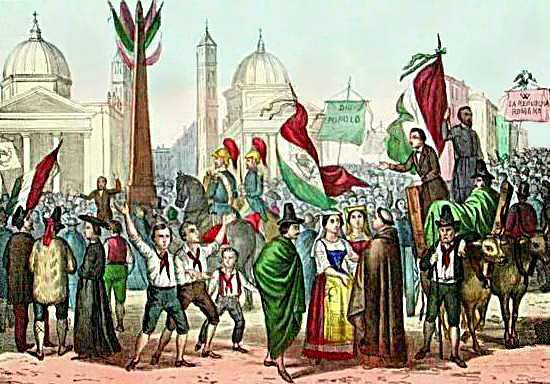
The Proclamation of a Roman Republic in the Piazza del Popolo in 1849
(as depicted by Stampatore Rosetti in 1861)
The firm intention of the new assembly, to move to replace the temporal authority of the Papacy with its own administrative power, can be gauged from these articles which were enthusiastically proclaimed -
Article 1. The temporal government of the papacy is now at an end, in fact and in law.
Article 2. The Roman pontiff will have every guarantee needed for the independent exercise of his spiritual power.
Article 3. The form of government at Rome shall be that of a pure democracy, and it will take the glorious name of the Roman Republic.
Article 4. The Roman Republic will enter into such relations with the rest of Italy as our common nationality demands.
On February 18th Pope Pius, believing this Declaration of a Roman Republic to be an intolerable
revolutionary overthrow of what was not only an historically valid polity but which was also, and more
importantly, the divinely ordained seat of the Papacy, called
upon traditionally catholic European powers to restore the States of
the Church to Papal Sovereignty.Article 2. The Roman pontiff will have every guarantee needed for the independent exercise of his spiritual power.
Article 3. The form of government at Rome shall be that of a pure democracy, and it will take the glorious name of the Roman Republic.
Article 4. The Roman Republic will enter into such relations with the rest of Italy as our common nationality demands.
In the wake of the establishment of a Roman Republic Garibaldi urged Mazzini to leave Florence and to present himself in Rome. When Mazzini arrived there in early March to participate in the deliberations of the Constituent Assembly its presiding figure, Galletti, actually invited Mazzini, as a revered champion of Italian Republicanism, to take a seat beside him.
The would-be Roman Republic was faced with many challenges and, before many weeks had passed, opted to vest virtually dictatorial powers in a Triumverate, nominated by a ballot of Assembly members, in order to facilitate prompt and decisive governmental action.
Mazzini now emerged as the leading figure in this governing Triumverate and presided over a situation where the Temporal Sovereignty of the Papacy over Roman territory was denied, the majority of the Church lands were set aside to help with the maintenance of poorer persons and clerics were denied their long established influence over education.
Both private property and private religious observance were respected however.
The Papal administration continued to encourage such powers as Spain, Austria, Naples and France to overthrow "that band of wretches, which is exercising there, with every kind of enormity, the most atrocious despotism."
The uneasy armistice made between Austria and Piedmont-Sardinia in 1848, after a severe reverse suffered by the Piedmontese-Sardinians at a battle of Custozza, lasted less than seven months, before Charles Albert denounced it on 12 March 1849.
In a subsequent battle contested near Novara, which lasted the whole day of 22 March 1849 and ended at dawn on 23 March, the Austrians won an important victory over the forces led by Piedmont-Sardinia prompting King Charles Albert to abdicate. He was succeeded by a son, Victor Emmanuel who, in a personal interview with the Austrian commander Radetzky agreed to the continuance of the Piedmontese-Sardinian Statuto constitutional arrangements as this continuance was seen, by the Austrians, to be likely to better reconcile potentially turbulent Piedmontese radicals, (Genoa was notable a radicalist city), to the post-conflict situation.
The Sicilian Parliament had pronounced Ferdinand, the Bourbon dynast who ruled from Naples, to be deposed and had offered the throne to the Duke of Genoa, a younger brother of Victor Emmanuel. King Ferdinand responded by despatching a naval fleet which proceeded, over five days, with a naval bombardment intended to humble his opponents. Negotiations were entered into but agreement proved elusive. In the event Sicily was invested with King Ferdinand's soldiers such that most resistance was overcome by early April, 1848.
Popular local intervention secured the restoration of the Grand Duke of Tuscany to his throne some days later - it now seemed that Rome would similarly be returned to Papal authority before many weeks had passed.
The government of Louis Napoleon in France preferred that Austrian arms should not themselves achieve the restoration of the Papal power in Rome as this could lead to the re-establishment of an Austrian hegemony in the peninsula that could well be harmful to the perceived interests of France. Louis Napoleon also hoped to gain favour with powerful Roman Catholic interests in France through a French intervention intended to win Rome back to the sovereignty of the papacy.
Some six thousand soldiers were duly sent from the French Republic with the minority republican element in the French assembly being assured of the good intentions of the assembly towards the Roman population and of a desire to avert possible Austrian domination.
On the 20th of April General Oudinot, commander of the French forces read to his troops preparing for embarkation on ships at Marseilles an order of the day, in which he said nothing of Pope or papal government, but of the French flag, which was to be planted on the Roman territory, in testimony of affection to its inhabitants, whom they could not think of leaving subject to a foreign power, or the domination of any party not approved by the majority.
This French army landed on the coast at Civita Vecchia quite near to Rome on 25 April 1849. As they marched towards Rome some days four later an inscription repeatedly came into view upon roadside walls which read:-
"Article 5 of the preamble of the French Constitution. The French Republic respects foreign
nationalities as it intends to make its own respected. It does not undertake any war of conquest. It will never use its own forces against the liberty of any people."
In Paris a radical politician named Ledru-Rollin proposed to impeach the ministers and the president for having violated the constitution in their interference at Rome, and
declared that he and his friends would appeal to arms. This attack consolidated the ministry then holding the reins of power in France. Great uproar was the result, first in the chamber
and then in the streets. General Bedeau in the former announced his determination in that case to defend the majority of the assembly and uphold its decision.
Thiers declared that the appeal to arms had rendered all discussion impossible, and pressed for a voting division, which was carried
by a majority for the ministry of 361 to 203.
Oudinot advised his troops that they had come as liberators to free Rome from a divisive party which had expelled the Pope, and which had rebuffed his own recent efforts at conciliation.
The French forces were subsequently directly responsible for the militarily contested overthrow of the Roman Republic in early July 1849 despite a stout resistance, over several weeks, led by several patriotic Italians including Mazzini and Garibaldi. This French intervention, was styled for French domestic consumption as being a necessary to overthrow unpopular "foreigners who had come from all parts of Italy."
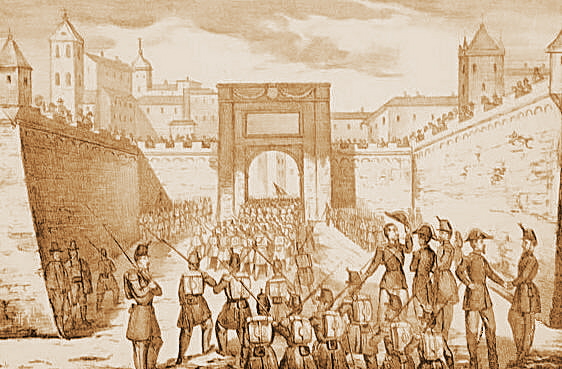
The entry of the French army into Rome (as depicted by Stampatore Rosetti in 1861).
Just prior to this capture of Rome Garibaldi, believing that its defence was no longer possible, appealed to its remaining defenders:-
"I have nothing to give you but hunger, sufferings, and battles; the bare earth for your bed, and the burning sun for your refreshment. Yet let him who does not yet disbelieve in
the fortune of Italy follow me."
and led a force of about 4000 men away from the city with the
intention of continuing to contend for his vision of the future for "Italia" by maintaining resistance against the French,
and against the Austrians, in the Roman provinces.
Garibaldi subsequently turned his thoughts to Venice, which still resisted, but after hearing that there was a dissatisfied situation in Tuscany wherein he could offer to participate on the side of potential political allies, he opted to proceed there instead.
Many of his followers dropped behind worn out by the hardships and privations they were experiencing and deserted. Garibaldi eventually returned to the Adriatic coast, and taking some fishing boats, attempted with some three hundred remaining supporters to get to Venice; but the flotilla was stopped by Austrian ships, and was dispersed.
The Papal authority, as restored to Rome on July 14, soon showed itself, in defiance of the wishes of France, as being interested in the re-imposition of a priestly absolutism. The civic guard was disarmed, the publication of all newspapers was forbidden, and all assemblages in the streets of more than five persons were prohibited.
Austrian forces continued to close in on the island city of Venice. On 12 August, 1849, Daniel Manin issued a defiant manifesto which read:-
Italian Soldiers!
The war of independence, to which you have consecrated your blood, has now entered a phase which for us is disastrous.
Perhaps the only refuge of Italian liberty are these lagoons, and Venice must at any cost guard the sacred fire.
Valorous ones! In the name of Italy, for which you have fought, and want to fight, I implore you not to lessen your efforts in the defence of this sacred sanctuary of our nationality. The moment is a solemn one: It concerns the political life of an entire people, whose destiny could depend on this final bulwark.
As many as you may be, that from beyond the Po, beyond the Mincio, beyond the Ticino, have come here for the final triumph of our common cause, just think that by saving Venice, you will also save the most precious rights of our native land. Your families will bless the sacrifices which you have chosen to undergo; an admiring Europe will reward your generous perseverance; and the day that Italy will be able to proclaim itself redeemed, it will raise, among the many monuments which are here, of the valour and glory of our fathers, another monument, on which it will be written: The Italian soldiers defending Venice saved the independence of Italy.
Perhaps the only refuge of Italian liberty are these lagoons, and Venice must at any cost guard the sacred fire.
Valorous ones! In the name of Italy, for which you have fought, and want to fight, I implore you not to lessen your efforts in the defence of this sacred sanctuary of our nationality. The moment is a solemn one: It concerns the political life of an entire people, whose destiny could depend on this final bulwark.
As many as you may be, that from beyond the Po, beyond the Mincio, beyond the Ticino, have come here for the final triumph of our common cause, just think that by saving Venice, you will also save the most precious rights of our native land. Your families will bless the sacrifices which you have chosen to undergo; an admiring Europe will reward your generous perseverance; and the day that Italy will be able to proclaim itself redeemed, it will raise, among the many monuments which are here, of the valour and glory of our fathers, another monument, on which it will be written: The Italian soldiers defending Venice saved the independence of Italy.
The Government, Venice, 12 August 1848.
MANIN
On August 25 an Austrian army overthrew the independence of Venice where resistance had been worn down by cholera and famine as well as by military siege and bombardment.
The diverse forms of "Italian" aspiration evident in 1848-1849 had now been largely repressed by military interventions.
The undeniably obvious impetus of Constitutionalism / Liberalism / Nationalism and Republicanism as released across the Italian peninsula during 1848-1849 was checked, rather than halted, as a constitutional, and somewhat liberal, Kingdom of Italy emerged in 1861 as an outcome of further turmoil wherein Italian republicans offered support to Victor Emmanuel, and the Piedmontese-Sardinian kingdom, in efforts towards "the making of Italy."
The undeniably obvious impetus of Constitutionalism / Liberalism / Nationalism and Republicanism as released across the Italian peninsula during 1848-1849 was checked, rather than halted, as a constitutional, and somewhat liberal, Kingdom of Italy emerged in 1861 as an outcome of further turmoil wherein Italian republicans offered support to Victor Emmanuel, and the Piedmontese-Sardinian kingdom, in efforts towards "the making of Italy."
Pope Pius IX did not personally return to Rome from Gaeta until 12 April, 1850, and when he did so he returned with an escort of French soldiers and with a head of hair that had become rapidly and prematurely grey due to the stresses of the time.
Pope Pius IX thereafter followed notably conservative policies in theology and in politics over the following two decades.
The revolutions of 1848-9 which had once seemed to sweep all before them, had revealed that there was a powerful groundswell of dissatisfaction with traditional dynastic governance but where it was set aside this usually led to the emergence of situations where deep rivalries centred on the forwarding of sectionally "popular" socialistic and nationalist aspirations by some interested groups that were deeply unwelcome to other interested groups.
Radical socialist reformers sought justice for the 'disinherited' classes, the peasants and the factory workers,
while more moderate political reformers were concerned with protecting and increasing the influence of
the middle classes, the bourgeoisie and the professional groups. The radicals in general favoured a
republican form of government while many moderates were prepared to accept constitutional monarchy
as a satisfactory substitute. (...) Many of the revolutionaries, especially in the Germanies and Italy,
wanted to transform their homeland into a strong and united country, but their aims contradicted the
nationalist aspirations of minority groups.
From the opening chapter to Revolution and Reaction 1848-1852 by Geoffrey Brunn
The resulting divisions and turmoil alienated many people from the course of
the revolutions
and facilitated the return of local dynastic authority as a broadly acceptable champion of order over chaos.From the opening chapter to Revolution and Reaction 1848-1852 by Geoffrey Brunn
In the German lands the liberal's so-called "springtime of peoples" (Völkerfrühling) of 1848 was now often openly condemned as the Year of Folly (das tolle Jahr) by those who favoured the return of traditional authority.
Just as in the 1789-1815 era Russia again eventually intervened in western, central and eastern European affairs.
A key difference being that in the earlier turmoil Russia had been blatantly provoked by Napoleon who had led a vast army to Russia in 1812 capturing Moscow but losing hundreds of thousands of soldiers during a retreat from the onset of a Russian Winter whilst being harassed be pursuing Tsarist forces. In 1849 Russia intervened largely for power political reasons in order to diminish the possibility of Polish national aspirations being heightened by an Hungarian breakaway from the Habsburg system but also in support of traditions of throne and altar governance.
The Ottoman Turks similarly could see good power political reasons to attempt to limit Romanian and Serbian National aspirations.
The events of 1848-1849 allowed prominent roles to be played by such persons as:-
- Kossuth
- A nationalist who attempted to establish constitutional liberty and an Hungarian nationality, (not necessarily in that order), in an extensive area of central and eastern Europe peopled by a number of historic ethnicities.
- Lamartine
- A liberal who sought to plot a reasonable course for his historically powerful, (and his historically somewhat radical?), country in difficult times.
- Palacký
- A liberal moved to adopt, and to champion, a re-awakening Czech nationality all too aware that that Czech nationality would be obliged to attempt to co-exist alongside powerful and potentially acquisitive Germanic and Russian neighbours.
- Radetzky
- A soldier's soldier of the old school - Kaisertrau - devoted to the Habsburg service.
But thought's the slave of life, and life time's fool;
And time, that takes survey of all the world,
Must have a stop.
William Shakespeare
History unfolded the way it did and we can but wonder, with the benefit of 20:20 hindsight:-And time, that takes survey of all the world,
Must have a stop.
William Shakespeare
How much "inevitability" there was to the eventual outcomes?
A serious economic-political crisis emerged largely as a result of dire crop failures due to bad weather and plant disease.It seems possible that, in such circumstances (historically somewhat radical?), France might overthrow a deeply unpopular ruling dynasty.
There was doubtless a powerful groundswell of support in many western European situations for constitutional democratic government rather than absolutist elitist / dynastic governance BUT liberal enthusiasts for change within various states might well be seen as being open to becoming alarmed if that change seemed to be turning in too radical a direction - and then opt to unmistakably return to supporting traditional authority.
Most tragically, but perhaps least anticipatable in the early months for 1848, was the degree to which many would-be nations all joined in, competitively, in seeking their own places in the sun now shining in a what seemed to be a "Springtime for Nationality". Many would-be nations also proved capable of joining in strenuous efforts to avoid being pushed into the shade by larger or more vigorous neighbouring would-be nations who were also themselves responding to the apparent opportunities evident in the "Springtime for Nationality" of 1848.
We have also seen how a recovering dynastic power (Habsburg Austria) could turn to an hitherto largely undisturbed dynastic power (Tsarist Russia) that had existed on the sidelines early in events but which had a significant capacity to intervene, with Habsburg consent, to influence longer term outcomes in line with its own wishes.
Even the Ottoman Empire, which had over previous centuries a serious and open rival to the Habsburgs (and the Romanov Tsars), but had more recently been in decline, was permitted (by Austria and also effectively by Russia), to affect longer term outcomes in line with objectives it independently held but which were consistent with a full recovery of Habsburg dynastic government.
It has been said that:-
"The past is a foreign country - they do things differently there"
Power political considerations aside the western, central and eastern European Emperors and Kings who were able to recover
governing authority in
1848-1849 did so because the could,
in their
own time, regard such things as democracy, popular sovereignty, national independence and socialism as
presumptuous, misguided and potentially highly divisive.
In 1848-1849 they could see how serious ethnic strife arose from competing claims of national groups who had previously lived side by side in peace under dynastic sovereignty. They could also see how poorer sections of the community, in revolutionary times, could demand that the state find ways of providing work, (or even making direct maintenance payments), - even though such work schemes as states managed to arrange tended to cause state coffers to haemorrhage funds as compensatory revenues were often not forthcoming due to insufficient amounts being available from purchasers of the goods or services produced under such work schemes.
They could also, sincerely or self-interestedly, insist on maintaining the principle of sovereignty by the Grace of God which could continue to underlie their claims of a "Divine Right" to exercise power hopefully offering Justice and Protection to their subjects in doing so.
At the close of the French Revolutionary and Napoleonic Period (1789-1815) a so-called "Congress System" had been instituted, (with Metternich as one of its main architects), under which the European powers undertook to co-operate to contain various forms of revolutionary activity.
The multi-power co-operation of 1849 could perhaps be seen as being undertaken within the spirit that had motivated the so-called "Congress System".
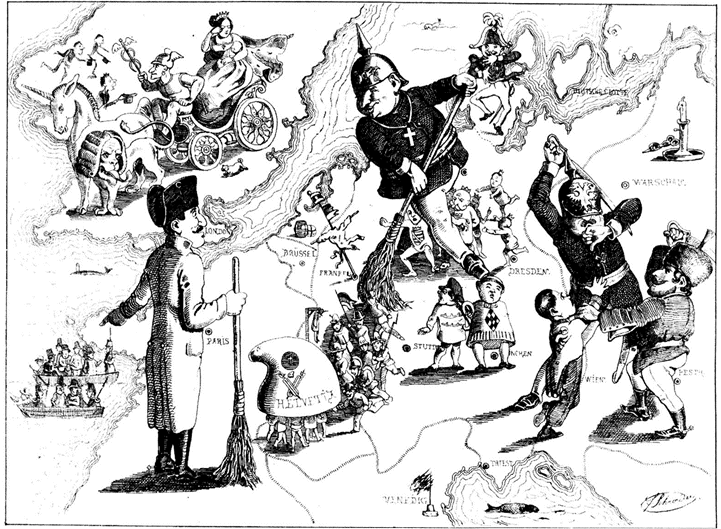
This caricature by Ferdinand Schröder on the defeat of the revolutions of 1848/49 in Europe, was published in the Düsseldorfer Monatshefte, August 1849 under the Title : Panorama of Europe in August 1849.
Populist support for democracy, popular sovereignty, national independence and socialism continued to build as the nineteenth century continued and spilled over into the twentieth.
It was to be as consequences of the extreme turmoil associated with the First World War (1914-1918) that the Austrian, German and Russian Empires were replaced by successor states.
Largely as part of a "battle for hearts and minds" where attempts were made to outflank such appeal as Communism sought to offer to peoples distressed by the many appaling aspects of that major war, the American President Wilson supported the autonomous development of the nationalities within the Habsburg territories leading to the establishment of a multiplicity of national states, (an the establishment of an independent Polish state with access to the sea), - although attempts were made to provide reassurances to the minorities inevitably inherited by these successor states.
Palacký's belief that the Slavic nationalities in large part depended on the Habsburg system for their security may have been fully vindicated after the Second World War as the successor states proved to be highly vulnerable to Soviet Russian encroachments.
Although the tide of revolution was turned back in 1849 the events of 1848-1849 left several direct legacies. There was profound reform of the lot of the peasantry over much of central Europe as approved by the Austrian Constituent Assembly on 7th September 1848 (and as retained by the restored Austrian administration).
This involved an elimination of the "robot" feudal services which the peasantry had previously to render to local magnates. This led to far-reaching transformations in society where agriculture became more commercial and less feudal and where many poorer peasants were unable to survive economically due to falling prices. A consequent increase in migration of (usually) Slav peasants to (often previously) Germanised urban areas sometimes tended to contribute further to the establishment of conditions for continued "local clashes of culture and language" between German and Slav over large tracts of the Austrian Empire.
There was also an imparting of impetus to nationalism in the Italian Peninsula and in "the Germanies." Enduring change towards more inclusive representation or constitutional government occurred in Belgium, Holland, Denmark and Switzerland.
Things had also changed in that Scwartzenberg's newly centralised Austrian Empire featured a lesser role than heretofore for persons of aristocratic background drawn from the non-Germanic nationalities. All too often in recent times such persons had identified with localised populist nationalisms at the expense of Imperial Order.
German was declared to be the official language across the empire and German-speaking middle class administrators were put in place as the administration became both more centralised and focused more locally on the nationalities - but with loyalty to the Emperor being expected of all. Such nationalities as had offered support to the continuance in being of the Habsburg system were treated in the same way as those nationalities which had sought constitutionalist, liberalist, or nationalist concessions.
It appeared to most observers that "the Croats got as a reward what the Magyars got as a punishment". Austrian German speaking administrators and officials descended as noticeably on Croatian and Romanian lands as they did on Hungarian ones.
According to an official - Austrian Parliamentary - web site -
The imposed constitution was short-lived and existed in theory for a mere three years only. When the power of the monarchy increased substantially, absolutism was formally re-instituted with the New Year's Eve Decree, (the "Silvester Patent"), of 31 December, 1851. For about a decade, no more was heard about parliaments.
The imposed constitution was short-lived and existed in theory for a mere three years only. When the power of the monarchy increased substantially, absolutism was formally re-instituted with the New Year's Eve Decree, (the "Silvester Patent"), of 31 December, 1851. For about a decade, no more was heard about parliaments.
Many consequences were to follow from Louis Napoleon's elevation to the French Presidency.
On October 31 1849, when he had been in Presidential office for almost a year, he sent a message to the Assembly which effectively undermined the constitution of the republic. This message sought to offer some justification as to why the former Brissot ministry had been dismissed.
"France, in the midst of confusion, seeks for the hand, the will of him whom it elected
on the
10th of December. The victory won on that day was the victory of a system, for the name of
Napoleon is itself a programme. It signifies order, authority, religion, national prosperity within;
national dignity without. It is this policy, inaugurated by my election, that I desire to carry to
triumph with the support of the Assembly and of the people."
On the 2nd of December 1851, an anniversary of a famous victory achieved at Austerlitz by Napoleon I, the
Republican constitution was more completely overthrown:-
"The present situation cannot continue. Each day that passes increases the country's danger. The Assembly,
supposed to be the staunchest supporter of order, has become a hot-bed of sedition. The patriotism of three hundred members
was not
enough to curb its fatal tendencies. Instead of legislation for the public good, it is forging weapons for civil war.
It is making a bid for the power that I wield directly by virtue of the people's will. It fosters every wicked passion.
It is jeopardising the stability of France. I have dissolved the National Assembly and I invite the whole people
to adjudicate between me and it."Proclamation of Louis Napoleon of the 2nd of December 1851
Under the previous constitutional arrangements Louis Napoleon would have had to leave office in
1852 with there also being a law against the re-election of previous holders of the presidential office. Louis
Napoleon, who had run up very heavy personal debts, knew that his political adversaries were waiting for
an opportunity to move against him.
The Proclamation of the 2nd of December was accompanied by the arrest of seventy-eight of such key political opponents. Each of these arrests being executed by a different police officer who was individually unaware of the other arrests taking place to facilitate Louis Napoleon's overall plans.
France was now presented by Louis Napoleon with a scenario where he would stay in power for a further ten years provided that his takeover of power was endorsed in a national plebiscite. In a short lived period of protest some 500 persons lost their lives, some 27,000 were arrested, with some 10,000 of those being deported.
In the subsequent National Plebiscite, held on 2nd December 1852, 7,400,000 persons voted for Louis Napoleon continuing to hold presidential powers with 600,000 voting against.
"France has realized that I broke the law only to do what was right. The votes of over
7,000,000 have just granted me absolution."
Louis Napoleon
The French Republic was subsequently replaced by a form of Empire under Louis Napoleon who was to hold power as
Emperor Napoleon III. Napoleon I being Napoleon Bonaparte, Napoleon II being a title imputed to the son of the
politically arranged marriage between Napoleon Bonaparte and an Austrian Archduchess. This son had been raised
under Metternich's overall supervision as an Austrian Duke but had died of tuberculosis at
the young age of twenty-one.
Louis Napoleon
As his life ebbed away this young Duke left the great ceremonial sword of honour he had inherited from his father not to any of his surviving Bonaparte uncles but to his cousin Louis Napoleon.
The implication of this title being that "Napoleon III" sought to identify his empire with that of Napoleon Bonaparte and intended to pursue somewhat Bonapartist policies at home and abroad. Where the truly dynastic rulers of Europe respected the principle of inherited dynastic sovereignty and were also usually supportive of church influence on society Napoleon III was less than fully accepting of the principle of inherited dynastic sovereignty and was somewhat prepared to take upon himself the promotion of states based on what was called the so-called "national principle."
His uncle, Napoleon Bonaparte after defeat and in exile, had claimed to have been a champion of this "principle" but an examination of Bonaparte's policies suggests that such support as he offered to it was perhaps guided by considerations related to his own imperial framework and the winning of allies amongst peoples whilst avoiding the alienation of mighty adversaries such as the Tsar of Russia.
Napoleon III saw the promotion of national statehood as being a necessary response to the existence of popular and national aspirations that might tend to overspill into turbulent challenges to the then existing system. He also hoped that France might gain diplomatically by being the sponsor of such states and thus winning friends and allies. The situation where Napoleon III, as the ruler of one of the most inherently powerful states of western Europe, was prepared to undermine historic traditions of dynastic rule in order to facilitate the emergence of states based moreso on ethnic nationhood was likely to bring with it a degree of constitutional and political turmoil in Europe.
Napoleon III was also to some degree dismissive of the validity of the "Vienna Settlement" of 1815, which had attempted to restore dynastic rule after the defeat of Napoleon Bonaparte.
(Something of the nature of the potential constitutional and political turmoil that might tend to result from Napoleon III's adoption of such policies can be seen in a scenario, early in 1863, where the Empress Eugenie the wife of Napoleon III, spent some three hours showing the Austrian ambassador a projected "more rational" map of Europe. This proposed map envisioned dramatic and unprecedented changes to the sovereignty of several states.
A Polish state was to be re-established - such re-establishment would be at the expense of Prussia, Austria and Russia but Russia was to make compensatory gains in Asia Minor and Prussia in a consolidated North Germany. The emergent Italian kingdom [that had been formed in 1861] would gain Venetia with the Austrian Empire being compensated with Silesia and some territories in the Balkans. Greece would gain Constantinople [Istanbul] whilst the Ottoman Empire's lands in Europe seemed to disappear into other existing european states. France herself was to gain the left bank of the Rhine at the expense of German princes who might hope for territorial compensation in South America.)
Given his political outlook it happened that Napoleon III decided to interact diplomatically, and militarily, with dynastic ministers such as Cavour (prime minister to the House of Savoy) and Bismarck (prime minister to the House of Hohenzollern), in ways which culminated in the establishment of states - a Kingdom of Italy in 1861 (Cavour) and a second German Empire in 1871 (Bismarck) - that were simultaneously both dynastic and moreso in accordance with the "national principle". Powerful sections of the local populations in both these situations tending to support the replacement of the former patchworks of traditional dynastic states of the Italian peninsula and the German lands as a necessary route towards the establishment of more powerful and more progressive states that were also associated with shared feelings of nationality.
Interestingly, in both of these cases Napoleon III got more than he bargained for in that the Italian Kingdom and the German Empire that eventually emerged were both more territorially extensive and more independent of French influence than he had anticipated.
Similarly Cavour and Bismarck also got more than they bargained for in that the establishment of the Italian Kingdom and the German Empire were in practice associated with a lessening of the full acceptance of the personal sovereignty of dynastic rulers and a greater acceptance of popular national sovereignty.
Whereas the sort of approach to federalism within the Habsburg Empire embraced by the delegates to the Kremsier Congress may have offered some hopes of an agreed and tolerant co-existence of many cultural communities within the Empire the aftermath of the wars of Italian Unification and of German Unification also featured a reorganisation of the Habsburg Empire into an Austro-Hungarian Dual Monarchy where the Austrian Germans to some degree, and the Hungarian Magyars to a more vigorous extent, attempted to culturally and linguistically prevail in their respective swathes of Austro-Hungary.
- The European Revolutions of 1848 begin
- A broad outline of the background to the onset of the turmoils and a consideration of some of the early events in
Paris, Berlin, Vienna, Budapest and Prague.
- The French Revolution of 1848
- A particular focus on France - as the influential Austrian minister Prince Metternich, who sought to encourage the re-establishment of "Order" in the wake of the French Revolutionary and Napoleonic turmoil of 1789-1815, said:-"When France sneezes Europe catches a cold".
- The "Italian" Revolution of 1848
- A "liberal" Papacy after 1846 helps allow the embers of an "Italian" national aspiration to rekindle across the Italian Peninsula.
- The Revolution of 1848 in the German Lands and central Europe
- "Germany" (prior to 1848 having been a confederation of thirty-nine individually sovereign Empires, Kingdoms, Electorates, Grand Duchies, Duchies, Principalities and Free Cities), had a movement for a single parliament in 1848 and many central European would-be "nations" attempted to promote a distinct existence for their "nationality".
- Widespread social chaos allows the re-assertion of Dynastic / Governmental Authority
- Some instances of social and political extremism allow previously pro-reform liberal elements to join conservative elements in supporting
the return of traditional authority. Such nationalities living within the Habsburg Empire as the Czechs, Croats, Slovaks, Serbs and Romanians,
find it more credible to look to the Emperor,
rather than to the democratised assemblies recently established in Vienna and in Budapest as a result of populist agitation, for the future protection
of their nationality.
The Austrian Emperor and many Kings and Dukes regain political powers. Louis Napoleon, (who later became the Emperor Napoleon III), elected as President in France offering social stability at home but ultimately follows policies productive of dramatic change in the wider European structure of states and their sovereignty.
Other Popular European History pages
at Age-of-the-Sage
The preparation of these pages was influenced to some degree by a particular "Philosophy
of History" as suggested by this quote from the famous Essay "History" by Ralph Waldo Emerson:-
There is one mind common to all individual men...
Of the works of this mind history is the record. Its genius is illustrated by the entire series of days. Man is explicable by nothing less than all his history. Without hurry, without rest, the human spirit goes forth from the beginning to embody every faculty, every thought, every emotion, which belongs to it in appropriate events. But the thought is always prior to the fact; all the facts of history pre-exist in the mind as laws. Each law in turn is made by circumstances predominant, and the limits of nature give power to but one at a time. A man is the whole encyclopaedia of facts. The creation of a thousand forests is in one acorn, and Egypt, Greece, Rome, Gaul, Britain, America, lie folded already in the first man. Epoch after epoch, camp, kingdom, empire, republic, democracy, are merely the application of his manifold spirit to the manifold world.
Of the works of this mind history is the record. Its genius is illustrated by the entire series of days. Man is explicable by nothing less than all his history. Without hurry, without rest, the human spirit goes forth from the beginning to embody every faculty, every thought, every emotion, which belongs to it in appropriate events. But the thought is always prior to the fact; all the facts of history pre-exist in the mind as laws. Each law in turn is made by circumstances predominant, and the limits of nature give power to but one at a time. A man is the whole encyclopaedia of facts. The creation of a thousand forests is in one acorn, and Egypt, Greece, Rome, Gaul, Britain, America, lie folded already in the first man. Epoch after epoch, camp, kingdom, empire, republic, democracy, are merely the application of his manifold spirit to the manifold world.