
The revolutionism of 1848 - in Germany
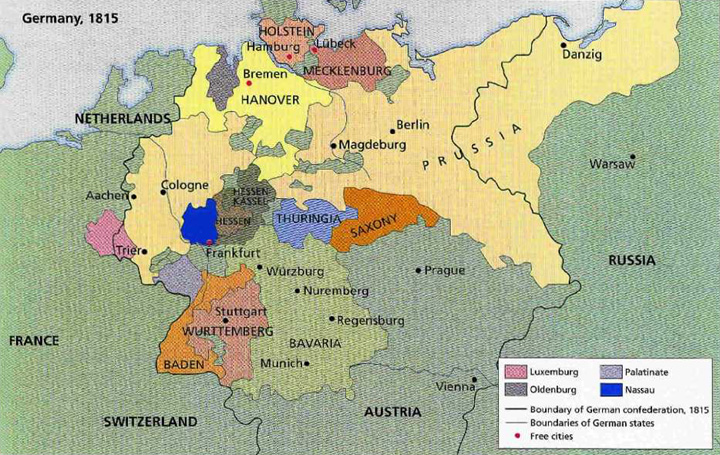
In 1848 the many, locally fully sovereign states - Empires, Kingdoms, Grand-Duchies, Duchies, Free Cities etc., - involved in the German Confederation were directly descended from the terms of settlement agreed at the Congress of Vienna held in 1815 at the close of the French Revolutionary and Napoleonic wars.
Early in 1848 several outbreaks of revolution had caused the French King Louis Philippe to abdicate (24th February) and Metternich, the chief minister of the Habsburg Monarchy and architect of a system of restored monarchical government in Europe since before the fall of Napoleon (1815), lost the confidence of the Habsburg ruling family and was driven into exile.
In these times in the diverse states of the Germanies several rulers were faced with respectful, yet determined, demands for change and, starting with Baden in early March, moved to award Constitutions or to allow liberalisation of existing Constitutions.
The powerful north german Kingdom of Prussia was then ruled by King Frederick William IV who was determindly anti-liberal in outlook. During the inaugurating ceremonies to an 'United Diet' of his territories that had been called in the spring of 1847 in order to gain formal consent for the raising of new taxes and the raising of a state loan in relation to unprecedented spending on railway construction, (and was the first such assembly of representatives from all the provinces of Prussia that any Prussian monarch had been prepared to recognise), King Frederick William IV had said that:-
"There is no power on earth that can succeed in making me transform the natural relationship between prince and people ... into a constitutional relationship, and I never will permit a written sheet of paper to come between our God in heaven and this land ... to rule us with its paragraphs and supplant the old, sacred loyalty." In the closing sections of this inaugural address Frederick William that the United Diet would only be reconvened if it showed itself to be "good and useful, and if this Diet offers me proof that I can do so without injuring the rights of the crown."
The turbulences of 1848, however, spread to Berlin and after an incident precipitated street fighting the King withdrew his soldiers rather than see even more fatalities amongst his "beloved Berliners" and was subsequently called upon by the populace on the 19th to stand bareheaded whilst the earthly remains of those Berliners killed in the street fighting were paraded with their wounds exposed. The King formalised a change in political direction through the appointment of a new ministry and proclamation issued on the morning of the 21st offered official recognition to the emergence of a single German nation. It was announced that the King had placed himself at the head of the movement for the redemption of Germany and would appear on horseback that day in his capital wearing the "venerable colours of the German Nation".
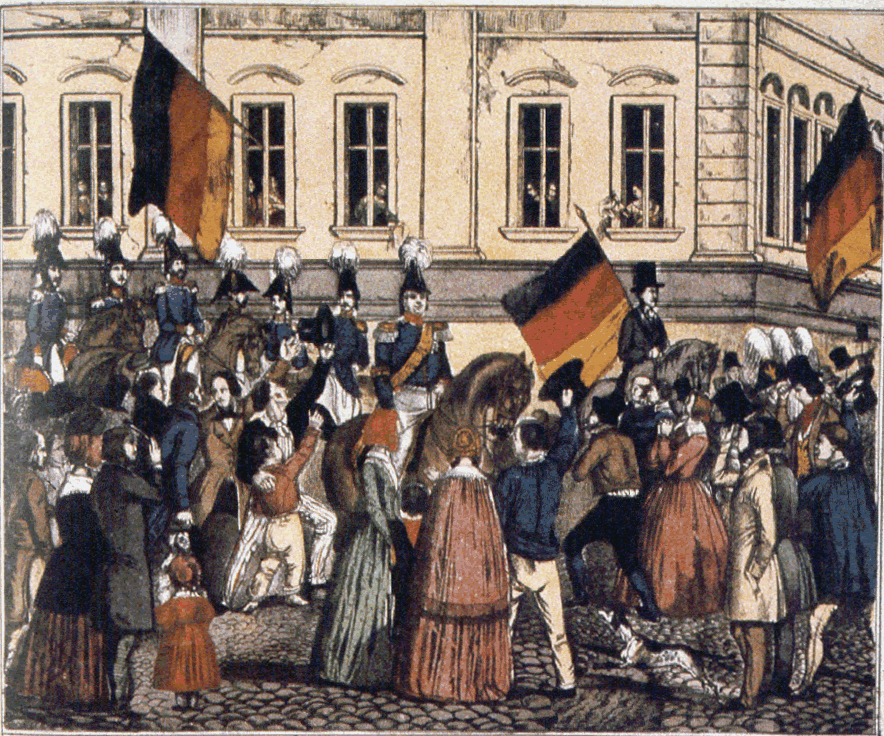
These black, red, and gold, colours were at one and the same time "revolutionary" in being associated with contemporary German Liberalism and Nationalism having been adopted by "patriotic" students in 1817 who were opposed to the official German Confederal repression of liberalism and "German-patriotism" in these early years following the overthrow of Napoleon but were also thought of as being associated with the earlier "Holy Roman Empire of the German Nation," (which had been discontinued as a result of a dramatic reorganisation of the Germanies that had been sponsored by Napoleon at thre height of his power). The students of 1817 may themselves have been influenced in their choice of emblem by the example of the Lützow Freikorps - a semi regular force that featured many students and intellectuals in its ranks - that had played a celebrated role in the then recent "Wars of Liberation" against Napoleon.
During his progress through the streets of Berlin the King was occasionally hailed as Emperor but he felt moved to assert that he intended to rob no German prince of his sovereignty.
A Declaration entitled "To My People and to the German Nation" was issued towards evening which sought to sum up up the position being adopted:-
"Germany is in ferment within, and exposed from without to danger from more than one side. Deliverance from this danger can come only from the most intimate union of the German princes and people under a single leadership... I have taken this leadership upon me for the hour of peril... I have today assumed the old German colours, and placed Myself and My people under the venerable banner of the German Empire. Prussia henceforth is merged into Germany."
The Federal Diet of the German Confederation declared on 8 March that a revision of the Constitution of the German Confederation was necessary. It adopted, and unfurled over its palace in the longstanding confederal capital, Frankfurt, a black-red-gold standard and invited German States to send delegates to discuss Constitutional reform.
In the unsettled and challenging times invitations had already been sent out several days earlier by a self-appointed group of liberals based in Heidelberg that led to the convening, in Frankfurt on the 31st March, of a preparatory parliament ( Vorparlament ). At the close of five days in session, the Vorparlament recognised a fifty member committee as being responsible for the organisation of processes of election to a German National Assembly which was projected to convene in Frankfurt in May.
It had also pronounced on Polish affairs thus :- "The German Union proclaims the partition of Poland to be a shameful injustice, and considers it the sacred duty of the German peoples to do their utmost to achieve her reconstitution".
At the time of this meeting of the Vorparlement, although aspirations for various forms of political change were being widely voiced, all the traditional states of the German Confederation were still actually in being!!!
There were a minority of more committed Republican delegates amongst those participating in the Vorparlament's deliberations who were disappointed not to secure the endorsement of radical-democratic constitutional aspirations or of the transformation of the Vorparlament itself into an on-going National Convention capable of assuming wide powers.
After the Vorparlament concluded its brief days of holding sessions some of these more committed Republicans opted to raise the standard of actual armed revolution in the traditionally liberal state of Baden, and were supported in this by German exiles returning from France and by Polish radical elements-in-exile. In the event they received less support than they had hoped from the local populace and were overwhelmed by troops sent to suppress their radical-democratic rising.
During these times the Federal Diet of the German Confederation was debating processes of election towards reaching decisions about the future of the Germanies but, in the event, it decided that it was not to be the authority behind such decisions and actually endorsed the elective programme of the Vorparlament thus consigning itself to a position of relative political obscurity.
It was agreed by the German governments that extensive diplomatic, military and commercial powers were to be entrusted to an Executive Body that was to concern itself with the welfare of the Confederation without direct involvement in the framing of the Constitution. This Executive Body of responsible ministers was to be headed up by a titular Regent of the Empire. This title was awarded to Archduke John of Austria - a proposal that it should go to the King of Prussia having failed to find support.
The Confederal Diet did however insist that it should continue to quietly exist pending the establishment of a new Constitution for Germany. In the meanwhile its functions were to be vested in the Regent of the Empire.
The Vorparlament presumed that representatives should be sought from across the Germanic Confederation and also from non-Confederal territories dear to German sentiment such as East and West Prussia and Schleswig. Whilst some presumptions relating to territorial representation were inevitable they could not but involve complications - the Austrian Empire was the most powerful of the states historically involved in the Germanic Confederation but also exercised sovereignty over immense territories that were outside the Confederation - the Danish king was the sovereign duke of Schleswig and of Holstein. Ancient treaties deemed Holstein ( a confederal territory ) to be inseparable from Schleswig. The Grand Duchy of Luxemburg was a longstanding member of the Confederation - it was also non-German speaking and its Grand Duke was simultaneously King of the Netherlands. The Czechs showed a preference that their homelands of Bohemia and Moravia, (where, despite being a major community, they had been living over recent centuries prior to 1848 in a condition of relative political disenfranchisment), should continue as provinces within the Austrian Empire rather than be brought in a close association with a German-national state.
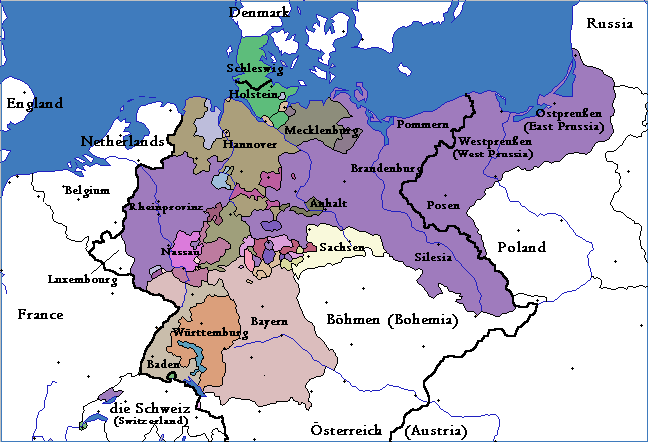
The darker line depicts the borders of the German Confederation.
In a letter of 11th April in response to an invitation by the Vorparlament to involve himself in proceedings as the representative for Bohemia, Moravia, and Silesia, the eminent historian Palacký, now showed himself to be something of a nationalistic Czech, declaring -
"The letter of 6th April in which you, greatly esteemed gentlemen, did me the honour of inviting me to Frankfurt in order to take part in the business concerned 'mainly with the speediest summoning of a German Parliament' has just been duly delivered to me by the post.
With joyful surprise I read in it the most valued testimony of the confidence which Germany's most distinguished men have not ceased to place in my views: for by summoning me to the assembly of 'friends of the German Fatherland', you yourselves acquit me of the charge which is as unjust as it has often been repeated, of ever having shown hostility towards the German people. With true gratitude I recognise in this the high humanity and love of justice of this excellent assembly, and I thus find myself all the more obliged to reply to it with open confidence, freely and without reservation.
Gentlemen, I cannot accede to your call, either myself or by despatching another 'reliable patriot'. Allow me to expound the reasons for this to you as briefly as possible.
The explicit purpose of your assembly is
to put a German people's association [Volksbund] in the place of the
existing federation of princes, to bring the German nation to real unity,
to strengthen German national feeling, and thus to raise Germany's power
both internal and external. However much I respect this endeavour and the
feeling on which it is based, and particularly because I respect it, I
cannot participate in it. I am not a German - at any rate I do not
consider myself as such - and surely you have not wished to invite me as a
mere yes-man without opinion or will...."
Palacký's letter was written against a social background where persons who could think of themselves as being Czech were encouraged by their peers to take an interest in, and to feel pride about, Czech history and literature. Such romanticisation of the Czech heritage was often expressed through German as Czech had yet to be firmly established as a literary language whilst most educated "Czechs" knew German. This revival had, in fact, been encouraged by Habsburg imperial administrators who hoped that such cultural enthusiasms, as sponsored by the Habsburg system, would be potentially likely to win adherence to that system and also help to divert energies away from 'unsettling' political activities.
Arrangements were made for the convening in Prague in June of a Congress of the Slavs living within the lands of the Habsburgs. Palacký emerged as a leading influence in this Slavic Congress and effectively championed an Austro-Slavism where the preservation of the Austrian Empire as a buffer against both German and Russian expansionism was seen as being essential to the best interests of the Slavs. Slavic national development within a federalized, and protective, Austrian empire being hoped for.
In the event whilst elections to the Frankfurt Assembly went ahead in those parts of Bohemia mainly peopled by Germans participation was not forthcoming in predominantly Czech areas.

The German National Assembly was attended by some six hundred delegates and held its first meetings in the Paulskirche (St. Paul's Church) in Frankfurt-am-Main on May 18th. These social backgrounds of these delegates was overwhelmingly that of middle or upper class university educated professors, teachers, magistrates, lawyers, mayors, civil servants or businessmen, writers and noblemen. There was only one delegate, a pole, of peasant origin and only fifteen could be regarded as lower middle-class (e.g. postmasters or customs officers).
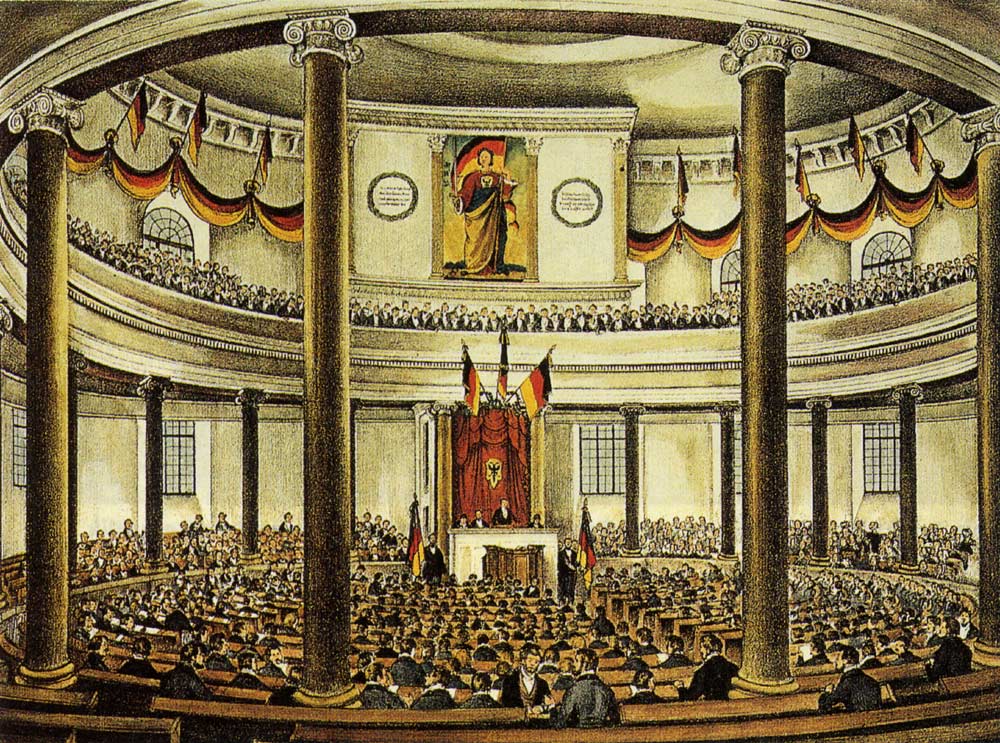
For this occasion the elegant elliptical interior of the Paulskirche was draped in German-national colours with an imposing large-scale painting representing "Germania" being prominently displayed.
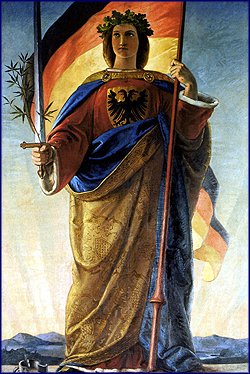
This work, by the artist Paul Veit, depicted Germania as a female figure standing against a background where beams of sunlight shone through the tricolour fabric of the national flag. Germania was wearing a crown of oak leaves and had a pair of shackles lying close to her feet that had evidently been recently discarded.
In this political and cultural atmosphere Heinrich von Gagern was elected as President, (or Speaker), of the National Assembly and in his opening speech suggested that :-
"We wish to create a constitution for Germany, for the whole empire. The call and the authority for this creation lie in the sovereignty of the nation...Germany will be one...Unity she wishes, unity she will have."
(Heinrich von Gagern later expressed the opinion that "The Revolution ... had been chiefly the result of the conviction of the German people that they did not occupy that prominent position among the people of Europe which was due to them" and that "that feeling had, of course, been strongest in the smallest states, and weakest in Austria.")
Given the nationalistic / liberalistic / constitutionalistic stirrings of the times the validity of the Confederal Diet was seen as being diminished by its not having been elected by "the sovereign people" and by its delegates having to consistently seek guidance from the (discredited?) authorities in the various (unsatisfactory?) pre-existing states about what line to take on issues under discussion.
The thirty-nine traditional states of the German Confederation continued to exist - with their own local forms of princely or state government as perhaps recently modified by the recent upsurge in political and constitutional aspiration.
At the end of May the Frankfurt Parliament declared that the Constitution it was in the process of framing would be sovereign over all the governments of the former German Confederation. The Frankfurt Parliament further maintained that any legislation passed by princely or state governments would only be valid if consistent with the new constitution which would be based 'on the will and election of the German people, to found the unity and political liberty of Germany'.
In April 1848 Prussia, Brunswick, and Hanover, sent forces into Holstein after being asked to intervene by those assembled at Frankfurt at a time of a succession crisis, following on from the repudiation of the incoming Danish Kings personal Sovereignty as Duke, by the Estates of Holstein and Schleswig. In early May Prussian forces penetrated into the Danish province of Jutland. The Tsar of all the Russia's had let it be known that he disapproved of these actions by Prussia.
On 25 April 1848 the Habsburg Austrian Emperor had authorised a "Pillersdorf" constitution, drawn up by Minister of the Interior Franz von Pillersdorf, applicable to Austria which envisaged its continuance as a centralised state under a politically powerful ruler. This was at odds with opinion then being popularly expressed by liberal elements.
The constitution was of the "early constitutional" type, ignoring the concept of people's sovereignty. The rights held by the "sacred and inviolable" emperor held included the right to initiate law, to sanction laws and summon the Constituent Imperial Diet (Reichstag), which was to be composed of two houses, the Senate and the Chamber of Deputies. The Senate was to be composed of princes of the Imperial House after the age of 24, life members appointed by the emperor, and 150 members elected by large landowners. The 383 members of the Chamber of Deputies were to be elected by the people. Both chambers were given equal rights, with bills requiring the consent of both chambers and the sanction of the emperor, who thus retained the absolute power of veto. The immunity of members of the chambers was incorporated, like the (legal) responsibilities of the ministers. The constitution also contained a Bill of Rights, which, however, left several delicate problems unresolved. This so-called Pillersdorf Constitution did not apply to Hungary, which had obtained its own constitution on 11 April.
(Descriptive text taken from an official - Austrian Parliamentary - web site)
This constitution was partially intended by the Habsburg Austrian government of April, 1848, to place obstacles against the pan-Germanism it saw as potentially being embraced by many liberal Germans in Austria.
The April 25 Constitution contained a vague phrase concerning the nationality issue:-
Although the Pillersdorf Constitution was initially celebrated as a victory, public and publicised opinion soon criticised its enforced nature - i.e. the fact that it had been decreed by the emperor - increasing sharply... ...there was fierce opposition to the Pillersdorf Constitution, especially from the liberal middle classes, workers and students. This was due to the fact that the constitution was unilaterally imposed by the emperor, the aristocratic upper house was to be on an equal footing with the democratic lower house, and finally the majority of workers would have been excluded from elections... ...Following the uprising of 15 May (the so-called "Storm-Petition"), an amendment to the constitution adopted the following day expressly entrusted the Reichstag with the elaboration of a new constitution. However, the Reichstag had yet to be elected, and now consisted of only one chamber, the Senate having been dispensed with.
(Descriptive text taken from official - Austrian Parliamentary - web pages)
Like the French in 1789, and indeed the Americans and British in earlier times of crisis and change, the Frankfurt Parliament now also, over several months from its first sittings in the late spring of 1848, gave a very great deal of its attention to questions of basic constitutional law in relation to citizenship endeavouring to frame a Grundrecht or "Declaration of the Fundamental Rights of the German People."
As the would-be German Authority the German National Assembly inherited a longstanding dispute with the Danish crown concerning sovereignty over the Duchies Schleswig and Holstein. Kings of Denmark had for some time been simultaneously sovereign Dukes of Schleswig and of Holstein alongside their Danish sovereignty. Holstein was traditionally a member of the German Confederation, ancient treaties held Holstein to be inseparable from Schleswig in controlling sovereignty.
Holstein was peopled mainly by ethnic Germans, as was southern Schleswig. These ethnic Germans were excited by and attracted to the developments in Frankfurt. The Danish authorities meanwhile wished to incorporate the Duchies, and Schleswig in particular, under a common constitution with Denmark.
Ethnic Germans in Holstein and Schleswig set up a provisional government in open defiance of the Danish authorities and in favour of adherence to the emergent German state. Prussian German forces intervened in what was now an active dispute. Prussian forces entered Holstein and Schleswig and many casualties ensued. Prussian armies continued their advance into the Danish province of Jutland.
Many patriotic Germans volunteered for service against the Danish interest. The German National Assembly voted for the availability of substantial naval funding.
Liberals in Western Europe had long deplored the condition of Poland being maintained principally under the repressive sovereignty of the Tsar but also, in the case of the Grand Duchy of Posen, under the rather more liberal sovereignty of the Prussian King.
Those assembled at Frankfurt had, in the heady days of early April, declared support for the restitution of a Polish state as being "an Holy Duty of the German Nation." A political amnesty of March 20 following on from Frederick William's capitulation to populist feeling in Berlin included provisions which brought about the release of Polish revolutionists from imprisonment at Moabit. A triumphant procession composed of carriages pulled by enthusiastic Berliners conveyed the Polish revolutionist Mieroslawski and his followers from the prison to the palace. During the journey Mieroslawski proclaimed that Poles and Germans were brothers and waved a black, red, and gold banner in support of the changed situation in Prussia.
In April there some unrest in which the Poles of Posen, who tended to be supportive of concessions favourable to the restoration of Polish nationality, were in opposition to Germans domiciled there. The Tsar of Russia was known to be completely opposed to any reorganisation of "his" Kingdom of Poland. By July many representatives of the German minority in Posen, (a minority totalling some 700,000 persons), were seeking its incorporation into the German confederation. In the Frankfurt Parliament Wilhelm Jordan, (a Prussian delegate who had an established reputation as a liberal!), went so far as to tell the assembly that:-
"It is high time that we awaken from the romantic self-renunciation which makes us admire all sorts of other nationalities whilst we ourselves languished in shameful bondage, trampled on by all the world; it is high time that we awaken to a healthy national egoism which, to put it frankly, places the welfare and honour of the fatherland above everything else..."
In these times the Frankfurt Parliament voted by 342 votes to 31 ( with 75 abstentions ) to support a partition of the Grand Duchy of Posen. The motion voted on countenanced the full participation of those areas of Posen peopled by Germans in the workings of the Frankfurt Assembly. This inclusion of representatives was supported despite Posen being outside the historic frontiers of the Germanic Confederation. Representatives were also recognised from Schleswig, another non-Confederal territory.
On 26th April Frederick William IV authorised the incorporation of the German districts of the Grand Duchy of Posen, (some two-thirds of the land area of the Grand Duchy), into Prussia.
The Frankfurt Parliament also resolved that those who had been returned from (mainly Germanic parts of) Bohemia should be regarded as fully representing Bohemia. Some European Powers began to be increasingly alarmed by such potential inclusions of widespread areas peopled by Germans in a future Germanic polity.
The dispute with Denmark was brought to a close, partly due to the influence of international protest and mediation, in a Malmo Armistice of July 9 where Prussian and Danish soldiers were to be withdrawn and where Holstein and Schleswig were to be autonomous under the Danish Crown.
This Armistice was agreed to by Prussia, under Russian and British persuasion and with Prussian commerce being seriously disrupted by Danish naval activity. Prussia did not enter into consultation with the German National Assembly.
The provisions of the Malmo Armistice were unwelcome to German National sentiment and although the German National Assembly narrowly endorsed the Malmo Armistice after turbulent and agonised debate it had to call on Hessian, Austrian and Prussian forces to defend it against the street fighting of those of outraged national sentiment.
Two prominent conservative delegates to the parliament and a number of protesting citizens lost their lives in these disturbances.
The German Lands
and central Europe
It is practically necessary to consider the effects European Revolutions of 1848 in relation to Germany in association with the
developments in central Europe as in 1848 what was then known as "The German Confederation" or as "The Germanies" was inextricably linked to
central Europe due to the Habsburg Emperor of Austria, the most powerful ruler involved in the German Confederation, also
also holding sovereignty over immense tracts of territory - and diverse peoples - in central and eastern Europe.
The following maps may give an enhanced idea of the extensive territories and widespread peoples of Europe that may be held to have been "linked up" in the developments of 1848 due to initial shared dynastic sovereignties that had implications when populist ideologies attempted to forge "New Futures" moreso under the principles of popular / national sovereignty.
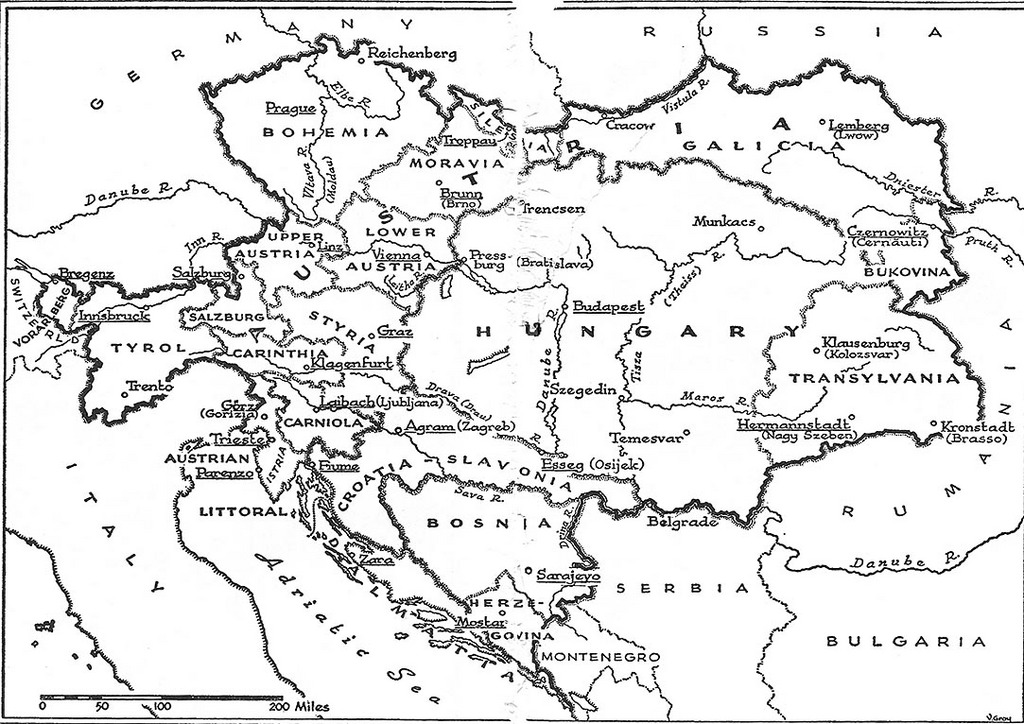
Territories under the of the House of Habsburg
(N.B. Lombardy and Venetia in the north of the Italian peninsula were also under Habsburg sovereignty.)
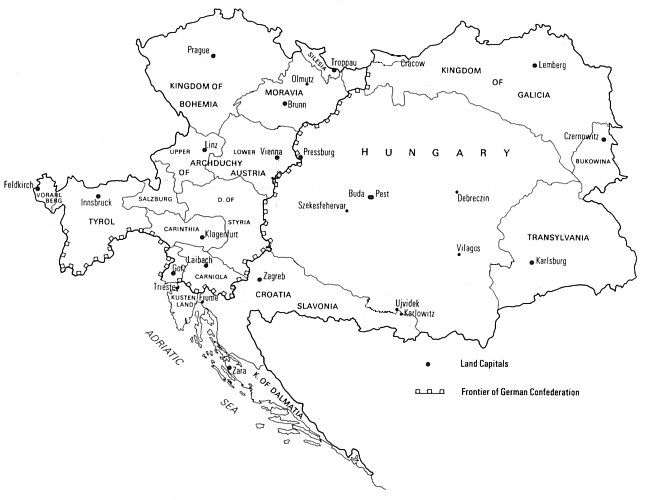
This outline map of the Habsburg Empire's truly immense territories shows how they lay
both within and (to the east) outside the

Peoples of the Habsburg Empire
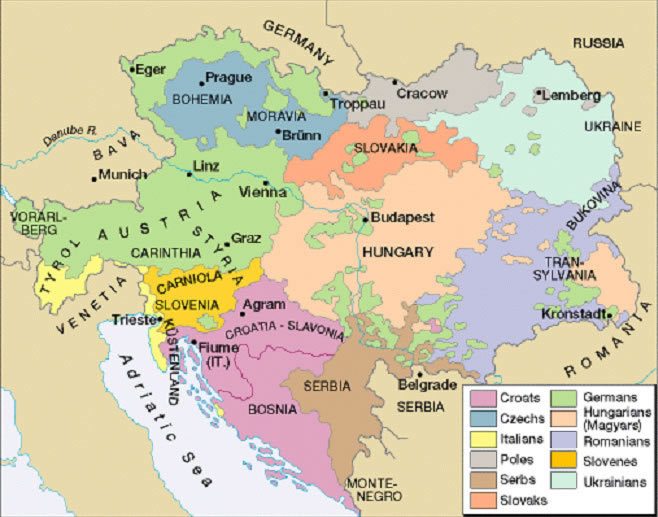
(N.B. Lombardy and Venetia in the north of the Italian peninsula were also under Habsburg sovereignty.)
The Magyars tended to see themselves as the natural "people of state" and the Magyar tongue as the natural "language of state" in their hoped for restored and constitutional kingdom of Hungary. As of early 1848 it transpired that Transylvanian and Romanian lands were politically associated by the Habsburg Emperor with his Hungarian kingdom which already had an historically arising political association with Croatia-Slavonia.
Although Kossuth, in sponsoring Hungarian constitutional autonomy in March 1848, had pronounced that "Our task is to found a happier future on the brotherhood of all the Austrian races" it happened that the Magyar dominated Hungarian Diet sought to effectively impose the Magyar tongue, as the language of state, on the several Slav nationalities that had been living under the political control of the Hungarian Diet. This being done at a time when the admittedly traditionally dominant Magyars comprised somewhat less than forty per cent of the population of the Kingdom of Hungary.
Latin had traditionally been the political language of the Hungarian Kingdom - this was broadly acceptable in cultural and historic terms to most of the ethnic groups domiciled in that kingdom as, by learning to speak Latin, the non-Magyar peoples living under the sovereignty of the Kings of Hungary did not unduly compromise their inherited local ethnicity or their preferred "wider European" cultural perspectives.
Magyar, on the other hand, had been brought west in association with a conquering Magyar mass migration several centuries previously and was regarded as being a difficult language to learn.
Kossuth, and Magyar nationalism, also tended to see Transylvania and Croatia, although they were not actually within the historic Kingdom of Hungary, as being self-evidently subject to the governmental power to be exercised by the Hungarian Diet. In the case of Croatia the long history of association with Hungary was based on the person of the monarch rather than any other binding political or cultural arrangements.
In 1843 the Hungarian dominated Pressburg assembly had voted to make Magyar the official language of Hungary and Slavonia, and nominated Magyar as the future official language of Hungarian-Croatian relations. Such relations had hitherto been conducted through culturally and politically "neutral" Latin.
Magyar was also nominated as the official language of public instruction, though this innovation was to be dealt with by a special law. Eventually provisions were put in place allowing a stay of six years before this innovation was to be enforced in three Slovak counties within Hungary and where Magyar was to be a compulsory subject, but not the language of instruction, in Croatia.
The Croats regarded these new provisions as infringements on their traditional autonomy and saturated the Imperial authority at Vienna with petitions for political separation, within the Austrian Empire, from Hungary. As part of this scenario Croat officials returned to Budapest many documents that had been sent them written in Magyar.
In 1847 the linguistic chauvinism of the Magyars had run high at the Diet of Pressburg and Croat national enthusiasm ran no less high at the chief Croatian city - Agram (today's Zagreb). The pent-up feelings of the long linguistic struggle found expression when the Croatian Diet assembled on October 20, 1847; and three days later it resolved by acclamation that the Croatian language should be introduced in every office of the state and in every school.
An evident breach naturally ensued between the Croat delegates and the linguistically intolerant Magyar majority at Pressburg.
Fresh linguistic claims expressed by the Magyars were passionately opposed by the Croats as an outrage upon Croatian nationality, "I know no Croatian nationality," retorted Louis Kossuth.
Following on from the turbulence in Vienna of mid-March, 1848, political representatives drawn from across the historic Triune Kingdom of Croatia, Slavonia, and Dalmatia spontaneously convened on 25th March in Agram, the historic capital of Croatia, and issued a declaration setting out an agreed future course for the lands and peoples the saw themselves as representing:-
Some thirty "demands on the king's sense of justice" included:-
The first such demand was for the appointment of a Baron Jellachic as principal magistrate of the three united kingdoms as a man who commanded the confidence of the whole nation.
Subsequent demands displayed this Agram assembly's hopes for the full recognition of the Triune Kingdom, with its own ministers, and with the free use of the national language.
A demand was expressed for the formation of a National Guard which a later demand saw as "swearing fidelity to the common Constitution, their King, and the freedom of their nation, and of all other free nations composing the Austrian monarchy, according to the principles of humanity."
All public offices, without exception, temporal as well as spiritual, were to be held only by persons native to the Triune Kingdom.
 On April 8th a Serb deputation from the Banat in the south of the
Hungarian monarchy which was largely but very far from being exclusively peopled by Serbs, (local Serbs may have even been an overall
minority),
was admitted to the floor of the Diet of Pressburg, several
members of this deputation
were actually wearing Hungarian cockades, (see picture left), and the leader of this deputation, Alexander Kostic, declared
that his compatriots were ready to risk their blood against the Habsburgs in the interest of the independence of the
Hungarian kingdom.
On April 8th a Serb deputation from the Banat in the south of the
Hungarian monarchy which was largely but very far from being exclusively peopled by Serbs, (local Serbs may have even been an overall
minority),
was admitted to the floor of the Diet of Pressburg, several
members of this deputation
were actually wearing Hungarian cockades, (see picture left), and the leader of this deputation, Alexander Kostic, declared
that his compatriots were ready to risk their blood against the Habsburgs in the interest of the independence of the
Hungarian kingdom.
In their subsequent private audience with Kossuth, the Serb deputation insisted that the Serb nation regarded the recognition of its language as essential. "What do you understand by ' nation ' ?" inquired Kossuth. "A race which possesses its own language, customs and culture," was the Serb reply, "and enough self-consciousness to preserve them." "A nation must also have its own government," objected Kossuth. "We do not go so far," Kostic explained ; "one nation can live under several different governments, and again several nations can form a single state." To this the minister replied that the government would not concern itself with the language of the home and would not even object to minor offices being held by non-Magyars, but that the Magyar interest demanded that no second race should be recognized as a nation and that only the Magyar language could bind the different nationalities together.
Istvan Deak, in his work The Lawful Revolution, which considers these these unsettled times has Kossuth telling the Serb delegation that:-
On May 13, 1848, an autonomous Serbian Vojvodina, (a sort of Duchy and located in the south of the kingdom of Hungary), was self-proclaimed by local Serbian interests supported by the Serbian Orthodox church. The Serbian Congress which issued this proclamation declared undying loyalty to the Emperor but the government of that Emperor's Hungarian kingdom depicted this proclamation of autonomy as being treasonous.
Magyar liberal nationalism seemed to offer a broad range of human and personal liberties, but nevertheless demonstrated an assimilationist state-nationalism that would deny many existential freedoms to any nation under the Hungarian Monarchy but the Hungarian.
The fulfilment of Kossuth's aspirations would have involved national a marked degree of suppression for all the other races domiciled in the Hungarian kingdom; and it was directly due to his intolerance that the Magyars found themselves before the end of the summer ringed round by hostile nationalities in arms.
The Hungarian kingdom's Slovaks and Rumanians came to emulate the national claims of the Croats and the Serbians and joined with them, with the tacit support of Vienna, against the centralising and Magyarising aspirations of the Hungarian interest led by Kossuth.
Istvan Deak, in his work The Lawful Revolution, gives consideration to the overall dilemma of the day:-
The year was 1848 and perhaps Europe as a whole at that time had yet to experience widespread instances of historic communities making pressing claims for linguistic and cultural autonomy.
One Croat representative to the Diet, Ljudevit Gaj, was perhaps the leading figure in an Illyrian movement which sought to join together Croatia, Slavonia, and Dalmatia and also several of the south-west provinces of Austria in a movement favourable to Slavic Revivalism. Like many romantic nationalists in these times, and later, across Europe and Scandinavia he was not native to the (in this case "Illyrian") nationality that was being championed. Gaj was the son of a German father and a Slovak mother and was born just north of Agram, in 1814, and developed an interest in Croatian history as he grew up. Whilst he was later being educated in German speaking universities he became influenced by a romanticisation of Pan-Slav cultural nationhood that held all Slavs to be brothers in the wider sense, but accepted the division of them into four main groups, one of which was the Southern Slav, or 'Illyrian', comprising the Croats, Slovenes, Serbs and Bulgars.
The lands Gaj sought to identify with, "Illyria", or "Croatia with Dalmatia and Slovenia and possibly also Bulgaria and Serbia", had long been under the sway of external powers and foreign cultural influences to the extent that little remained of what was thought of as Croat identity. Gaj, through his involvement with his Croat language Illyrian News journal had gained a certain celebrity particularly in those parts where people could think of themselves as being "Croats" as a would-be champion of an awakening of a cultural patriotism that hoped to see a recovery of a "Croat-Illyrian" language, and a renaissance of "Croat-Illyrian" culture.
In his efforts to recover "Croatian" as a South Slavic literary language, Gaj had personally devised a Latin character based script through which to better express "Illyrian" literature, aspirations and nationalist sentiments.
The Magyar authorities, meanwhile, were alarmed by the upsurge of "Illyrianism" and had even tried to ban public utterance of the word "Illyria."
Baron Jellachic, formerly a colonel of a Croatian regiment in the Habsburg service and more recently (March 1848) endorsed by the local interests as the principal magistrate, officially recognised as Governor of Croatia by the Habsburg Emperor (March 1848), was a close friend of Ljudevit Gaj! Soon after his appointment he expelled Magyar officials from Croatia in the aftermath of Magyar insistence in state-linguistic matters, in May forbade correspondence with the Hungarian government, and in June moved to restore the Croatian Diet at Agram. Under Hungarian diplomatic lobbying most of these measures by Jellachic were successively officially condemned by the Emperor even to the point of suspending Jellachic from office in early June. Local interests in Agram refused to accept Jellachic's dismissal and even invested him with many administrative and governmental powers. After an interview with an emissary from Vienna Jellachic recognised that a powerful faction in the Viennese court was sympathetic to the Croats defiance of the Magyars - all be it principally because this would contribute to a recovery of Habsburg power. Jellachic, although dismissed from office had continued to give fulsome assurances of loyalty to the Habsburg state system and had published an address to the numerous Croat soldiers based under Radetzky's overall command in Lombardy to continue in the Habsburg service and "not to be diverted from their duty to the Emperor in the field by any report of danger to their rights and to the nationality nearer home." Such statements had won him the support of many important persons in the higher reaches of the Austrian military and court.
During these times the Habsburg authorities began to place more reliance on their Slavic peoples than on the Magyars as being reliable allies in the restoration of the Habsburg System. Against Hungarian wishes Jellachic was accepted as being able to continue to exercise authority in Croatia.
The Habsburg authority let it be known that there was to be a recognition of "the equal rights of all nationalities" living within the Austrian state.
Details of subsequent developments are to be found on our Widespread social chaos allows the re-assertion of Dynastic / Governmental Authority page.
- The European Revolutions of 1848 begin
- A broad outline of the background to the onset of the turmoils and a consideration of some of the early events in
Paris, Berlin, Vienna, Budapest and Prague.
- The French Revolution of 1848
- A particular focus on France - as the influential Austrian minister Prince Metternich, who sought to encourage the re-establishment of "Order" in the wake of the French Revolutionary and Napoleonic turmoil of 1789-1815, said:-"When France sneezes Europe catches a cold".
- The "Italian" Revolution of 1848
- A "liberal" Papacy after 1846 helps allow the embers of an "Italian" national aspiration to rekindle across the Italian Peninsula.
- The Revolution of 1848 in the German Lands and central Europe
- "Germany" (prior to 1848 having been a confederation of thirty-nine individually sovereign Empires, Kingdoms, Electorates, Grand Duchies, Duchies, Principalities and Free Cities), had a movement for a single parliament in 1848 and many central European would-be "nations" attempted to promote a distinct existence for their "nationality".
- Widespread social chaos allows the re-assertion of Dynastic / Governmental Authority
- Some instances of social and political extremism allow previously pro-reform liberal elements to join conservative elements in supporting
the return of traditional authority. Such nationalities living within the Habsburg Empire as the Czechs, Croats, Slovaks, Serbs and Romanians,
find it more credible to look to the Emperor,
rather than to the democratised assemblies recently established in Vienna and in Budapest as a result of populist agitation, for the future protection
of their nationality.
The Austrian Emperor and many Kings and Dukes regain political powers. Louis Napoleon, (who later became the Emperor Napoleon III), elected as President in France offering social stability at home but ultimately follows policies productive of dramatic change in the wider European structure of states and their sovereignty.
Other Popular European History pages
at Age-of-the-Sage
The preparation of these pages was influenced to some degree by a particular "Philosophy
of History" as suggested by this quote from the famous Essay "History" by Ralph Waldo Emerson:-
Of the works of this mind history is the record. Its genius is illustrated by the entire series of days. Man is explicable by nothing less than all his history. Without hurry, without rest, the human spirit goes forth from the beginning to embody every faculty, every thought, every emotion, which belongs to it in appropriate events. But the thought is always prior to the fact; all the facts of history pre-exist in the mind as laws. Each law in turn is made by circumstances predominant, and the limits of nature give power to but one at a time. A man is the whole encyclopaedia of facts. The creation of a thousand forests is in one acorn, and Egypt, Greece, Rome, Gaul, Britain, America, lie folded already in the first man. Epoch after epoch, camp, kingdom, empire, republic, democracy, are merely the application of his manifold spirit to the manifold world.