
The "new-born Human Mind" as a Blank Slate?
How far are human behaviors, ideas, and feelings, INNATE and how far are they all LEARNED?
These issues are at the center of the ongoing nature versus nurture debate or controversy.
In the 17th century the French philosopher René Descartes set out views which held that we all, as individual Human Beings, possess certain in-born ideas that underpin our approach to the world.
The British philosophers Thomas Hobbes and John Locke, on the other hand, emphasised the role of experience as fully contributing to behavioral development.
Does human psychology start as a blank slate?
Locke set out the case that the human mind at birth is a complete, but receptive, blank slate ( scraped tablet or tabula rasa ) upon which experience imprints knowledge.Let us then suppose the mind to be, as we say, white paper void of all characters, without any ideas. How comes it to be furnished? Whence comes it by that vast store which the busy and boundless fancy of man has painted on it with an almost endless variety? Whence has it all the materials of reason and knowledge? To this I answer, in one word, from EXPERIENCE.
John Locke : Essay Concerning Human Understanding : Hernnstein & Murray, 1994, p.311

In his work English Men of Science: Their Nature and Nurture, which discussed the influence of genetics and environment on a person's development and which was originally published in 1874, Francis Galton, a second or half-cousin to Charles Darwin stated: "[Nature and nurture are] a convenient jingle of words, for it separates under two distinct heads the innumerable elements of which personality is composed. Nature is all that a man brings with himself into the world; nurture is every influence that affects him after his birth."
Whilst Galton was specifically giving consideration to scientific genius, and concluded that it was to largely down to nature and was heritable, since the days of Descates, Hobbes, and Locke, the empirical " nuture " approach has possibly tended to prevail in terms of the wider argument about how people relate to the world - but the debate is far from being settled.
Ralph Waldo Emerson
The nature vs nurture debate and our path-breaking discovery of a consensus which suggests that:-
Human Nature, not only exists ~
but also, ~
has three principal aspects.
Plato was a pupil and friend of the greek philosopher Socrates. Amongst the many works attributed to Plato's authorship is his "The Republic" wherein is set out a series of discourses that allegedly took place between Socrates and a number of other persons who variously arrived and departed as the discussions continued.
It is in this record, made by Plato, of "Socrates?" philosophising that most intriguing themes are developed in relation to the affairs of the Ancient World during the Golden Age of Classical Greece:-
...can we possibly refuse to admit that there exist in each of us the same generic parts and characteristics as are found in the state? For I presume the state has not received them from any other source. It would be ridiculous to imagine that the presence of the spirited element in cities is not to be traced to individuals, wherever this character is imputed to the people, as it is to the natives of Thrace, and Scythia, and generally speaking, of the northern countries; or the love of knowledge, which would be chiefly attributed to our own country; or the love of riches, which people would especially connect with the Phoenicians and the Egyptians.
Certainly.
This then is a fact so far, and one which it is not difficult to apprehend.
No, it is not.
But here begins a difficulty. Are all our actions alike performed by the one predominant faculty, or are there three faculties operating severally in our different actions? Do we learn with one internal faculty, and become angry with another, and with a third feel desire for all the pleasures connected with eating and drinking, and the propagation of the species; or upon every impulse to action, do we perform these several actions with the whole soul.
Socrates à la Plato's Republic : Book 4
Ralph Waldo Emerson
RALPH WALDO EMERSON (1803-1882) was, in his time, the leading voice of intellectual culture in the United States. He remains widely influential to this day through his essays, lectures, poems, and philosophical writings.
In the later eighteen-twenties Ralph Waldo Emerson read, and was very significantly influenced by, a work by a French philosopher named Victor Cousin.
A key section of Cousin's work reads as follows:
"What is the business of history? What is the stuff of which it is made? Who is the personage of history? Man : evidently man and human nature.
There are many different elements in history. What are they? Evidently again, the elements of human nature. History is therefore the development of humanity,
and of humanity only; for nothing else but humanity develops itself, for nothing else than humanity is free. …
… Moreover, when we have all the elements, I mean all the essential elements, their mutual relations do, as it were, discover themselves. We draw from the nature of these different elements, if not all their possible relations, at least their general and fundamental relations."
Introduction to the History of Philosophy (1829)
… Moreover, when we have all the elements, I mean all the essential elements, their mutual relations do, as it were, discover themselves. We draw from the nature of these different elements, if not all their possible relations, at least their general and fundamental relations."
Introduction to the History of Philosophy (1829)
Even before he had first read Cousin, (in 1829), Emerson had expressed views in his private Journals which suggest that he accepted that Human Nature, and Human Beings, tend to display three identifiable aspects and orientations:
Imagine hope to be removed from the human breast & see how Society will sink, how the strong bands of order & improvement will be relaxed & what a deathlike stillness would take the place of the restless energies that now move the world. The scholar will extinguish his midnight lamp, the merchant will furl his white sails & bid them seek the deep no more. The anxious patriot who stood out for his country to the last & devised in the last beleagured citadel, profound schemes for its deliverance and aggrandizement, will sheathe his sword and blot his fame. Remove hope, & the world becomes a blank and rottenness.
(Journal entry made between October and December, 1823)
In all districts of all lands, in all the classes of communities thousands of minds are intently occupied, the merchant in his compting house, the mechanist over his plans, the statesman at his map, his treaty, & his tariff, the scholar in the skilful history & eloquence of antiquity, each stung to the quick with the desire of exalting himself to a hasty & yet unfound height above the level of his peers. Each is absorbed in the prospect of good accruing to himself but each is no less contributing to the utmost of his ability to fix & adorn human civilization. (Journal entry of December, 1824)
Our neighbours are occupied with employments of infinite diversity. Some are intent on commercial speculations; some engage warmly in political contention; some are found all day long at their books … (This dates from January - February, 1828)
In all districts of all lands, in all the classes of communities thousands of minds are intently occupied, the merchant in his compting house, the mechanist over his plans, the statesman at his map, his treaty, & his tariff, the scholar in the skilful history & eloquence of antiquity, each stung to the quick with the desire of exalting himself to a hasty & yet unfound height above the level of his peers. Each is absorbed in the prospect of good accruing to himself but each is no less contributing to the utmost of his ability to fix & adorn human civilization. (Journal entry of December, 1824)
Our neighbours are occupied with employments of infinite diversity. Some are intent on commercial speculations; some engage warmly in political contention; some are found all day long at their books … (This dates from January - February, 1828)
The quotes from Emerson are reminiscent of a line from another "leading voice of intellectual culture" - William Shakespeare.
There's neither honesty, manhood, nor good fellowship in thee.
William Shakespeare: Henry IV (Pt 1), Act I, Scene II
William Shakespeare: Henry IV (Pt 1), Act I, Scene II
Authoritative key insights, (from Plato, Socrates, Shakespeare, the Great Faiths of the World and Modern Psychological Science!!!),
which are available on this site give convincing support to such a "Tripartite" view of Human Nature!!!
We must surely pay close attention any demonstrable consensus between historically accepted sources of this caliber and modern science!!!
"The first glance at History convinces us that the actions of men proceed from their needs, their passions, their characters and talents; and impresses us with the belief that such needs, passions and interests are the sole spring of actions."
Georg Hegel, 1770-1831, German philosopher, The Philosophy of History (1837)
Plato, Socrates and Shakespeare endorse a Tripartite Soul view of Human Nature. Platos' Republic
Understanding the Past and Present. Why is the World the way it is today?
Understanding the Past and Present. Why is the World the way it is today?
According to the seriously influential philosopher Immanuel Kant, in his brief work entitled "Idea for a Universal History from a Cosmopolitan Point of View" :-
"Whatever concept one may hold, from a metaphysical point of view, concerning the freedom of the will, certainly its appearances,
which are human actions, like every other natural event, are determined by universal laws. However obscure their causes, history,
which is concerned with narrating these appearances, permits us to hope that if we attend to the play of freedom of the human will
in the large, we may be able to discern a regular movement in it, and that what seems complex and chaotic in the single individual
may be seen from the standpoint of the human race as a whole to be a steady and progressive though slow evolution of its original endowment."
To quote Ralph Waldo Emerson, from his famous Essay ~ History:-
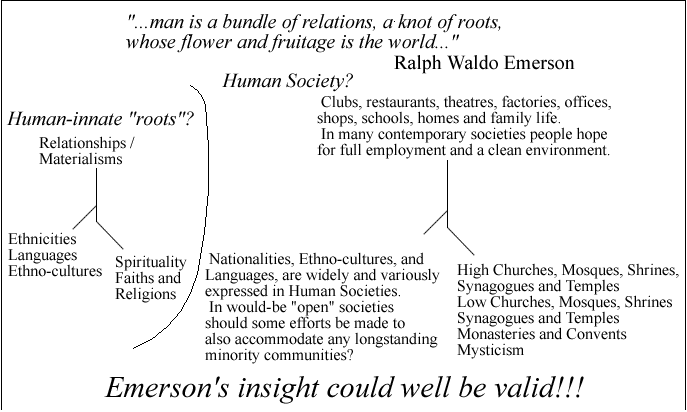
"In old Rome the public roads beginning at the Forum proceeded north, south, east, west, to the centre of every province of the empire, making each market-town of Persia, Spain, and Britain pervious to the soldiers of the capital: so out of the human heart go, as it were, highways to the heart of every object in nature, to reduce it under the dominion of man. A man is a bundle of relations, a knot of roots, whose flower and fruitage is the world. His faculties refer to natures out of him, and predict the world he is to inhabit, as the fins of the fish foreshow that water exists, or the wings of an eagle in the egg presuppose air. He cannot live without a world."
This passage is also to be found in Emerson's essay:-
"There is one mind common to all individual men....
....Of the works of this mind history is the record. Man is explicable by nothing less than all his history. All the facts of history pre-exist as laws. Each law in turn is made by circumstances predominant. The creation of a thousand forests is in one acorn, and Egypt, Greece, Rome, Gaul, Britain, America, lie folded already in the first man. Epoch after epoch, camp, kingdom, empire, republic, democracy, are merely the application of this manifold spirit to the manifold world."
To quote Ralph Waldo Emerson, from his famous Essay ~ History:-
"In old Rome the public roads beginning at the Forum proceeded north, south, east, west, to the centre of every province of the empire, making each market-town of Persia, Spain, and Britain pervious to the soldiers of the capital: so out of the human heart go, as it were, highways to the heart of every object in nature, to reduce it under the dominion of man. A man is a bundle of relations, a knot of roots, whose flower and fruitage is the world. His faculties refer to natures out of him, and predict the world he is to inhabit, as the fins of the fish foreshow that water exists, or the wings of an eagle in the egg presuppose air. He cannot live without a world."
This passage is also to be found in Emerson's essay:-
"There is one mind common to all individual men....
....Of the works of this mind history is the record. Man is explicable by nothing less than all his history. All the facts of history pre-exist as laws. Each law in turn is made by circumstances predominant. The creation of a thousand forests is in one acorn, and Egypt, Greece, Rome, Gaul, Britain, America, lie folded already in the first man. Epoch after epoch, camp, kingdom, empire, republic, democracy, are merely the application of this manifold spirit to the manifold world."
Is Human Being more truly Metaphysical than Physical?
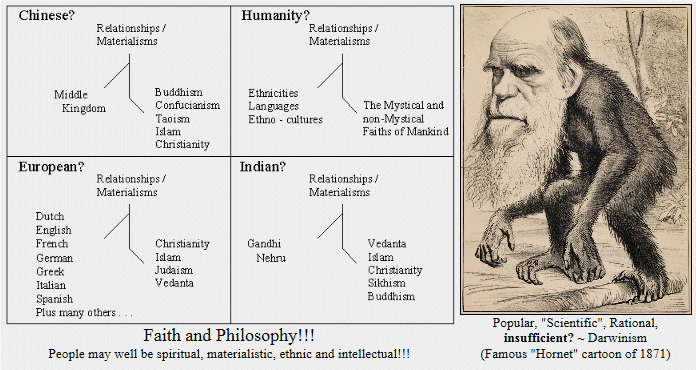
Where this could, possibly, lead ...
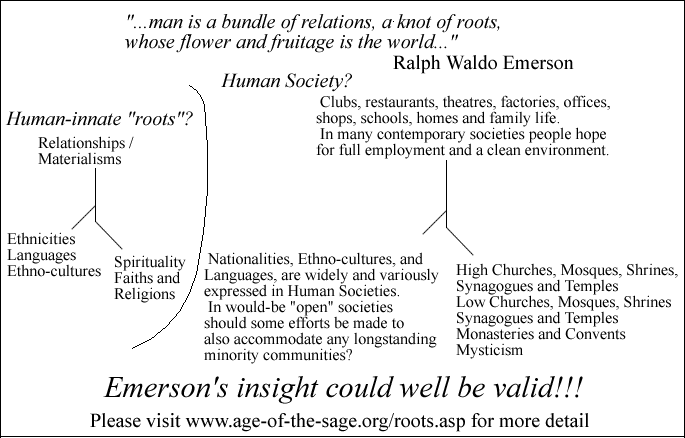
N. B. The page mentioned in the graphic ~ roots.asp ~
has been replaced by this page
This 'knot of roots' insight features in: