
Friedrich Nietzsche quotes
from Ecce Homo and Thus Spake Zarathustra
He began to actually write Thus Spake Zarathustra in February of 1883 but the germ of the idea behind it had been developing in his mind for some eighteen months. In Ecce Homo it is related how the idea occured to him in August 1881 and remained in gestation. When he came to actually write based upon his initial idea Nietzsche felt that he was actually inspired - as one of the most intriguing quotes from Ecce Homo suggests:-
"One hears but one does not seek; one takes - one does
not ask who gives; a thought flashes up like lightning, it comes
of necessity and unfalteringly formed".
His fundamental contention was that traditional values
(represented primarily by Christianity) had lost their power in
the lives of individuals. He expressed this in his proclamation
"God is dead."
Since God is dead Neitzsche sees the necessity for the emergence of the Übermensch, the Overman or Superman, who is to replace God.

Overman, or Superman, quotes present in Thus Spake Zarathustra include:-
When Zarathustra came into the next town, which lies on the edge of the forest, he found many people gathered together in the market place; for it had been promised that there would be a tightrope walker. And Zarathustra spoke thus to the people:
"I teach you the overman. Man is something that shall be overcome. What have you done to overcome him?
"All beings so far have created something beyond themselves; and do you want to be the ebb of this great flood and even go back to the beasts rather than overcome man? What is the ape to man? A laughingstock or a painful embarrassment. And man shal1 be just that for the overman: a laughingstock or a painful embarrassment. You have made your way from worm to man, and much in you is still worm. Once you were apes, and even now, too, man is more ape than any ape.
"Whoever is the wisest among you is also a mere conflict and cross between plant and ghost But do I bid you become ghosts or plants?
"Behold, I teach you the overman. The overman is the meaning of the earth. Let your will say: the overman shall be the meaning of the earth! I beseech you, my brothers, remain faithful to the earth, and do not believe those who speak to you of otherworldly hopes! Poison-mixers are they, whether they know it or not. Despisers of life are they, decaying and poisoned themselves, of whom the earth is weary: so let them go.
"Once the sin against God was the greatest sin; but God died, and these sinners died with him. To sin against the earth is now the most dreadful thing, and to esteem the entrails of the unknowable higher than the meaning of the earth.
From Book 1, Zarathustra's Prologue, 3
"I teach you the overman. Man is something that shall be overcome. What have you done to overcome him?
"All beings so far have created something beyond themselves; and do you want to be the ebb of this great flood and even go back to the beasts rather than overcome man? What is the ape to man? A laughingstock or a painful embarrassment. And man shal1 be just that for the overman: a laughingstock or a painful embarrassment. You have made your way from worm to man, and much in you is still worm. Once you were apes, and even now, too, man is more ape than any ape.
"Whoever is the wisest among you is also a mere conflict and cross between plant and ghost But do I bid you become ghosts or plants?
"Behold, I teach you the overman. The overman is the meaning of the earth. Let your will say: the overman shall be the meaning of the earth! I beseech you, my brothers, remain faithful to the earth, and do not believe those who speak to you of otherworldly hopes! Poison-mixers are they, whether they know it or not. Despisers of life are they, decaying and poisoned themselves, of whom the earth is weary: so let them go.
"Once the sin against God was the greatest sin; but God died, and these sinners died with him. To sin against the earth is now the most dreadful thing, and to esteem the entrails of the unknowable higher than the meaning of the earth.
From Book 1, Zarathustra's Prologue, 3
and
"Zarathustra, however, beheld the people and was amazed. Then he spoke thus:
"Man is a rope, tied between beast and overman - a rope over an abyss. A dangerous across, a dangerous on-the-way, a dangerous looking-back, a dangerous shuddering and stopping.
"What is great in man is that he is a bridge and not an end: what can be loved in man is that he is an overture and a going under.
"I love those who do not know how to live, except by going under, for they are those who cross over.
"I love the great despisers because they are the great reverers and arrows of longing for the other shore.
"I love those who do not first seek behind the stars for a reason to go under and be a sacrifice, but who sacrifice themselves for the earth, that the earth may some day become the overman's.
"I love him who lives to know, and who wants to know so that the overman may live some day. And thus he wants to go under.
"I love him who works and invents to build a house for the overman and to prepare earth, animal, and plant for him: for thus he wants to go under.
"I love him who loves his virtue, for virtue is the will to go under and an arrow of longing.
"I love him who does not hold back one drop of spirit for himself, but wants to be entirely the spirit of his virtue: thus he strides over the bridge as spirit.
From Book 1, Zarathustra's Prologue, 4
The context in which the Overman or Superman is to be judged to be such
is implied by Neitzsche's previous works. He maintained that all
human behavior is motivated by the will to power. In its positive
sense, the will to power is not simply power over others, but the
power over oneself that is necessary for creativity. Supermen are
those who have overcome man - i.e. the individual self - and
subliminated the will to power into a momentous creativity.
"Man is a rope, tied between beast and overman - a rope over an abyss. A dangerous across, a dangerous on-the-way, a dangerous looking-back, a dangerous shuddering and stopping.
"What is great in man is that he is a bridge and not an end: what can be loved in man is that he is an overture and a going under.
"I love those who do not know how to live, except by going under, for they are those who cross over.
"I love the great despisers because they are the great reverers and arrows of longing for the other shore.
"I love those who do not first seek behind the stars for a reason to go under and be a sacrifice, but who sacrifice themselves for the earth, that the earth may some day become the overman's.
"I love him who lives to know, and who wants to know so that the overman may live some day. And thus he wants to go under.
"I love him who works and invents to build a house for the overman and to prepare earth, animal, and plant for him: for thus he wants to go under.
"I love him who loves his virtue, for virtue is the will to go under and an arrow of longing.
"I love him who does not hold back one drop of spirit for himself, but wants to be entirely the spirit of his virtue: thus he strides over the bridge as spirit.
From Book 1, Zarathustra's Prologue, 4
Supermen are creators of a "master morality" that reflects the strength and independence of one who is liberated from all values, except those that he deems valid. Such power is manifested in independence, creativity, and originality.
Nietzsche saw the Superman as the answer to the nihilistic rejection of all religious and moral principles that would be consequent on a widespread acceptance that God is dead. The Superman being the exemplar of true humanity.
Although he explicitly denied that any Overmen or Supermen had yet arisen, he mentions several individuals who could serve as models. Among these models he lists Socrates, Jesus, Julius Caesar, Leonardo da Vinci, Michelangelo, Shakespeare, Goethe, and Napoleon.
Nietzsche's philosophical concepts were often concerned with areas that came within the interest of the emerging school of Existentialism and came to the particular notice of numerous thinkers, writers, and theologians who were themselves broadly interested in Existentialism. Amongst these are Karl Jaspers, Martin Heidegger, Martin Buber, Paul Tillich, Albert Camus and Jean-Paul Sartre.
Is Human Being more truly Metaphysical than Physical?
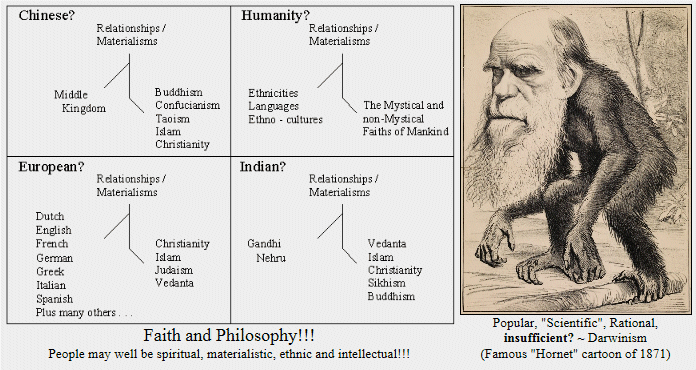
Where this could, possibly, lead ...
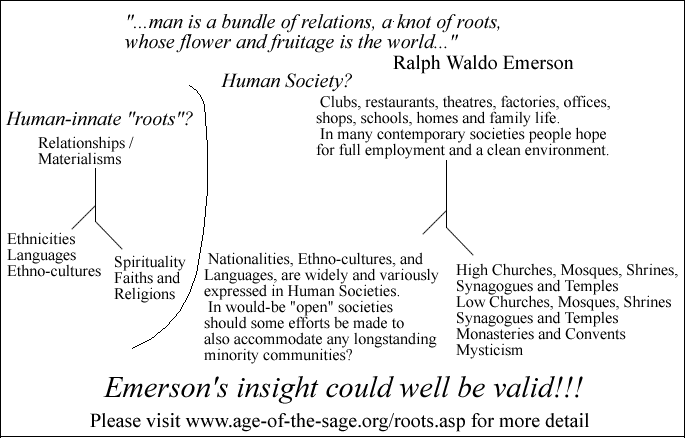
N. B. The page mentioned in the graphic ~ roots.asp ~
has been replaced by this page
This 'knot of roots' insight features in: