
Dr. William Sheldon ~
personality traits and
temperament types

Dr. William Sheldon (1898-1977) was an American psychologist who during his career held teaching and research posts at a number of Universities in the United States.
Much of Dr. William Sheldon's professional life was devoted to investigating the range human personality traits or temperament types. Dr. Sheldon was particularly active in which field of study during the 1940s and eventually came to hold that there were three major human personality traits which he called Viscerotonia, Somatotonia, and Cerebrotonia. These personality traits, Sheldon came to believe, bore a direct relationship with each of three human body types ( or Somatypes ) which he called Endomorphy, Mesomorphy and Ectomorphy.
Through a meticulous examination of the carefully posed (front view, side view, and back view) photographs of some four thousand, decently but scantily clothed, college-age, men Sheldon became persuaded that there were three fundamental elements that, in various proportions, contributed to each person's actual physique or somatype.
He conjectured that there might well be some relationship between these elements and the three layers of the human embryo - the endoderm, the mesoderm and the ectoderm - and consequently gave the three elements that he held as contributing to ALL human physiques the names Endomorphy, Mesomorphy and Ectomorphy.
He devised ways of standardising the measurement and numerical expression of the various degrees to which each of the three elements was present in any individual person's physique.
He came to see:-
- Endomorphy
as being focussed on the digestive system, particularly the stomach.
- Mesomorphy
as being focussed on musculature and the circulatory system.
- Ectomorphy
as being focussed on the nervous system and the brain.
A graphical representation of such body-typism!
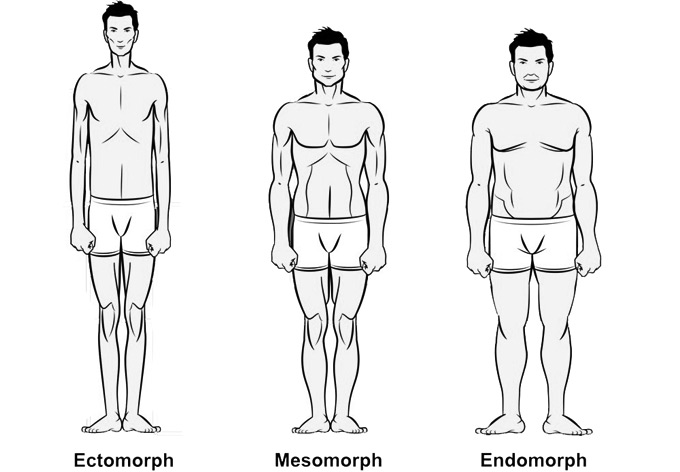
Attribution in relation to the above image : "Bodytypes" by Granito Diaz - Own work. Licensed under CC BY-SA 4.0 via Wikimedia Commons
http://commons.wikimedia.org/wiki/File:Bodytypes.jpg#/media/File:Bodytypes.jpg
As his theorising continued Dr.Sheldon came to recognise that individual human beings would all possess stomachs, muscles, and nervous systems, but would also differ, more or less, in the inherent focus of their bodies towards their stomachs, their muscles, or their nervous systems.
He accepted that, in any population, there would be a few extreme Endomorphs, a few extreme Mesomorphs, and a few extreme Ectomorphs.
He saw extreme Endomorphic physiques as being rounded and tending towards fleshiness. He discovered that extreme Endomorphic body types are endowed with a far longer digestive tract than extreme Ectomorphic body types.
He saw extreme Mesomorphic physiques as being large, bony, and tending towards a substantial and well-defined musculature.
He saw extreme Ectomorphic body types as being light-boned and tending towards a slightness of musculature.
He also conducted a large number of surveys directed towards the investigation of whether there was any identifiable link between physique and temperament type. Sheldon's surveys led him consider that there were three basic temperament types or human personality traits that he labelled Viscerotonia, Somatotonia, and Cerebrotonia.
He saw extreme Viscerotonia as being associated with a love of relaxation and of comfort. Extreme Viscerotonics tend to be sociable "food and people" persons.
He saw extreme Somatonia as being associated with physical assertiveness. Extreme Somatotonics tend to be very keen on physical activity. Extreme Somatotonics also tend to be keen on physical competition in which they tend to expect to do well.
He saw extreme Cerebrotonia as being associated with a pronounced need for privacy. Extreme Cerebrotonics tend to be highly self-aware and socially restrained.
He considered that there was a strong correlation between body type and temperament type. According to this view human personality traits are underwritten, as it were, by human physical types. Extreme Endomorphs tend towards Viscerotonia, extreme Mesomorphs towards Somatotonia, and extreme Ectomorphs towards Cerebrotonia.
Whilst Sheldon wrote several books on the variety of human temperament types / human personality traits these seem to be out of print.
Whilst it should be again noted that this Constitutional psychology theory, largely attributable to Dr. William Sheldon, has largely fallen from acceptance and favor, a case can nevertheless be hesitantly made that, in a search for faint glimmers of "psychological truth" an association can be made between Dr. William Sheldon's work and the work of other psychologists - not least the work of Stella Chess and Alexander Thomas
Working in the area of child psychology in New York Chess and Alexander ultimately went on to classify the temperament types of their young charges as variously being "easy", "difficult", and "slow to warm up".
N.B. Although differences in temperament do exist, they may not be as associated with body-typism as Dr. Sheldon suggested.
It is widely known that Plato, pupil of and close friend to Socrates, accepted that Human Beings have a "Tripartite Soul" where individual Human Psychology is composed of three aspects - Wisdom-Rationality, Spirited-Will and Appetite-Desire.
Ralph Waldo Emerson
RALPH WALDO EMERSON (1803-1882) was, in his time, the leading voice of intellectual culture in the United States. He remains widely influential to this day through his essays, lectures, poems, and philosophical writings.
In the later eighteen-twenties Ralph Waldo Emerson read, and was very significantly influenced by, a work by a French philosopher named Victor Cousin.
A key section of Cousin's work reads as follows:
"What is the business of history? What is the stuff of which it is made? Who is the personage of history? Man : evidently man and human nature.
There are many different elements in history. What are they? Evidently again, the elements of human nature. History is therefore the development of humanity,
and of humanity only; for nothing else but humanity develops itself, for nothing else than humanity is free. …
… Moreover, when we have all the elements, I mean all the essential elements, their mutual relations do, as it were, discover themselves. We draw from the nature of these different elements, if not all their possible relations, at least their general and fundamental relations."
Introduction to the History of Philosophy (1829)
… Moreover, when we have all the elements, I mean all the essential elements, their mutual relations do, as it were, discover themselves. We draw from the nature of these different elements, if not all their possible relations, at least their general and fundamental relations."
Introduction to the History of Philosophy (1829)
Even before he had first read Cousin, (in 1829), Emerson had expressed views in his private Journals which suggest that he accepted that Human Nature, and Human Beings, tend to display three identifiable aspects and orientations:
Imagine hope to be removed from the human breast & see how Society will sink, how the strong bands of order & improvement will be relaxed & what a deathlike stillness would take the place of the restless energies that now move the world. The scholar will extinguish his midnight lamp, the merchant will furl his white sails & bid them seek the deep no more. The anxious patriot who stood out for his country to the last & devised in the last beleagured citadel, profound schemes for its deliverance and aggrandizement, will sheathe his sword and blot his fame. Remove hope, & the world becomes a blank and rottenness.
(Journal entry made between October and December, 1823)
In all districts of all lands, in all the classes of communities thousands of minds are intently occupied, the merchant in his compting house, the mechanist over his plans, the statesman at his map, his treaty, & his tariff, the scholar in the skilful history & eloquence of antiquity, each stung to the quick with the desire of exalting himself to a hasty & yet unfound height above the level of his peers. Each is absorbed in the prospect of good accruing to himself but each is no less contributing to the utmost of his ability to fix & adorn human civilization. (Journal entry of December, 1824)
Our neighbours are occupied with employments of infinite diversity. Some are intent on commercial speculations; some engage warmly in political contention; some are found all day long at their books … (This dates from January - February, 1828)
In all districts of all lands, in all the classes of communities thousands of minds are intently occupied, the merchant in his compting house, the mechanist over his plans, the statesman at his map, his treaty, & his tariff, the scholar in the skilful history & eloquence of antiquity, each stung to the quick with the desire of exalting himself to a hasty & yet unfound height above the level of his peers. Each is absorbed in the prospect of good accruing to himself but each is no less contributing to the utmost of his ability to fix & adorn human civilization. (Journal entry of December, 1824)
Our neighbours are occupied with employments of infinite diversity. Some are intent on commercial speculations; some engage warmly in political contention; some are found all day long at their books … (This dates from January - February, 1828)
The quotes from Emerson are reminiscent of a line from another "leading voice of intellectual culture" - William Shakespeare.
There's neither honesty, manhood, nor good fellowship in thee.
William Shakespeare: Henry IV (Pt 1), Act I, Scene II
William Shakespeare: Henry IV (Pt 1), Act I, Scene II
"The first glance at History convinces us that the actions of men proceed from their needs, their passions, their characters and talents; and impresses us with the belief that such needs, passions and interests are the sole spring of actions."
Georg Hegel, 1770-1831, German philosopher, The Philosophy of History (1837)