
Aldous Huxley & "The Perennial Philosophy"
We believe that it is entirely reasonable to assert that the content of our pages will persuade anyone seriously interested in Comparative Religion studies that there are close comparisons to be made between the Core Spiritual Teachings of ALL the major World Religions!

We have engaged in studies in Comparative Religion which has led to our identification of key selections of spiritual insights quotations and quotes drawn from the texts of several major World Religions.
These extensive studies were largely inspired by Aldous Huxley's "The Perennial Philosphy" where some Common Ground between ~ the inner-most spiritual teachings of Christianity, Islam, Hinduism, Buddhism, Taoism and Judaism ~ was considered.
The existence of said "Common Ground" has positive implications in that it provides just causation for greater Inter-Faith toleration - from all points of the "Theological Compass" - to all other points of the "Theological Compass".
We at Age-of-the-Sage are also fully persuaded that Christianity Spirituality can be shown to very definitely hold its own in terms of Spiritual Profundity, and of - Potential for Spirituality-Related Insight - with other World Faiths newly significantly present in "The West".
Aldous Huxley's The Perennial Philosophy is sufficiently celebrated as to have its own entry on the popular online encyclopedia Wikipedia.
This Wikipedia page, speaking of the critical reception of its first US edition stated, (in August 2024), that:-
The Perennial Philosophy was widely reviewed when first published in 1945, with articles appearing in Book Week, Booklist, The Christian Century, The Nation, The New Republic, The New Yorker, Saturday Review of Literature, Springfield Republican, New York Herald Tribune, and the Wilson Bulletin.
The New York Times wrote that, "Perhaps Mr. Huxley, in The Perennial Philosophy has, at this time, written the most needed book in the world."
(N.B. In 1945 the USA was still involved in a World War which had then been raging for several years.)
The Perennial Philosophy has been reported of on the goodreads.com website as having been made available in all of one hundred and thirty three editions - in several languages - over the years - and does not seem to have been out-of-print since first publication.
The New York Times wrote that, "Perhaps Mr. Huxley, in The Perennial Philosophy has, at this time, written the most needed book in the world."
(N.B. In 1945 the USA was still involved in a World War which had then been raging for several years.)
The Perennial Philosophy has been reported of on the goodreads.com website as having been made available in all of one hundred and thirty three editions - in several languages - over the years - and does not seem to have been out-of-print since first publication.
The fly-leaf to the dust jacket on the first (Hardback, 1946) UK edition of The Perennial Philosophy begins:-
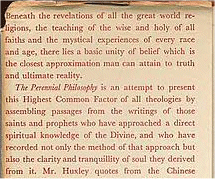
Beneath the revelations of all the great world religions, the teaching of the wise and holy of all faiths and the mystical experiences of every race and age, there lies a basic unity of belief which is the closest approximation man can attain to truth and ultimate reality.
The Perennial Philosophy is an attempt to present this Highest Common Factor of all theologies by assembling passages from the writings of those saints and prophets who have approached a direct spiritual knowledge of the Divine, and who have recorded not only the method of that approach but also the clarity of soul they derived from it.
Aldous Huxley's Introduction to The Perennial Philosophy includes this section:-
"with the one, divine Reality"
and that
"the nature of this one Reality is such that it cannot be directly or immediately apprehended except by those who have chosen to fulfill certain conditions, making themselves loving, pure in heart, and poor in spirit."
Some truly extra-ordinary wisdoms ~ a brief selection of "Central Spiritual Insights" gleaned from Christian sources closely followed by another brief selection of "Central Spiritual Insights" drawn from "non-Christian" Inter-Faith sources ~ are set out below!
These Christian quotations have been selected based on their inherent Spiritual Impact, (rather than whether they might be deemed to be Catholic, Protestant or Orthodox), and come from The New International Version of The Bible.
Our world seems to be becoming more and more "globalised" presenting us with new challenges of co-existence between cultural communities and of toleration between faith communities!
Extensive studies have been conducted into Comparative Spirituality by ourselves at age-of-the-sage and were actually undertaken before 2000 A.D. and hence prior to that difficult situation, often overstated as being an actual "Clash of Cultures," that has (however that situation should be depicted) been all too evident in recent years.
As such these studies will hopefully qualify to be considered as having adopted a somewhat open and unprejudiced consideration of the spiritual teachings of such major World Religions as Christianity, Islam, Hinduism, Buddhism, Sikhism, Taoism and Judaism.
In the following brief overview one or two quotes are presented from Buddhist, Hindu, Islamic, Jewish, Sikh and Taoist sources respectively.
Such inclusivity as this is quite clearly necessary in any genuine attempt to present a wide-ranging and profound overview of non-Christian spiritual insights.
Those inclined to look further into Comparative Religion Spirituality can find links to more detailed studies at the end of this initial presentation.
An undeniably significant Christian teaching, known as The Parable of the Sower, presents a scenario where "seeds", (i.e. Spiritual Teachings), fall on the ears of hearers variously characterized as being "stony ground", "thorny ground" and "good ground."
In this teaching it is clearly implied that the "seed analogy" refers to grain of some kind.
In favorable conditions grain seeds germinate and this typically leads to the growth of maturing plants which individually have the potential to produce a multiple harvest of individual grains from an original single seed sown.
The Parable of the Sower can be interpreted as inferring that the sowing of a Spiritual "seed" can lead to a spiritually-related "harvesting" of Insight or Knowledge.
… And these are they which are sown on good ground; such as hear the word, and receive it, and bring forth fruit, some thirtyfold, some sixty, and some an hundred.
And he said unto them, Is a candle brought to be put under a bushel, or under a bed? and not to be set on a candlestick?
For there is nothing hid, which shall not be manifested; neither was anything secret, but that it should come abroad.
Two particularly noteworthy Faith versus Reason quotes, related to Spiritual Insight, from "non-Christian" sources now follow:-
Rumi lived 1207 - 1273, (by the western calendar).
A BBC "Culture" web page of April, 2014 has said of him:-
Whilst Buddhism cannot lay claim to having as many self-identifying adherents as Christianity, Islam or Hinduism it is often viewed with a degree of respect by very many persons who would see themselves as being "spiritual but not religious".
"The Enlightened One" is one of the titles attributed, (by Western observers), to Gautama Buddha, the founding figure of Buddhism.
This term actually appears to be a fairly direct translation of what the word "Buddha" means in its original linguistic context.
Christianity, Islam, Hinduism and Buddhism are joined by Sikhism in accepting possiblities of "Spiritually-related" Insight.
Nanak, the founding figure of Sikhism, (and his nine recognised successors), are all considered to have been "Gurus" - (i.e. Spiritual and Intellectual guides and leaders).
The Holy Book of the Sikh faith, the Granth, continues this tradition being known to the Sikh faithful as The Guru Granth Sahib.
(Sahib being a respectful term expressive of perceived authority)
Many persons inclined towards atheism or agnosticism can tend to see Religion as being superstitious: it is to be hoped that the last few quotations and observations from Christian, Islamic, Hindu, Buddhist and Sikh sources will do something encourage people to view the practice of Spirituality as potentially resulting in heightened capacities for spiritually-related Insight.
Whilst many of our visitors may be now prepared to accept that it has been shown that Faiths can value "Spiritual Insight" over "Rationality" fuller evidence is available on our pages that Christianity, Islam, Hinduism, Buddhism, Sikhism, Taoism and Judaism are all in agreement that "Human Intellect is to be in some ways distrusted" and that "Spiritual Insight is possible, desirable and profoundly important."
The following linked pages are intended to more fully demonstrate a degree of Common Ground between the Inner-most Spiritual Teachings of several major World Religions on Charity, Purity of Heart, Humility, Meekness, A Disdain for Materialism (compared to the Spiritual), A Distrust of the Intellect (compared to Divine Inspiration) and A Yearning for Divine Edification (or A Thirst for Spiritual Enlightenment).
These quotations are presented on a series of very brief pages where each faith is considered individually.
A rather extensive page treating with Central Spiritual Insights - and more - from the Major World Faiths is available to download from our site.
Those potentially interested in accessing this content can follow the - Downloads + link - on the navigation menu to the right, (or for Smartphones available below), for more information.
It is surely worth noting that both The Sermon on the Mount and The Parable of the Sower can be seen as suggesting the "Spirituality" is relative to "Desire" and to "Wrath".
Hearken; Behold, there went out a sower to sow:
And it came to pass, as he sowed, some fell by the way side, and the fowls of the air came and devoured it up.
And some fell on stony ground, where it had not much earth; and immediately it sprang up, because it had no depth of earth:
But when the sun was up, it was scorched; and because it had no root, it withered away.
And some fell among thorns, and the thorns grew up, and choked it, and it yielded no fruit.
And other fell on good ground, and did yield fruit that sprang up and increased; and brought forth, some thirty, some sixty, and some an hundred.
And he said unto them, He that hath ears to hear, let him hear. …
… The sower soweth the word.
And these are they by the way side, where the word is sown; but when they have heard, Satan cometh immediately, and taketh away the word that was sown in their hearts.
And these are they likewise which are sown on stony ground; who, when they have heard the word immediately receive it with gladness;
And have no root in themselves, and so endure for a time: afterward, when affliction or persecution ariseth for the word's sake, immediately they are offended.
And these are they which are sown among thorns; such as hear the word,
And the cares of this world, and the deceitfulness of riches, and the lusts of other things entering in, choke the word, and it becometh unfruitful.
And these are they which are sown on good ground; such as hear the word, and receive it, and bring forth fruit, some thirtyfold, some sixty, and some an hundred.
And he said unto them, Is a candle brought to be put under a bushel, or under a bed? and not to be set on a candlestick?
For there is nothing hid, which shall not be manifested; neither was anything secret, but that it should come abroad.
Such suggestion of "Spirituality" as being relative to "Desire" and to "Wrath" can also be found in Islamic, Hindu, Buddhist and Sikh teachings.
Examples of such suggestion are to be found on the Islamic, Hindu, Buddhist and Sikh spirituality pages which were offered as links in the above panel.
Is Human Being more truly Metaphysical than Physical?
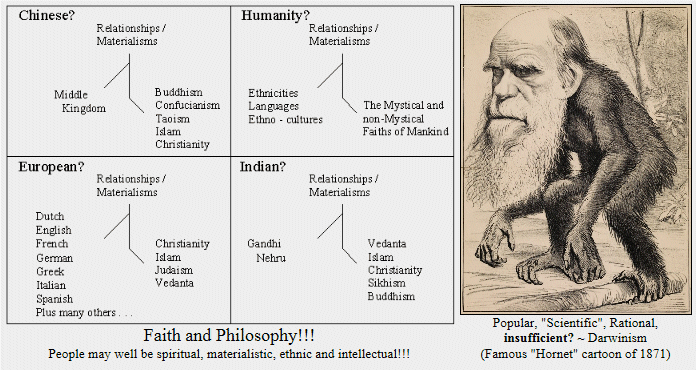
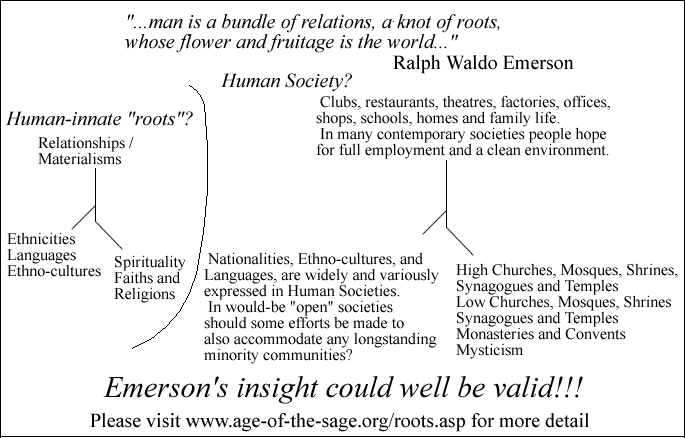
N. B. The page mentioned in the graphic ~ roots.asp ~
has been replaced by this page
This 'knot of roots' insight features in:
Beneath the revelations of all the great world religions, the teaching of the wise and holy of all faiths and the mystical experiences of every race and age, there lies a basic unity of belief which is the closest approximation man can attain to truth and ultimate reality.
The Perennial Philosophy is an attempt to present this Highest Common Factor of all theologies by assembling passages from the writings of those saints and prophets who have approached a direct spiritual knowledge of the Divine, and who have recorded not only the method of that approach but also the clarity of soul they derived from it.
Aldous Huxley's Introduction to The Perennial Philosophy includes this section:-
"Rudiments of the Perennial Philosophy may be found among the traditionary lore of primitive peoples in every region of the world, and in its fully
developed forms it has a place in every one of the higher religions. A version of this Highest Common Factor in all preceding and subsequent theologies
was first committed to writing more than twenty-five centuries ago, and since that time the inexhaustible theme has been treated again and again, from the
standpoint of every religious tradition and in all the principal languages of Asia and Europe."
In The Perennial Philosophy
Aldous Huxley accepted the proposition, deriving from Leibniz, a notably
eminent scholar who was an early investigator
into Comparative Religion and the
Common Ground shared by The World Religions, that Religions concern themselves"with the one, divine Reality"
and that
"the nature of this one Reality is such that it cannot be directly or immediately apprehended except by those who have chosen to fulfill certain conditions, making themselves loving, pure in heart, and poor in spirit."
The results of our own investigation into Comparative Religion and The Perennial Philosophy were such as to lead us to also accept that "the one, divine Reality"
is better discerned by those
spiritually endowed with Charity, Purity of Heart and Humility. However, we came to believe Meekness to be another spiritual endowment which
may well tend to contribute towards heightened powers of discernment.
This suggestion that Meekness is of immense spiritual value may not surprise.
More unexpectedly, perhaps, the outcomes of our own Comparative Religion Studies were such as to suggest that it is appropriate to fully associate A Disdain for Materialism (compared to the Spiritual), A Distrust of the Intellect (compared to Divine Inspiration), and A Yearning for Divine Edification (or A Thirst for Enlightenment), with the centralities of The Perennial Philosophy.
This suggestion that Meekness is of immense spiritual value may not surprise.
More unexpectedly, perhaps, the outcomes of our own Comparative Religion Studies were such as to suggest that it is appropriate to fully associate A Disdain for Materialism (compared to the Spiritual), A Distrust of the Intellect (compared to Divine Inspiration), and A Yearning for Divine Edification (or A Thirst for Enlightenment), with the centralities of The Perennial Philosophy.
Some truly extra-ordinary wisdoms ~ a brief selection of "Central Spiritual Insights" gleaned from Christian sources closely followed by another brief selection of "Central Spiritual Insights" drawn from "non-Christian" Inter-Faith sources ~ are set out below!
A selection of "Central Spiritual Insights" gleaned from Christian sources
"...the natural man receiveth not the things of the Spirit of God: for they are foolishness unto him: neither can he know them, because they are spiritually discerned. ..."
(From the first letter written by St. Paul to a faith-community in Corinth)
(From the first letter written by St. Paul to a faith-community in Corinth)
These Christian quotations have been selected based on their inherent Spiritual Impact, (rather than whether they might be deemed to be Catholic, Protestant or Orthodox), and come from The New International Version of The Bible.
- A Disdain for Materialism
-
Whosoever will come after me, let him deny himself, and take up his cross, and follow me. For whosoever will save his life shall lose it; but whosoever shall lose his life for my sake and the gospel's, the same shall save it. For what shall it profit a man, if he shall gain the whole world, and lose his own soul?
Jesus - A Distrust of Intellect
- So I tell you this, and insist on it in the Lord, that you must no longer live as the Gentiles do, in the futility of their thinking.
They are darkened in their understanding and separated from the life of God because of the ignorance that is in them due to the hardening
of their hearts.
St. Paul - Spiritual Insights are possible!
- What we have received is not the spirit of the world, but the Spirit who is from God, so that we may understand what God has freely
given us. This is what we speak, not in words taught us by human wisdom but in words taught by the Spirit, explaining spiritual realities
with Spirit-taught words. The person without the Spirit does not accept the things that come from the Spirit of God but considers them
foolishness, and cannot understand them because they are discerned only through the Spirit.
St. Paul - Charity
- Dear friends, let us love one another, for love comes from God. Everyone who loves has been born of God and knows God. Whoever does
not love does not know God, because God is love.
St. John - Purity of Heart
- Do everything without grumbling or arguing, so that you may become blameless and pure, "children of God without fault in a warped and
crooked generation." Then you will shine among them like stars in the sky as you hold firmly to the word of life...
St. Paul - Humility
- Nor are you to be called 'teacher,' for you have one Teacher, the Christ. The greatest among you will be your servant. For
whoever exalts himself will be humbled, and whoever humbles himself will be exalted.
Jesus - The Golden Rule
- And as ye would that men should do to you, do ye also to them likewise.
St. Luke 6:31 - Meekness
- Therefore, my beloved brethren, let every man be swift to hear, slow to speak, slow to wrath; for the wrath of man worketh not the
righteousness of God.
St. James - On a Contented Life
- Rejoice in the Lord always: and again I say, Rejoice. Let your moderation be known unto all men. The Lord is at hand. Be careful of nothing; but in everything by prayer and supplication with thanksgiving let your request be made known unto God. And the peace of God, which passeth all understanding, shall keep your hearts and minds through Christ Jesus. Finally, brethren, whatsoever things are honest, whatsoever things are just, whatsoever things are lovely, whatsoever things are of good report; and if there be any virtue, and if there be any praise, think on these things. Those things, which ye have both learned, and received, and heard, and seen in me, do: and the God of peace shall be with you.
St. Paul
"Central Spiritual Insights" drawn from "non-Christian" Inter-Faith sources
"... The original Buddha-nature, in all truth, is nothing which can be apprehended. It is void, omniscient, silent, pure; it is glorious and mysterious
peacefulness, and that is all which can be said. You yourself must awake to it, fathoming its depths. ..."
(from: "The Teachings of the Compassionate Buddha," edited by Edwin A. Burtt, c 1955, p. 194-204)
(from: "The Teachings of the Compassionate Buddha," edited by Edwin A. Burtt, c 1955, p. 194-204)
Our world seems to be becoming more and more "globalised" presenting us with new challenges of co-existence between cultural communities and of toleration between faith communities!
Extensive studies have been conducted into Comparative Spirituality by ourselves at age-of-the-sage and were actually undertaken before 2000 A.D. and hence prior to that difficult situation, often overstated as being an actual "Clash of Cultures," that has (however that situation should be depicted) been all too evident in recent years.
As such these studies will hopefully qualify to be considered as having adopted a somewhat open and unprejudiced consideration of the spiritual teachings of such major World Religions as Christianity, Islam, Hinduism, Buddhism, Sikhism, Taoism and Judaism.
In the following brief overview one or two quotes are presented from Buddhist, Hindu, Islamic, Jewish, Sikh and Taoist sources respectively.
Such inclusivity as this is quite clearly necessary in any genuine attempt to present a wide-ranging and profound overview of non-Christian spiritual insights.
Those inclined to look further into Comparative Religion Spirituality can find links to more detailed studies at the end of this initial presentation.
- A Disdain for Materialism
- Chuang Tzu put on cotton clothes with patches in them, and
arranging his girdle and tying on his shoes,
(i.e. to keep them from falling off),
went to see the prince of Wei.
"How miserable you look, Sir!" Cried the prince. "It is poverty, not misery," replied Chuang Tzu. "A man who has TAO cannot be miserable. Ragged clothes and old boots make poverty, not misery."
Chuang Tzu - (Taoism) - A Distrust of Intellect
- Sell your cleverness and buy bewilderment; Cleverness is mere
opinion, bewilderment intuition.
Rumi - (Sufism ~ a notably mystical, minority, tradition associable with both Sunni and Shia Islam) - Spiritual Insights are possible!
- The intelligence of the mean man does not rise beyond bribes and letters of
recommendation. His mind is beclouded with trivialities. Yet he would penetrate the
mystery of TAO and of creation, and rise to participation in the ONE. The result is
that he is confounded by time and space; and that trammelled by objective existences,
that he fails apprehension of that age before anything was.
But the perfect man, - he carries his mind back to the period before the beginning.
Content to rest in the oblivion of nowhere, passing away like flowing water, he is
merged in the clear depths of the infinite.
Chuang Tzu - (Taoism) - Charity
- He that does everything for Me, whose supreme object I am, who
worships Me, being free from attachment and without hatred to any
creature, this man, Arjuna!, comes to Me.
Bhagavad Gita ~ (Hinduism) ~ also known as ~ (Vedanta).
And my soul is absorbed
In the Love of My Lord.
Bow humbly to the saint
That is a pious act.
Bow to the ground before him
That is devotion, indeed.
The faithless know not,
The joy of the love of the Lord;
From Sohila-Arti ~ a bed-time prayer
This section of which is attributed to Guru Ram Das - (Sikhism) - Purity of Heart
- The path of the just is as the shining light, that shineth more
and more unto the perfect day. The way of the wicked is as
darkness: they know not at what they stumble.
Solomon - (Judaism) - Humility
- Would you become a pilgrim on the road of love? The first
condition is that you make yourself humble as dust and ashes.
Ansari of Herat - (Islam) - The Golden Rule
- This is the sum of duty: Do naught unto others which would cause you pain if done to you.
Mahabharata 5:1517 - (associable with Hinduism) - Meekness
- Let a man overcome anger by love, let him overcome evil by good;
let him overcome the greedy by liberality, the liar by truth!
Speak the truth, do not yield to anger; give, if thou art asked
for little; by these three steps thou wilt go near the gods.
Dhammapada - (Buddhism) - On a Contented Life
- There is a way which seemeth right unto a man, but the end thereof are the ways of death.
Even in laughter the heart is sorrowful; and the end of that mirth is heaviness.
The backslider in heart shall be filled with his own ways: and a good man shall be satisfied from himself.
Book of Proverbs - (Judaism)
An undeniably significant Christian teaching, known as The Parable of the Sower, presents a scenario where "seeds", (i.e. Spiritual Teachings), fall on the ears of hearers variously characterized as being "stony ground", "thorny ground" and "good ground."
In this teaching it is clearly implied that the "seed analogy" refers to grain of some kind.
In favorable conditions grain seeds germinate and this typically leads to the growth of maturing plants which individually have the potential to produce a multiple harvest of individual grains from an original single seed sown.
The Parable of the Sower can be interpreted as inferring that the sowing of a Spiritual "seed" can lead to a spiritually-related "harvesting" of Insight or Knowledge.
… And these are they which are sown on good ground; such as hear the word, and receive it, and bring forth fruit, some thirtyfold, some sixty, and some an hundred.
And he said unto them, Is a candle brought to be put under a bushel, or under a bed? and not to be set on a candlestick?
For there is nothing hid, which shall not be manifested; neither was anything secret, but that it should come abroad.
Jesus' teaching from St. Mark's Gospel, Chapter 4
Two particularly noteworthy Faith versus Reason quotes, related to Spiritual Insight, from "non-Christian" sources now follow:-
"Would he had been less full of borrowed knowledge! Then he would have accepted inspired knowledge from his father. When, with
inspiration at hand, you seek book-learning, your heart, as if inspired, loads you with reproach. Traditional knowledge,
when inspiration is available, is like making ablutions in sand when water is near. Make yourself ignorant, be submissive,
and then you will obtain release from your ignorance."
Rumi - (Sufism / Islam)
Rumi - (Sufism / Islam)
Rumi lived 1207 - 1273, (by the western calendar).
A BBC "Culture" web page of April, 2014 has said of him:-
The ecstatic poems of Jalal ad-Din Muhammad Rumi, a Persian poet and Sufi master born 807 years ago in 1207, have sold millions of copies in recent years, making him the
most popular poet in the US. Globally, his fans are legion.
Vivekananda, (the name-in-religion Vivekananda translates as - The Bliss of Discerning Wisdom), was a Vedic scholar and Hindu sage who made an
appearance at the Parliament of World Religions that convened in Chicago in 1893 and was generally recognised as having made a singularly important contribution to the
proceedings:-

"When there is conflict between the heart and the brain, let the heart be followed, because intellect has only one state, reason, and within that intellect works, and cannot get beyond. It is the heart which takes one to the highest plane, which intellect can never reach; it goes beyond the intellect, and reaches what is called inspiration. Intellect can never become inspired; only the heart when it is enlightened, becomes inspired. An intellectual, heartless man can never become an inspired man. It is always the heart that speaks in the man of love; it discovers a greater instrument than intellect can give you, the instrument of inspiration. Just as the intellect is the instrument of knowledge, so is the heart the instrument of inspiration."
"When there is conflict between the heart and the brain, let the heart be followed, because intellect has only one state, reason, and within that intellect works, and cannot get beyond. It is the heart which takes one to the highest plane, which intellect can never reach; it goes beyond the intellect, and reaches what is called inspiration. Intellect can never become inspired; only the heart when it is enlightened, becomes inspired. An intellectual, heartless man can never become an inspired man. It is always the heart that speaks in the man of love; it discovers a greater instrument than intellect can give you, the instrument of inspiration. Just as the intellect is the instrument of knowledge, so is the heart the instrument of inspiration."
Whilst Buddhism cannot lay claim to having as many self-identifying adherents as Christianity, Islam or Hinduism it is often viewed with a degree of respect by very many persons who would see themselves as being "spiritual but not religious".
"The Enlightened One" is one of the titles attributed, (by Western observers), to Gautama Buddha, the founding figure of Buddhism.
This term actually appears to be a fairly direct translation of what the word "Buddha" means in its original linguistic context.
Christianity, Islam, Hinduism and Buddhism are joined by Sikhism in accepting possiblities of "Spiritually-related" Insight.
Nanak, the founding figure of Sikhism, (and his nine recognised successors), are all considered to have been "Gurus" - (i.e. Spiritual and Intellectual guides and leaders).
The Holy Book of the Sikh faith, the Granth, continues this tradition being known to the Sikh faithful as The Guru Granth Sahib.
(Sahib being a respectful term expressive of perceived authority)
Many persons inclined towards atheism or agnosticism can tend to see Religion as being superstitious: it is to be hoped that the last few quotations and observations from Christian, Islamic, Hindu, Buddhist and Sikh sources will do something encourage people to view the practice of Spirituality as potentially resulting in heightened capacities for spiritually-related Insight.
Whilst many of our visitors may be now prepared to accept that it has been shown that Faiths can value "Spiritual Insight" over "Rationality" fuller evidence is available on our pages that Christianity, Islam, Hinduism, Buddhism, Sikhism, Taoism and Judaism are all in agreement that "Human Intellect is to be in some ways distrusted" and that "Spiritual Insight is possible, desirable and profoundly important."
The following linked pages are intended to more fully demonstrate a degree of Common Ground between the Inner-most Spiritual Teachings of several major World Religions on Charity, Purity of Heart, Humility, Meekness, A Disdain for Materialism (compared to the Spiritual), A Distrust of the Intellect (compared to Divine Inspiration) and A Yearning for Divine Edification (or A Thirst for Spiritual Enlightenment).
These quotations are presented on a series of very brief pages where each faith is considered individually.
We have seen it as worthwhile to add another category of quotation ~ where recognition has been given "by the wise and holy of several faiths" to the possibility of Mystical Communion with God.
At Age-of-the-Sage we hope that it will be possible to see our contribution to the Faith vs Reason debate as being consistent with such Sermons and Parables of Jesus as The Sermon on the Mount and The Parable of the Sower.
We nevertheless have great respect for the Spiritualities that exist at the cores of the Buddhist, Islamic, Jewish, Sikh, Taoist and Vedic-Hindu faiths and have laid out the above table of links in a manner consistent with our aspiration towards promoting a mutually respectful co-existence of The Great Faiths of the World.
Many more Comparative Religion quotations are available to

from the Age-of-the-Sage web site!
from the Age-of-the-Sage web site!
A rather extensive page treating with Central Spiritual Insights - and more - from the Major World Faiths is available to download from our site.
Those potentially interested in accessing this content can follow the - Downloads + link - on the navigation menu to the right, (or for Smartphones available below), for more information.
It is surely worth noting that both The Sermon on the Mount and The Parable of the Sower can be seen as suggesting the "Spirituality" is relative to "Desire" and to "Wrath".
A selection from The Parable of the Sower:
And he taught them many things by parables, and he said unto them in his doctrine,Hearken; Behold, there went out a sower to sow:
And it came to pass, as he sowed, some fell by the way side, and the fowls of the air came and devoured it up.
And some fell on stony ground, where it had not much earth; and immediately it sprang up, because it had no depth of earth:
But when the sun was up, it was scorched; and because it had no root, it withered away.
And some fell among thorns, and the thorns grew up, and choked it, and it yielded no fruit.
And other fell on good ground, and did yield fruit that sprang up and increased; and brought forth, some thirty, some sixty, and some an hundred.
And he said unto them, He that hath ears to hear, let him hear. …
… The sower soweth the word.
And these are they by the way side, where the word is sown; but when they have heard, Satan cometh immediately, and taketh away the word that was sown in their hearts.
And these are they likewise which are sown on stony ground; who, when they have heard the word immediately receive it with gladness;
And have no root in themselves, and so endure for a time: afterward, when affliction or persecution ariseth for the word's sake, immediately they are offended.
And these are they which are sown among thorns; such as hear the word,
And the cares of this world, and the deceitfulness of riches, and the lusts of other things entering in, choke the word, and it becometh unfruitful.
And these are they which are sown on good ground; such as hear the word, and receive it, and bring forth fruit, some thirtyfold, some sixty, and some an hundred.
And he said unto them, Is a candle brought to be put under a bushel, or under a bed? and not to be set on a candlestick?
For there is nothing hid, which shall not be manifested; neither was anything secret, but that it should come abroad.
Jesus' teaching from St. Mark's Gospel, Chapter 4
Such suggestion of "Spirituality" as being relative to "Desire" and to "Wrath" can also be found in Islamic, Hindu, Buddhist and Sikh teachings.
Examples of such suggestion are to be found on the Islamic, Hindu, Buddhist and Sikh spirituality pages which were offered as links in the above panel.
Is Human Being more truly Metaphysical than Physical?
Where this could, possibly, lead ...
N. B. The page mentioned in the graphic ~ roots.asp ~
has been replaced by this page
This 'knot of roots' insight features in: