
Arnold Toynbee
The rise and fall of Civilizations
Toynbee, a prolific author, was the nephew of a great economic historian, Arnold Toynbee, with whom he is sometimes confused. Born in London, Arnold J was educated at Winchester College and Balliol College, Oxford. He worked for the Foreign Office during both World War I and World War II. He was Director of Studies at the Royal Institute of International Affairs (1925-1955) and Research Professor of International History at the University of London.
Toynbee was interested in the seeming repetition of patterns in history and, later, in the origins of civilisation. It was in this context that he read Spengler's Decline of the West and although there is some superficial similarity, both men describe the rise, flowering and decline of civilisations, their work moved in different directions.
Toynbee agreed with Spengler that there were strong parallels between their situation in Europe and the ancient Greco-Roman civilization. Toynbee saw his own views as being more scientific and empirical than Spengler's, he described himself as a "metahistorian" whose "intelligible field of study" was civilization.
In his Study of History Toynbee describes the rise and decline of 23 civilisations. His over-arching analysis was the place of moral and religious challenge, and response to such challenge, as the reason for the robustness or decline of a civilisation. He described parallel life cycles of growth, dissolution, a "time of troubles," a universal state, and a final collapse leading to a new genesis. Although he found the uniformity of the patterns, particularly of disintegration, sufficiently regular to reduce to graphs, and even though he formulated definite laws of development such as "challenge and response," Toynbee insisted that the cyclical pattern could, and should, be broken.
Toynbee's books, huge in scale, achieved wide prominence but he was more admired by the History reading public than by fellow historians, who criticised him for contorting information to fit his alleged patterns of history.
The ideas he promoted had some vogue (Toynbee actually appeared on the Cover of Time magazine in 1947). They have not however proved to be of decisive influence on other historians. Toynbee's work was subject to an effective critique by Pieter Geyl and an article written by Hugh Trevor-Roper, "Arnold Toynbee's Millenium" - descibing Toynbee's work as a "Philosophy of Mish-Mash" - dramatically undermined Toynbee's reputation.
Is Human Being more truly Metaphysical than Physical?
Ralph Waldo Emerson
RALPH WALDO EMERSON (1803-1882) was, in his time, the leading voice of intellectual culture in the United States. He remains widely influential to this day through his essays, lectures, poems, and philosophical writings.
In the later eighteen-twenties Ralph Waldo Emerson read, and was very significantly influenced by, a work by a French philosopher named Victor Cousin.
A key section of Cousin's work reads as follows:
"What is the business of history? What is the stuff of which it is made? Who is the personage of history? Man : evidently man and human nature.
There are many different elements in history. What are they? Evidently again, the elements of human nature. History is therefore the development of humanity,
and of humanity only; for nothing else but humanity develops itself, for nothing else than humanity is free. …
… Moreover, when we have all the elements, I mean all the essential elements, their mutual relations do, as it were, discover themselves. We draw from the nature of these different elements, if not all their possible relations, at least their general and fundamental relations."
Introduction to the History of Philosophy (1829)
… Moreover, when we have all the elements, I mean all the essential elements, their mutual relations do, as it were, discover themselves. We draw from the nature of these different elements, if not all their possible relations, at least their general and fundamental relations."
Introduction to the History of Philosophy (1829)
Even before he had first read Cousin, (in 1829), Emerson had expressed views in his private Journals which suggest that he accepted that Human Nature, and Human Beings, tend to display three identifiable aspects and orientations:
Imagine hope to be removed from the human breast & see how Society will sink, how the strong bands of order & improvement will be relaxed & what a deathlike stillness would take the place of the restless energies that now move the world. The scholar will extinguish his midnight lamp, the merchant will furl his white sails & bid them seek the deep no more. The anxious patriot who stood out for his country to the last & devised in the last beleagured citadel, profound schemes for its deliverance and aggrandizement, will sheathe his sword and blot his fame. Remove hope, & the world becomes a blank and rottenness.
(Journal entry made between October and December, 1823)
In all districts of all lands, in all the classes of communities thousands of minds are intently occupied, the merchant in his compting house, the mechanist over his plans, the statesman at his map, his treaty, & his tariff, the scholar in the skilful history & eloquence of antiquity, each stung to the quick with the desire of exalting himself to a hasty & yet unfound height above the level of his peers. Each is absorbed in the prospect of good accruing to himself but each is no less contributing to the utmost of his ability to fix & adorn human civilization. (Journal entry of December, 1824)
Our neighbours are occupied with employments of infinite diversity. Some are intent on commercial speculations; some engage warmly in political contention; some are found all day long at their books … (This dates from January - February, 1828)
In all districts of all lands, in all the classes of communities thousands of minds are intently occupied, the merchant in his compting house, the mechanist over his plans, the statesman at his map, his treaty, & his tariff, the scholar in the skilful history & eloquence of antiquity, each stung to the quick with the desire of exalting himself to a hasty & yet unfound height above the level of his peers. Each is absorbed in the prospect of good accruing to himself but each is no less contributing to the utmost of his ability to fix & adorn human civilization. (Journal entry of December, 1824)
Our neighbours are occupied with employments of infinite diversity. Some are intent on commercial speculations; some engage warmly in political contention; some are found all day long at their books … (This dates from January - February, 1828)
The quotes from Emerson are reminiscent of a line from another "leading voice of intellectual culture" - William Shakespeare.
There's neither honesty, manhood, nor good fellowship in thee.
William Shakespeare: Henry IV (Pt 1), Act I, Scene II
William Shakespeare: Henry IV (Pt 1), Act I, Scene II
Plato, Socrates and Shakespeare endorse a Tripartite Soul view of Human Nature. Platos' Republic
Popular European History pages
at Age-of-the-Sage
The preparation of these pages was influenced to some degree by a particular "Philosophy of History" as suggested by this quote from the famous Essay "History" by Ralph Waldo Emerson:-
There is one mind common to all individual men...
Of the works of this mind history is the record. Its genius is illustrated by the entire series of days. Man is explicable by nothing less than all his history. Without hurry, without rest, the human spirit goes forth from the beginning to embody every faculty, every thought, every emotion, which belongs to it in appropriate events. But the thought is always prior to the fact; all the facts of history preexist in the mind as laws. Each law in turn is made by circumstances predominant, and the limits of nature give power to but one at a time. A man is the whole encyclopaedia of facts. The creation of a thousand forests is in one acorn, and Egypt, Greece, Rome, Gaul, Britain, America, lie folded already in the first man. Epoch after epoch, camp, kingdom, empire, republic, democracy, are merely the application of his manifold spirit to the manifold world.
Of the works of this mind history is the record. Its genius is illustrated by the entire series of days. Man is explicable by nothing less than all his history. Without hurry, without rest, the human spirit goes forth from the beginning to embody every faculty, every thought, every emotion, which belongs to it in appropriate events. But the thought is always prior to the fact; all the facts of history preexist in the mind as laws. Each law in turn is made by circumstances predominant, and the limits of nature give power to but one at a time. A man is the whole encyclopaedia of facts. The creation of a thousand forests is in one acorn, and Egypt, Greece, Rome, Gaul, Britain, America, lie folded already in the first man. Epoch after epoch, camp, kingdom, empire, republic, democracy, are merely the application of his manifold spirit to the manifold world.
and again,
"In old Rome the public roads beginning at the Forum proceeded north, south, east, west, to the centre of every province of the empire, making each market-town of Persia, Spain, and Britain pervious to the soldiers of the capital: so out of the human heart go, as it were, highways to the heart of every object in nature, to reduce it under the dominion of man. A man is a bundle of relations, a knot of roots, whose flower and fruitage is the world. His faculties refer to natures out of him, and predict the world he is to inhabit, as the fins of the fish foreshow that water exists, or the wings of an eagle in the egg presuppose air. He cannot live without a world."
Both these quotes being sourced from Ralph Waldo Emerson's most famous essay - History.
Where this could, possibly, lead ...
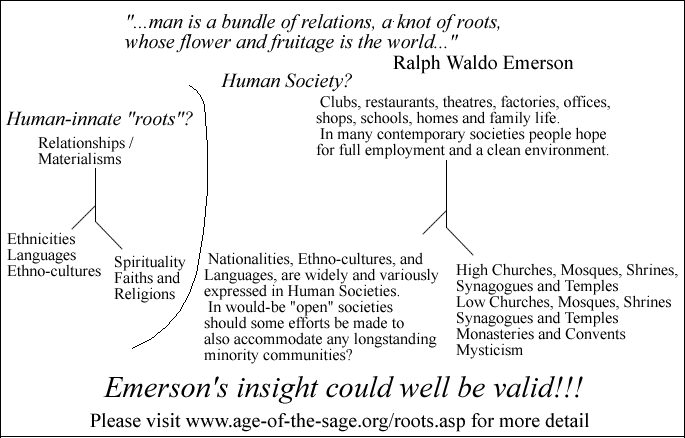
N. B. The page mentioned in the graphic ~ roots.asp ~
has been replaced by this page
This 'knot of roots' insight features in:

According to the seriously influential philosopher Immanuel Kant, in his brief work entitled "Idea for a Universal History from a Cosmopolitan Point of View" :
"Whatever concept one may hold, from a metaphysical point of view, concerning the freedom of the will, certainly its appearances,
which are human actions, like every other natural event, are determined by universal laws. However obscure their causes, history,
which is concerned with narrating these appearances, permits us to hope that if we attend to the play of freedom of the human will
in the large, we may be able to discern a regular movement in it, and that what seems complex and chaotic in the single individual
may be seen from the standpoint of the human race as a whole to be a steady and progressive though slow evolution of its original endowment."
- The European Revolution of 1848 begins
- A broad outline of the background to the onset of the turmoils and a consideration of some of the early events.
- The French Revolution of 1848
- A particular focus on France - as the influential Austrian minister Prince Metternich, who sought to encourage the re-establishment of "Order" in the wake of the French Revolutionary and Napoleonic turmoils of 1789-1815, said:-"When France sneezes Europe catches a cold".
- The Revolution of 1848 in the German Lands and central Europe
- "Germany" had a movement for a single parliament in 1848 and many central European would-be "nations" attempted
to assert a distinct existence separate from the dynastic sovereignties they had been living under.
- The "Italian" Revolution of 1848
- A "liberal" Papacy after 1846 helps allow the embers of an "Italian" national aspiration to rekindle across the Italian Peninsula.
- The Monarchs recover power 1848-1849
- Some instances of social and political extremism allow previously pro-reform conservative elements to support the return of traditional authority. Louis Napoleon, (who later became the Emperor Napoleon III), attains to power in France offering social stability at home but ultimately follows policies productive of dramatic change in the wider European structure of states and their sovereignty.